300-800 Tons of River Sand Gravel Production Line in Zimbabwe
April 20, 2026
Summary:An engineered blueprint addressing the transition from natural river sand to mechanized manufactured sand in Zimbabwe, detailing material flow, crushing configurations, and financial lifecycle analysis.
With the national ban on river sand mining fundamentally restructuring the construction landscape in Zimbabwe, aggregate producers must urgently pivot from traditional river sand extraction to high-grade mechanized sand production. Building a professional 300-800 tons of river sand gravel production line requires precise mass balance and equipment synchronization to replicate—and systematically exceed—natural sand quality. By processing river pebbles and boulders into manufactured sand, we architect a continuous closed-circuit material flow that eliminates bottlenecks and adheres to strict national compliance.
Core Equipment Synchronization and Material Flow
Designing an aggregate system for river stones demands machinery capable of enduring extreme abrasiveness while delivering precise shape control. Our architectural layout relies on three distinct crushing phases to maintain throughput equilibrium.
Primary Reduction: C6X Series Jaw Crusher
For the primary crushing of large river boulders, the C6X125 and C6X145 Jaw Crushers form the foundational intake of the system. Unlike local refurbished European machines frequently found in the Mutare region, the C6X Jaw Crusher features a detachable non-welded frame. This modular structural design is critical for safe transport into remote mining sites where bridge load limits are strictly capped at 40 tons. Processing up to 800t/h of raw feed, the C6X prepares a steady, geometrically optimized output for the secondary stages.
Secondary Crushing: HPT500 Multi-cylinder Hydraulic Cone Crusher
To ensure capacity scaling and correct particle pre-shaping, the HPT500 Multi-cylinder Hydraulic Cone Crusher acts as the secondary crushing unit. Operating with a robust continuous drive, this unit maintains a tightly calibrated closed side setting (CSS) to standardize the mass flow ratio transferred to the tertiary stage, mitigating surge loads and guaranteeing a stable feed grain profile.
Tertiary Shaping: VSI6X1263 Sand Making Machine
The core shaping and sand production unit is the VSI6X1263 Sand Making Machine, running at a powerful 540kW. Real-world site data validates this selection: in the Mazowe River basin projects, the raw river stones often contain over 85% silica. We observed that standard hammer crushers fail within 48 hours under these extreme abrasive conditions. Our VSI6X series, utilizing a specialized “rock-on-rock” crushing principle, handles this high abrasiveness effortlessly while maintaining a stable, uninterrupted output of 0-5mm sand at a consistent 30% yield ratio.
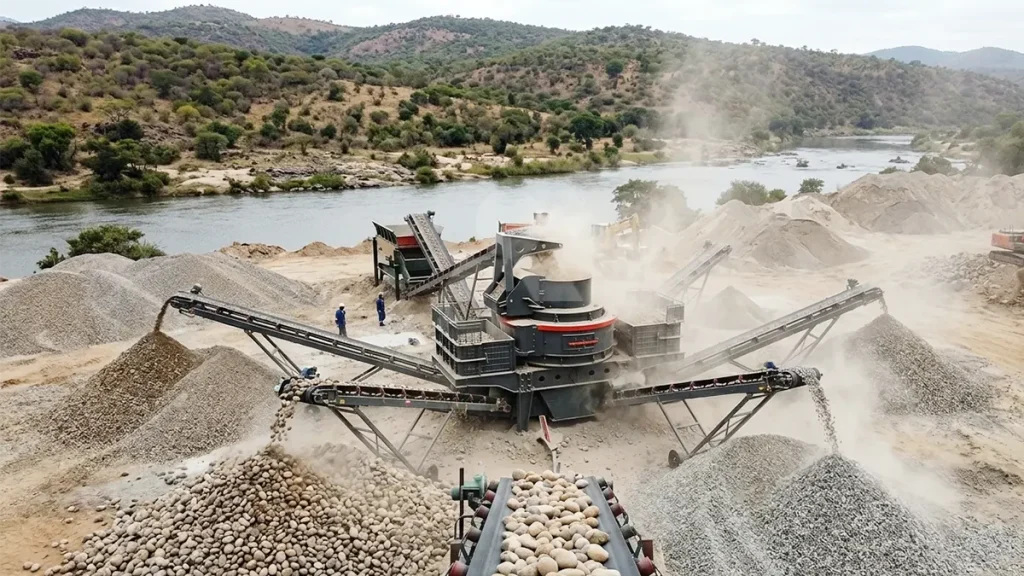
Crushing Stage Specifications
| Operational Stage | Equipment Series | Key Function | Critical Site Parameter |
|---|---|---|---|
| Primary | C6X Jaw Crusher | Large river boulder reduction | Detachable frame (< 40t per module) |
| Secondary | HPT500 Cone Crusher | Capacity stabilization | Closed Side Setting (CSS) calibration |
| Tertiary | VSI6X1263 | Core shaping & sand making | 540kW drive, 30% yield ratio |
Financial Logic of the Manufactured Sand Transition
When assessing the viability of transitioning to mechanized sand production, the fiscal architecture must be evaluated alongside the mechanical blueprint. The primary metric for sustainable site operations is the cost per ton of finished aggregate. This metric drops dramatically due to the wear-resistant cavity design of the VSI6X1263 and the HPT500, which are engineered specifically to process hard, high-silica river stones without excessive consumable depletion.
We systematically model the total cost of ownership over 5 years by factoring in electrical draw (such as the 540kW VSI rating), scheduled liner replacements, and planned maintenance intervals. Despite the industrial-grade setup required to process 85% silica content, the enhanced aggregate market value and the measurable reduction in cement costs accelerate the initial investment recovery cycle. This establishes a highly profitable, long-term operation that aligns perfectly with Zimbabwe’s environmental mandates.
System Architecture FAQ
- How does the system handle highly abrasive river stones?
- The integration of the VSI6X1263 utilizes a “rock-on-rock” configuration where the 85% silica material impacts against a material lining rather than the machine’s steel rotor, extending continuous operation times far beyond the 48-hour failure rate of traditional hammer crushers.
- Is the primary crusher suitable for restricted infrastructure zones?
- Yes, the C6X Jaw Crusher is engineered with a detachable, non-welded frame. This allows the heavy-duty machinery to be disassembled and transported safely across rural infrastructure, strictly complying with 40-ton bridge load limits.
- What is the impact of manufactured sand on concrete production?
- Mechanized sand from the VSI6X ensures a flakiness index below 8%. This optimal cubic shape reduces the interstitial voids in the mix, lowering the required cement paste volume per cubic meter and simultaneously increasing concrete strength by up to 15%.
Securing Aggregate Viability in High-Abrasion Zimbabwean River Gravel Circuits
The successful transition of a 300-800 tons of river sand gravel production line in the post-ban era hinges not on simple crushing, but on the precise synchronization of impact kinetics against the 85% silica barrier that has historically decimated local standard hammer mills within 48 hours. When you analyze the mass flow through the VSI6X1263, you must realize that ignoring the secondary HPT500 CSS calibration will result in an unmanageable recirculating load that will cause a catastrophic main-shaft bearing seizure or frame stress fractures by next month, effectively halting your initial investment recovery cycle during the peak construction season. Prioritize the rock-on-rock crushing cavity equilibrium immediately.
Stop Guessing on VSI Rotor Wear Cycles
“Let’s align your Zimbabwe site parameters with mechanized sand reality before the next maintenance window.” — From the Desk of your Solution Architect
