Factors Affecting The Output of A Primary Jaw crusher
April 14, 2026
Summary:Primary crushing output is a function of volumetric cavity management rather than raw horsepower. In C6X series configurations, throughput is dictated by the stability of the nip angle and the elimination of feed segregation. This technical audit breaks down how eccentric shaft speed and effective crushing stroke interact with the material's Bond work index to define actual site capacity.
If your primary circuit is underperforming, the problem is rarely the motor. In 15 years of site audits, I’ve found that output bottlenecks are almost always a failure to manage the physics inside the crushing chamber. A jaw crusher, specifically a high-frequency unit like the C6X, is a volumetric machine. If you aren’t feeding it a homogenized diet, or if your mechanical settings are fighting the material’s natural properties, your tons-per-hour will collapse. Below is the diagnostic breakdown of what is actually killing your throughput.
Nip Angle Stability and Intake Efficiency
The Nip Angle is the most critical geometric variable in the cavity. If the angle is too wide, the material slips and “belches” upward instead of being grabbed. This effectively nullifies the Effective Crushing Stroke. In the C6X series, the pivot point is positioned higher to keep the nip angle stable even as the material moves deeper into the high-pressure zone.
Field Diagnostic: If you see rocks “dancing” at the top of the jaw, your liners are likely worn past the point of effective friction, or your feed size exceeds the design ratio. Optimization: Monitor liner wear profiles weekly. Once the manganese teeth flatten by 60%, your nip angle increases, and your intake capacity will drop by 15-20% immediately. Replace liners before the intake geometry fails.
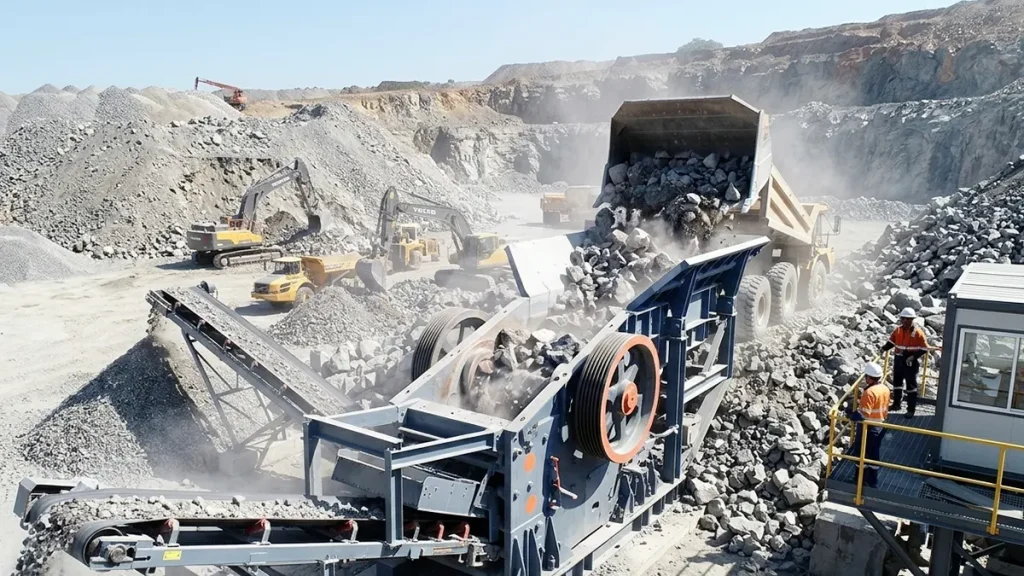
Feed Segregation and Cavity Utilization
Feed Segregation occurs when fines and boulders separate before entering the jaw. If the left side of the C6X is choked with fines while the right side handles 600mm boulders, the Eccentric Shaft Speed cannot be optimized for either. This creates asymmetric loading, leading to bearing heat and uneven wear on the toggle plate.
Field Optimization: Adjust your vibrating feeder frequency and stroke to ensure a blended feed. Ideally, the fines should be removed via a grizzly bypass before the jaw. If fines must enter the crusher, install a distributor plate or “stone box” at the feeder discharge to force the material into a central, homogenized stream. This allows for Interparticle Comminution, where rocks crush each other, significantly increasing the volume processed per stroke.
Moisture, Viscosity, and Discharge Choking
The Moisture and Viscosity of the ore can turn a high-performance C6X into a plugged box. In iron ore or gold circuits with high clay content, fine material “pancakes” at the bottom of the cavity. This prevents the crushed material from exiting, causing a backup that kills the 150tph target.
Field Optimization: When dealing with high moisture (>5%), widen the CSS (Closed Side Setting) by 10mm to facilitate discharge. While this increases the load on your secondary cone crusher, it prevents the primary jaw from stalling. Alternatively, increase the scalping efficiency of your grizzly feeder to ensure that sticky fines never enter the primary cavity.
CSS Calibration vs. Product Gradation Function
The throughput of the C6X is a direct function of the CSS and the Bond Work Index. For example, a C6X110 (110kW motor) has a max feed of 630mm. If the CSS is set too tight to try and produce “finished” product at the primary stage, you are wasting energy. The primary jaw’s job is to reduce mass to a size the secondary circuit can handle.
| Factor | Technical Variable | Throughput Impact |
|---|---|---|
| Liner Wear | Nip Angle Increase | High (Reduction in intake) |
| Feed Distribution | Feed Segregation | Medium (Asymmetric loading) |
| Shaft Speed | Eccentric Shaft RPM | Critical (Material fall rate) |
| Rock Hardness | Bond Work Index | High (Specific energy demand) |
Site Lead Intelligence: C6X100 Performance Benchmarks
- Maximum Feed Size: 630mm (Do not exceed for 150tph stability)
- Power Rating: 110kW (Monitor for amperage spikes during segregation)
- Frequency Tuning: Match eccentric speed to material fall velocity to prevent “bouncing”
- Hydraulic Wedge Adjustment: Allows for real-time CSS tuning to match ore moisture changes
Ref Code: SL-DIAG-C6X-2026-V1
Summary Diagnostic for the Site Lead
- Why does output drop when the jaw is 100% full?
- If the cavity is over-filled beyond the “sweet spot” (usually 80% capacity), the weight of the material creates excessive friction against the fixed jaw, slowing the material’s descent and reducing the effective crushing stroke. High-capacity C6X units perform best with a consistent, controlled choke feed rather than a flood feed.
- How does nip angle instability manifest in power consumption?
- When the nip angle fails, you will see high amperage on the 110kW motor with very little discharge. The machine is doing work (friction/slippage) but not breaking rock. Check your liners immediately.
- What is the relationship between eccentric shaft speed and iron ore hardness?
- Harder ores with a high Bond work index require a slightly slower eccentric speed to allow for deeper penetration of the crushing force. If the shaft spins too fast on hard magnetite, the jaw retreats before the fracture is complete, leading to inefficient “surface nibbling.”
- Can feed segregation be fixed without stopping the line?
- Yes. Adjust the angle of the grizzly bars or the stroke of the vibrating feeder. If the fines are dumping too far forward into the jaw, adjust the feeder’s counterweights to pull the discharge point back toward the center of the cavity.
