How Much 100tph Gold Slag Beneficiation Plant in Tanzania?
April 7, 2026
Summary:Vitrified gold slag contains unpredictable metallic iron inclusions that systematically destroy standard cast-iron wear liners. We audit the exact multi-stage flow diagram required to safely fracture this 250 MPa metallurgical waste. By configuring high-shear primary jaws with closed-circuit wet ball milling, operators protect their core assets from catastrophic failure. This specialized kinetic layout guarantees operational viability across East African infrastructure grids.
Extracting residual value from metallurgical waste is not a standard aggregate crushing exercise. Gold slag is an industrial composite of vitrified silicates and hard metallic iron that will rip apart light-duty machinery within hours. Securing capital payback velocity in East Africa requires engineering a circuit that anticipates severe structural trauma.
Flowchart Architecture: Primary Reduction of Vitrified Waste
High-torque eccentric shafts prevent stalling when the jaw encounters unsmelted iron blocks.
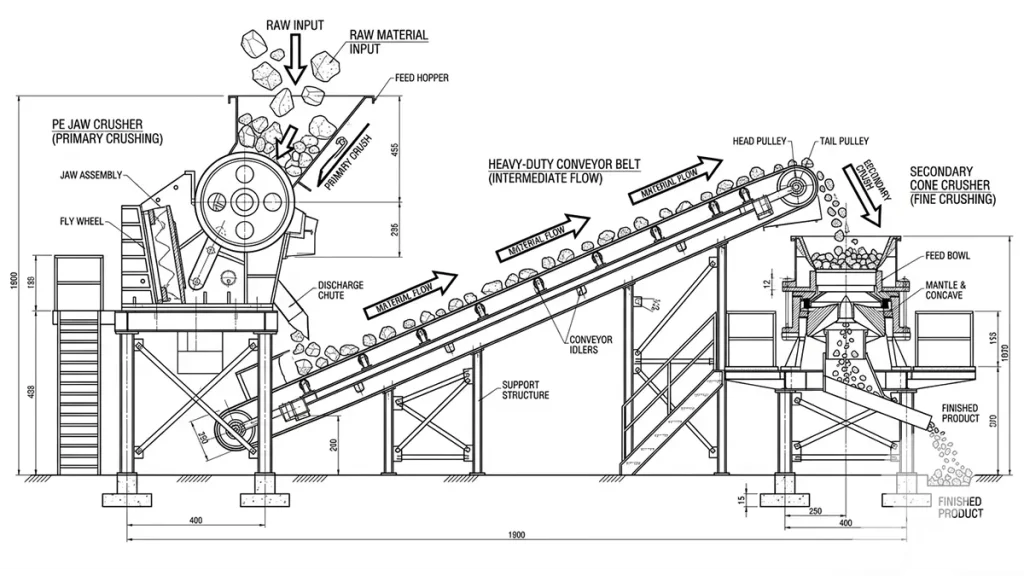
The layout begins with heavy-duty physical shear. Slag frequently dumps in massive, irregular blocks exceeding 500 millimeters. A PE series jaw crusher serves as the primary gateway, operating at a tight closed side setting to fracture the glassy outer shell. The swing jaw must maintain relentless pressure. If the toggle plate geometry is incorrect, the smooth, vitrified surface of the slag will slip upwards, causing dangerous material bridging in the feed cavity.
A cheap primary unit is a massive fiscal risk. The kinetic recoil from crushing 250 MPa slag requires a heavily reinforced non-welded frame. Any microscopic material fatigue in the main bearing housing will escalate into catastrophic failure. We design the foundation footprint to absorb these intense, irregular shockwaves, preventing the invisible drag of secondary maintenance overhead.
Secondary Grinding Dynamics and Grid Volatility
Continuous wet milling mitigates thermal expansion and ensures precise liberation of microscopic gold particles.
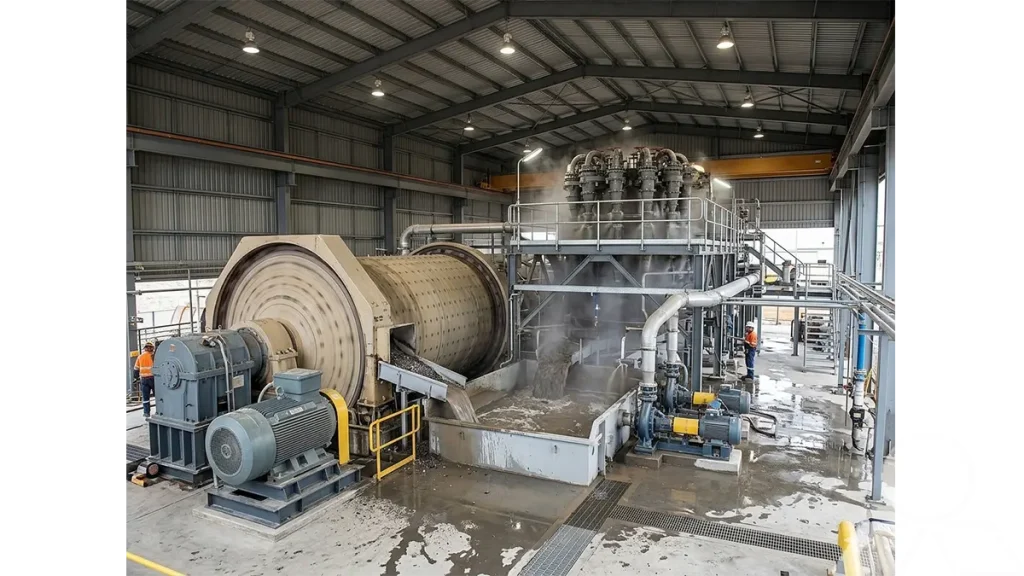
After the secondary cone crushers reduce the feed to below 15 millimeters, the material enters the core beneficiation phase: the Ball Mill. To process 100 tons per hour, you are demanding immense electrical draw. Operating in remote Tanzanian regions requires auditing the local power grid’s stability. Voltage volatility patterns can scorch the windings of a 400 kW motor during start-up under heavy load.
Inside the mill cylinder, forged steel grinding media systematically pulverize the slag. The slurry exits the trunnion bearing and feeds directly into a hydrocyclone classification battery. The hydrocyclone apex acts as the strict quality gatekeeper. Overflow fines proceed to the chemical recovery or flotation tanks, while the coarse underflow cycles back into the mill. The sharp scent of ozone from the heavy drive motors signals the immense energy required to break the molecular bonds of the slag.
The Synchronized Equipment Matrix for East African Slag
To safely handle the abrasive silicates of gold waste at 100 tons per hour while protecting the core capital expenditure, we have engineered the following sequential circuit.
| Process Stage | Recommended Model | Capacity (tons per hour) | Power (kilowatts) |
|---|---|---|---|
| Primary Crushing | PE600×900 Jaw Crusher | 70 – 150 | 55 – 75 |
| Iron Separation | RCYD Magnetic Separator | 100 | 5.5 |
| Secondary Crushing | HST100 Single Cylinder Cone | 90 – 180 | 90 |
| Wet Grinding | MQG2130 Ball Mill | 100 (Closed Circuit) | 245 |
Fiscal Drag: Logistical Reality of Wear Part Replacement
Factoring the inland freight cost of high-manganese steel dictates the true operational ceiling of the plant.
You must calculate the expenditure per shift based on Tanzanian logistics. Shipping cast steel concave liners or ball mill replacement gears from the port of Dar es Salaam to inland mining zones adds massive delay and cost. We engineer these circuits with high-interchangeability components.
A plant designed with fragmented part requirements will bleed money during downtime. Standardizing the hydraulic cylinders and lubrication pumps across the crushing line minimizes the required onsite inventory. The physics of slag abrasion guarantee that parts will wear; your fiscal efficiency depends on how quickly your maintenance crew can swap a mantle and restart the feed.
Investor Audit: Securing the Grinding Circuit Against Voltage Spikes
- Why does the hydrocyclone underflow suddenly increase during afternoon shifts?
- Look at the water pressure stability. A drop in the local municipal or pumped water supply alters the slurry density, forcing the classification apex to reject perfectly ground fines back into the mill cylinder, ruining your throughput.
- How does unextracted tramp iron affect the HST100 cone crusher?
- The history of metallurgical waste is full of ruined main shafts. If the magnetic separator fails, solid iron blocks enter the crushing cavity, triggering violent hydraulic relief jumps that destroy the mantle seating surface.
- What causes the primary jaw foundation to crack within the first six months?
- Do not ignore the kinetic recoil of 250 MPa material. Pouring standard concrete without high-tensile rebar reinforcement fails to absorb the 75 kilowatt kinetic shockwaves, transferring the stress directly into the civil engineering.
- Where is the highest expenditure drain in a remote East African installation?
- The data points directly to unplanned downtime and logistics. Waiting four weeks for a replacement trunnion bearing to clear customs will annihilate your asset amortization cycle entirely.
Stop Assuming Standard Aggregate Specs Will Survive Slag Processing
“An accurate capacity audit protects your capital from being consumed by extreme abrasive wear.” — From the Desk of your Capital Risk Auditor
