The Beneficiation Quartz Crushing Plant Invest Cost Guide
March 16, 2026
Summary:This industry solution provides professional B2B buyers with a comprehensive breakdown of the capital expenditure, equipment configuration, flow chart, and return on investment for high-purity quartz beneficiation crushing plants.
Processing quartz rock presents a unique set of challenges for quarry owners and mining investors. With a Mohs hardness of 7 and a highly abrasive silica composition, quartz can rapidly destroy standard crusher wear parts, leading to skyrocketing operational expenses. Investors must carefully evaluate the beneficiation quartz crushing plant invest cost to ensure long-term profitability. High capital expenditure on the wrong equipment will destroy your profit margins through frequent downtime and replacement parts. Liming Heavy Industry engineers robust, high-efficiency quartz crushing and beneficiation solutions designed specifically to minimize wear costs, maximize high-purity yields, and deliver a rapid return on investment for projects across Africa, Southeast Asia, and South America.
Understanding the Quartz Beneficiation Process and Capital Expenditure
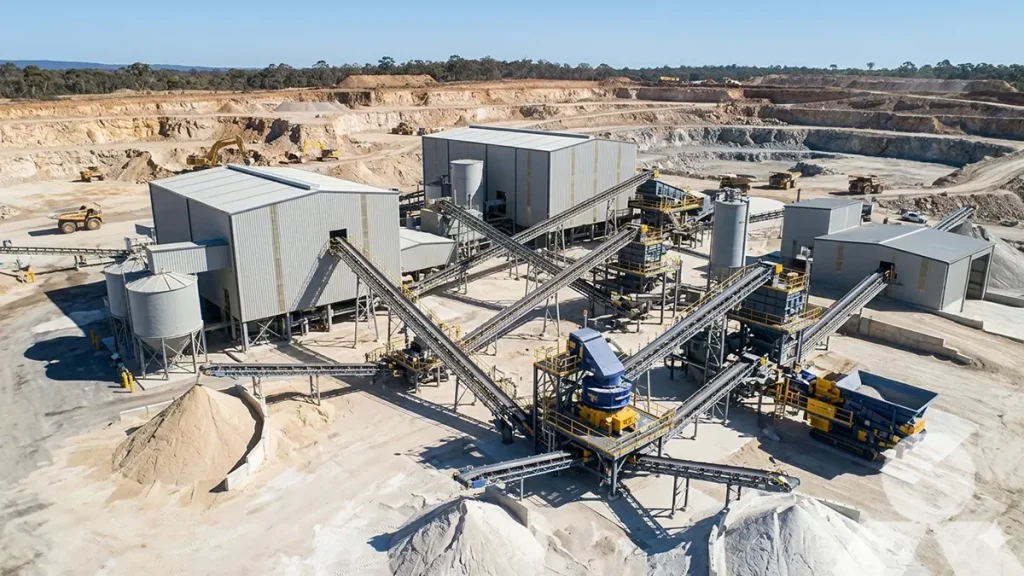
The total investment for a quartz beneficiation plant is not just about the sticker price of the primary crusher. It encompasses the entire production line, from raw material feeding to final washing and magnetic separation. High-purity quartz (HPQ) is heavily utilized in glass manufacturing, electronics, and solar panels, meaning the end-product must be virtually free of iron and other impurities.
Several key factors directly influence your initial capital expenditure:
- Production Capacity (TPH): A 50 Ton-Per-Hour (TPH) entry-level plant requires significantly less investment than a 300 TPH industrial-scale operation.
- Equipment Wear Resistance: Due to quartz’s abrasiveness, standard high-manganese steel parts are insufficient. Investing in high-chrome alloys and specialized rock-on-rock crushing technologies increases initial costs but drastically reduces long-term OpEx.
- Purity Requirements: Achieving high-purity silica sand requires advanced beneficiation stages, including specialized sand washers and magnetic separators, which add to the overall equipment cost.
Optimal Flow Chart for a Quartz Beneficiation Crushing Plant
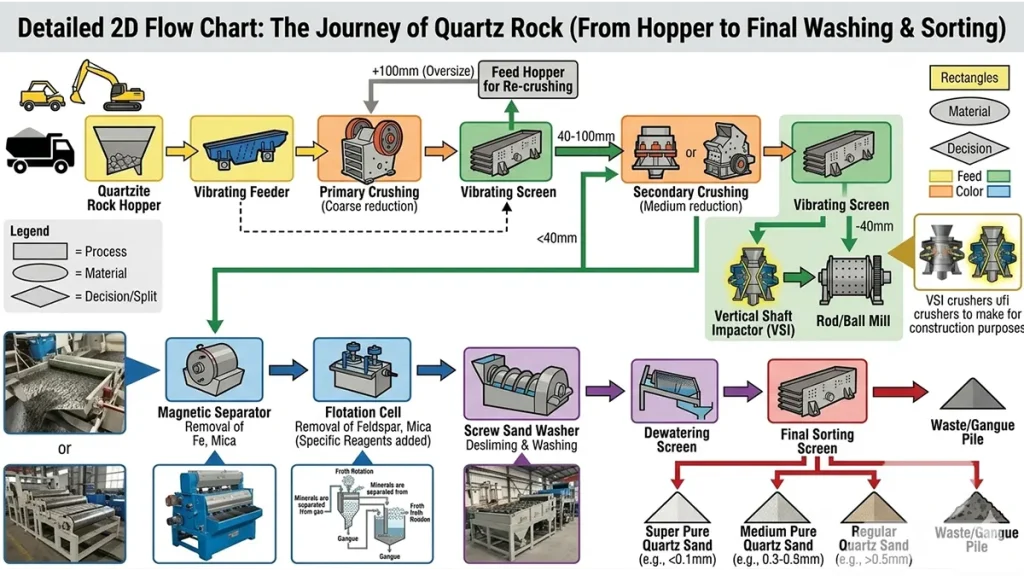
To produce high-value quartz sand while keeping wear costs manageable, the plant layout must be scientifically engineered. A standard Liming Heavy Industry quartz flow chart typically follows a multi-stage crushing and washing process.
Stage 1: Primary Coarse Crushing
Large quartz boulders dumped from trucks enter the vibrating feeder, which evenly supplies the Jaw Crusher. For extremely hard quartz, Liming’s PEW Series or C6X Series Jaw Crusher is recommended. These machines feature heavy-duty eccentric shafts and premium cast steel frames to handle the initial impact without structural fatigue.
Stage 2: Secondary Fine Crushing
The coarse quartz is conveyed to a Hydraulic Cone Crusher (such as the HPT Series). Unlike impact crushers, which suffer catastrophic wear when processing silica, cone crushers utilize a laminated crushing principle. This protects the mantle and bowl liner, significantly reducing replacement frequency.
Stage 3: Tertiary Crushing and Sand Shaping
To produce fine quartz sand (0-5mm), the secondary crushed material is fed into a VSI Sand Making Machine (VSI6X Series). The VSI utilizes a “rock-on-rock” crushing chamber. Instead of the quartz grinding against metal anvils, the rocks collide with each other at high speeds. This is critical for minimizing iron contamination and preserving the purity of the quartz.
Stage 4: Beneficiation and Washing
The final stage is where the “beneficiation” occurs. The crushed quartz sand passes through a multi-deck vibrating screen. The correctly sized particles are sent to a Wheel Sand Washer (XSD Series) to remove dust and clay. If iron removal is required for glass-grade quartz, magnetic separators are integrated into this stage.
[Insert Image: Close-up of an XSD wheel sand washer actively washing crushed quartz sand. Alt Text: Beneficiation equipment contributing to the beneficiation quartz crushing plant invest cost.]
Recommended Equipment Configuration & Technical Parameters
Below is a standardized high-efficiency equipment configuration for a 100-150 TPH quartz beneficiation plant. All equipment holds ISO and CE certifications, ensuring international compliance and safety.
| Production Stage | Recommended Liming Equipment | Max Feed Size (mm) | Motor Power (kW) | Strategic Advantage |
|---|---|---|---|---|
| Feeding | TSW1139 Vibrating Feeder | < 500 | 15 | Blind plates prevent fines from bypassing the primary crusher. |
| Primary Crushing | PEW760 Jaw Crusher | 600 | 90 | V-shaped crushing chamber prevents blockages with hard quartz. |
| Secondary Crushing | HPT300 Multi-Cylinder Cone Crusher | 210 | 250 | Tramp iron release system protects the machine from uncrushable objects. |
| Sand Making | VSI6X1040 Sand Maker | 45 | 2x 200 | Rock-on-rock technology ensures zero iron contamination to the silica. |
| Washing | XSD3016 Sand Washer | 10 | 15 | High cleaning degree with minimal fine sand loss. |
ROI Analysis: Maximizing Your Quartz Investment
While the initial capital layout for a specialized quartz plant may be higher than a standard limestone plant, the Return on Investment (ROI) is vastly superior due to the high market value of processed silica.
1. Premium Pricing for High Purity: By utilizing the VSI6X and XSD washing system, your plant produces a clean, cubical product with minimal iron content. This allows you to sell to lucrative B2B buyers in the glass, semiconductor, and solar industries, rather than low-margin local construction markets.
2. Slashing Operational Expenses (OpEx): Liming Heavy Industry’s equipment is engineered for abrasive environments. By using hydraulic cone crushers and rock-on-rock VSI technology, your expenditure on wear parts (mantles, blow bars, liners) decreases by up to 40% annually compared to competitor setups.
3. High Automation, Low Labor Cost: Our plants feature centralized electrical control systems. This automation requires fewer manual operators, reducing overhead costs and protecting workers in regions with strict safety regulations.
Frequently Asked Questions (FAQ)
1. How much does a complete 100 TPH quartz crushing plant typically cost?
The exact price fluctuates based on the required final product sizes and whether advanced magnetic separation is needed for beneficiation. Generally, a high-quality 100 TPH plant ranges from $300,000 to $600,000 USD. Contact Liming Heavy Industry for a precise, customized quotation.
2. Why shouldn’t I use an impact crusher for quartz?
Quartz is exceptionally abrasive (Mohs hardness 7). Using an impact crusher on quartz will cause the high-chrome blow bars to wear out within days, leading to unacceptable maintenance downtime and crippling operational costs. Always use a cone crusher for the secondary crushing of quartz.
3. How do we prevent iron contamination during the crushing process?
To prevent iron contamination, which ruins the value of glass-grade quartz, we recommend using a VSI crusher for the final stage. Its autogenous (rock-on-rock) crushing minimizes contact with metal plates. Additionally, installing magnetic separators before the final stockpile removes any trace iron introduced during the primary crushing stages.
Calculating the beneficiation quartz crushing plant invest cost requires looking beyond the initial purchase price. Success in the high-purity silica market demands durable equipment that can withstand extreme abrasion, maintain strict product purity, and operate with minimal downtime. By investing in a scientifically configured Liming Heavy Industry production line, investors secure a low OpEx operation and a rapid path to profitability.
