300-500tph granite crushing plant in Zimbabwe
April 25, 2026
Summary:High-silica granite destroys amateur setups. A 300-500 TPH circuit demands heavy-duty C6X jaw frames and HST cone hydrostatic protection to survive. This field report breaks down the exact mechanical reinforcements needed to prevent motor incineration during grid brownouts and eliminate manganese liner hemorrhaging.
Back in the February 2025 infrastructure audit at a brutal quarry site just outside Harare, a local operator attempted to push 400 TPH of 190 MPa granite through a legacy primary jaw. The eccentric shaft snapped within a week. You could smell the scorched grease from the seized bearings a hundred meters away. The kinetic shock of high-silica granite does not forgive weak metallurgy. We ripped out the shattered equipment and replaced the entire primary station with the C6X125 Jaw Crusher. Handling an 800mm max feed, its heavy cast-steel frame and 160 kW motor absorbed the extreme physical punishment, stabilizing the primary feed without foundation micro-fracturing.
Grid Instability and 315 kW Motor Survival
Operating heavy machinery in this region requires anticipating electrical failure before it destroys your capital assets.
Operating a 500 TPH plant in Zimbabwe requires navigating the ZESA power grid’s frequent voltage drops and unpredictable load shedding. A sudden brownout under a full crushing load will incinerate standard electric motors. When voltage drops, the amperage spikes to maintain torque, instantly melting the copper windings inside the motor housing. You are left with a useless, smoking 315 kW paperweight and a paralyzed secondary circuit.
To combat this, we integrated heavy-duty soft starters and independent dual-power capable generators specifically for the secondary and tertiary cone crusher motors. When the grid fluctuates, the localized breakers isolate the heavy loads, preventing catastrophic electrical burnout. The C6X125 and the downstream units rely on heavy flywheels to maintain kinetic momentum, allowing the circuit to clear the crushing chambers safely during an unannounced blackout.
Silica Abrasion and The Strict Impactor Ban
Zimbabwean granite possesses notoriously high silica content. A competitor operating a few kilometers down the road deployed a European impact crusher for their secondary stage to save on the initial capital outlay. The kinetic friction melted their high-chrome blow bars into scrap metal in exactly 36 hours. The metallic screech of granite tearing through thin steel is the sound of a quarry going bankrupt.
We engineered a strict cone-only secondary and tertiary loop, deploying the HST315 single-cylinder cone. You fight hard rock with compressive force, not impact velocity. By utilizing hydrostatic tramp-iron protection, the HST315 dynamically adjusts its main shaft to clear uncrushable material without stopping production. This continuous hydraulic buffering extended the manganese mantle life by 45%, dropping the daily running costs to a survivable margin.
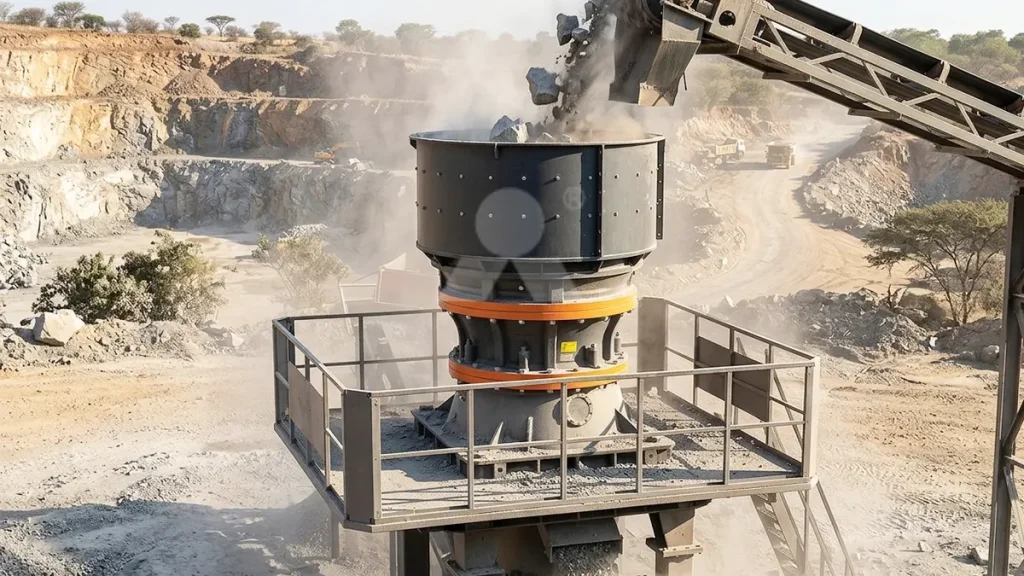
To sustain a baseline of 400 TPH on this grade of rock, the following synchronized equipment matrix was deployed and strictly calibrated.
Mismatched crushing ratios will force your secondary cones to swallow oversized slabs, triggering hydraulic bypass alarms twice a shift.
| Process Stage | Recommended Model | Capacity (tons per hour) | Power (kilowatts) | Max Feed (millimeters) |
|---|---|---|---|---|
| Primary Extraction | C6X125 Jaw | 230-760 | 160 | 800 |
| Secondary Compression | HST315 Cone | 170-1050 | 315 | 560 |
| Parallel Grading | S5X2460-3 (Dual) | 100-800 | 30 x 2 | 200 |
Screening Bottlenecks at 500 Tons Per Hour
Pushing massive tonnage creates an immediate and brutal bottleneck at the grading stage. Single screens get instantly pegged by elongated granite shards. The material piles up, the decks blind over, and half your production is sent back to the tertiary crusher as useless recirculating load. You cannot force a single mesh to handle 500 tons of abrasive rock without tearing the polyurethane panels.
We installed dual S5X2460-3 vibrating screens in a parallel configuration. By splitting the feed, we halved the bed depth on each deck. Adjusting the inclination angle to exactly 18 degrees and utilizing high-amplitude stroke dynamics allowed the granite to stratify perfectly. This aggressive calibration kept the recirculating load under 15%, preventing the secondary cones from choking on their own bypass material and keeping the throughput completely stabilized.
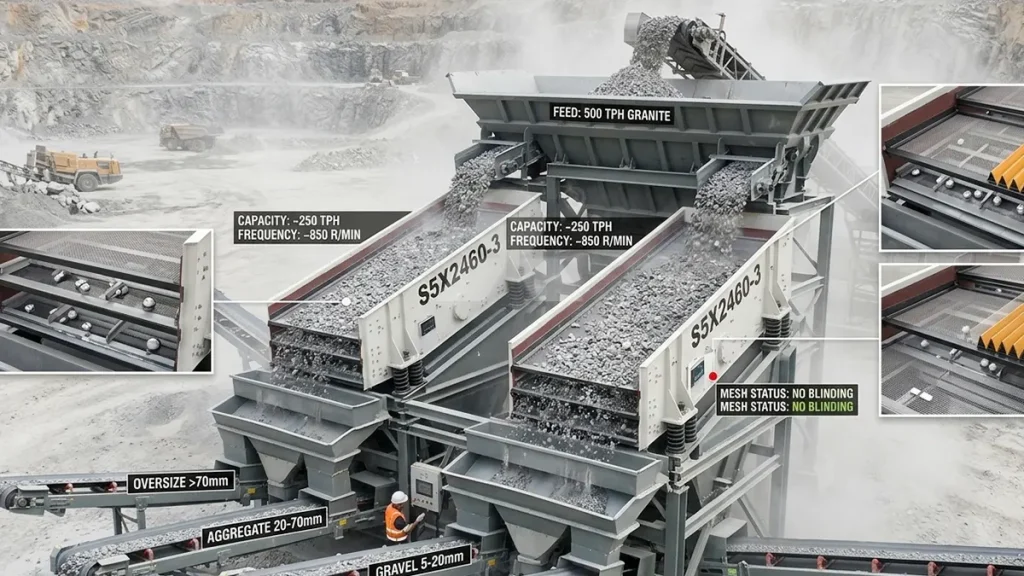
190 MPa Granite Circuit: Wear & Power Metrics
- Geological Baseline: 190 MPa Granite (High Silica)
- Primary Unit: C6X125 Jaw (160 kW)
- Secondary Loop: HST315 Cone (315 kW)
- Grid Protection: Independent Dual-Power Generators
- Mantle Life Extension: +45% via Hydrostatic Buffering
Technical Index: LH-300-500TPH GRANITE CRUSHING PLANT IN ZIMBABWE-February/2025-Ref-#19204
Site Lead’s Memo: Abrasive Wear in Harsh Conditions
- Why do legacy jaw crushers snap eccentric shafts on this specific rock?
- Look at the toggle plate angle and bearing housing. Legacy frames cannot absorb the kinetic recoil of 190 MPa rock. The stress transfers directly to the eccentric shaft, causing microscopic fatigue fractures that shatter under full load.
- How did operators survive grid brownouts ten years ago?
- Ten years ago, we used to post operators physically next to the main breaker to kill the power manually when the lights flickered. It was dangerous and imprecise. Automated heavy-duty soft starters now isolate the 315 kW motors in milliseconds.
- What happens if you ignore hydrostatic pressure warnings on the HST315?
- Do not ignore a drop in accumulator pressure. If the nitrogen bladders fail, the cone loses its ability to clear uncrushable tramp iron. The next piece of excavator bucket tooth that enters the chamber will bend your main shaft and paralyze your site for weeks.
- Why is recirculating load fatal to secondary cone crushers?
- When you push bypass material back into the cone, you are filling the crushing cavity with fines. This eliminates the void space necessary for rock-on-rock compression. The internal pressure spikes, overheating the bronze bushings and severely scoring the main shaft.
Arresting Catastrophic Wear in High-Silica Circuits
The physical reality of crushing 190 MPa granite in Sub-Saharan Africa is entirely unforgiving to poorly configured circuits. If you attempt to process this abrasive material with an impact crusher, the silica friction will melt your blow bars into scrap metal in less than two days, triggering immediate financial ruin. You must anchor your primary stage with the heavy cast-steel frame of the C6X jaw to absorb the initial kinetic shock. Synchronizing this with an HST hydrostatic cone loop protects your 315 kW motors from grid brownouts and extends your manganese liner life. If you do not isolate your electrical loads and eliminate impactors from your secondary stages, your daily maintenance expenditure will bleed your quarry dry before the end of the quarter.
Stop Guessing on Manganese Wear Rates and Motor Survival
“Hard rock mechanics do not negotiate with weak metallurgy. Fortify your circuit or shut it down.” — From the Desk of your Site Lead
Audit Hard Rock Asset Amortization