Spiral Classifier System
January 12, 2026
Summary:This guide explores the critical role of the spiral classifier system in mineral processing. It addresses common industry challenges like low separation efficiency and high maintenance costs, presenting Liming Heavy Industry's engineered solutions designed to optimize closed-circuit grinding operations.
In the competitive landscape of mineral processing, the efficiency of your grinding circuit defines your profitability. The spiral classifier system acts as the gatekeeper of quality, determining whether material is ready for the next stage or needs regrinding. At Liming Heavy Industry, we understand that a classifier is not just a machine; it is the strategic control point for your entire beneficiation line.
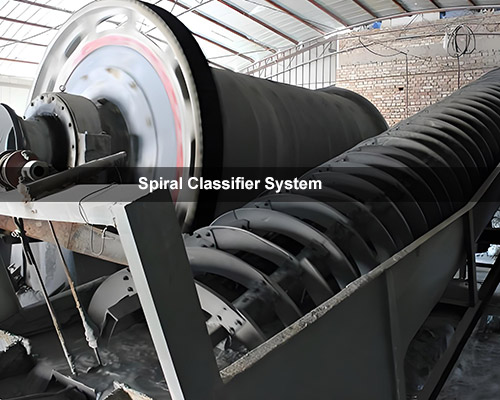
How the Spiral Classifier System Drives Recovery Rates
The core function of a spiral classifier relies on the principle of different sedimentation speeds of solid particles in a liquid due to varying sizes and specific gravities. Fine ore particles float in the water and overflow, while coarse ore particles sink to the bottom and are discharged by the spiral to the upper part for regrinding.
Liming Heavy Industry offers both High Weir (for coarse particle classification) and Submerged (for fine particle classification) types, ensuring seamless integration with your ball mill for an efficient closed-circuit grinding system.
Solving Industry Pain Points: The Liming Advantage
Operators frequently face challenges that bottle-neck production. Here is how Liming’s engineered spiral classifier system tackles the top three industry pain points:
1. Pain Point: Inefficient Separation (The “Rough Overflow” Issue)
The Challenge: Standard classifiers often allow coarse materials to escape into the overflow or drag useful fines back into the mill, leading to over-grinding and energy waste.
Liming’s Solution: We utilize an optimized spiral blade pitch and speed control. Our design creates a stable settlement area, minimizing turbulence. This ensures that the overflow fineness strictly meets the required standard, increasing the overall recovery rate of valuable minerals.
2. Pain Point: Excessive Wear and Maintenance Downtime
The Challenge: The abrasive nature of slurry causes rapid wear on the spiral blades and the lower bearing (the “submerged bearing”), leading to frequent replacements and costly shutdowns.
Liming’s Solution: Durability is in our DNA. Our blades are lined with wear-resistant alloy cast iron or polymer materials that extend service life by up to 50%. Furthermore, our proprietary advanced lifting mechanism and sealed lower bearing structure effectively isolate sand and water, preventing premature bearing failure.
3. Pain Point: High Energy Consumption & Unstable Operation
The Challenge: Old systems consume massive amounts of power and struggle to restart after emergency stops due to sand settling.
Liming’s Solution: Our system features a heavy-duty transmission device designed for energy efficiency. The automatic lifting device allows for easy startup even under load, preventing the dreaded “buried screw” scenario and reducing the motor load during operation.
Key Features of Liming’s Spiral Classifier
- Long Service Life: Heavy-duty chassis and abrasion-resistant materials.
- Adjustable Weir Height: Allows for flexible control of the classification area and overflow particle size.
- Stable Agitation: Ensures consistent slurry density for flotation or gravity separation downstream.
- Energy Saving: Optimized drive system reduces power consumption by approx. 15-20% compared to traditional models.
FAQ: Common Questions About Spiral Classifier Systems
What is the difference between High Weir and Submerged spiral classifiers?
The High Weir type has spirals that are only partially submerged, making it ideal for classifying coarse particles (usually >0.15mm). The Submerged type has the spiral completely underwater at the overflow end, creating a calm zone perfect for classifying very fine particles (<0.15mm).
How does the screw speed affect classification efficiency?
Faster screw speeds increase the agitation, allowing coarser particles to overflow. Slower speeds allow for better settling of coarse particles but reduce capacity. Liming experts help you calibrate the optimal speed for your specific ore density.
Can Liming’s classifier be used for sand washing?
Yes. While primarily used in metal ore dressing, our spiral classifier system is also excellent for desliming and dewatering in silica sand washing plants.
What maintenance is required for a spiral classifier?
Routine maintenance involves checking the wear of the spiral blades, lubricating the reduction gears and bearings, and ensuring the lifting mechanism functions correctly. Liming provides a comprehensive maintenance manual with every unit.
Ready to Optimize Your Grinding Circuit?
Choosing the right spiral classifier system is critical for the profitability of your mine. Don’t let inefficient separation drain your resources.
Liming Heavy Industry has over 30 years of experience in manufacturing world-class mining machinery. Contact us today for a free consultation and a customized proposal tailored to your plant’s capacity and ore type.
