1000 TPH Granite Crushing Plant Equipment Configuration
October 10, 2026
Summary:Configuring a massive 1000 Tons Per Hour (TPH) granite crushing plant requires precise equipment selection to manage extreme rock hardness and high silica abrasion. This engineering guide compares four successful plant configurations designed by Liming Heavy Industry. Written by a senior process engineer, the article details the strategic deployment of HGT Gyratory Crushers, HST Single-Cylinder Cone Crushers, and HPT Multi-Cylinder Cone Crushers. It explains how budget constraints, site layout, and final aggregate shape dictate the mechanical synergy between the secondary and tertiary crushing stages.
To fully understand how to process abrasive hard rock at a massive scale, we will review four different 1,000 Tons Per Hour (TPH) granite crushing production lines designed by Liming Heavy Industry that have been in stable commercial operation for several years. These plants utilize different combinations of Gyratory Crushers, Single-Cylinder Cone Crushers, and Multi-Cylinder Cone Crushers across their secondary and tertiary crushing stages. The reason for these varying configurations comes down strictly to site conditions, capital budgets, and specific discharge requirements.
I. Four Decisive Variables in Configuring a 1000 TPH Granite Line
First, we must analyze the raw material itself. Granite is the quintessential hard rock; it exhibits massive compressive strength and extreme abrasiveness. The manganese liners and crushing walls inside the crushing cavity are in constant, brutal grinding contact with this hard material. Therefore, the absolute first engineering hurdle in equipment selection is durability—can the machine withstand the punishment? In other words, because hard rock is difficult to crush and consumes wear parts rapidly, the equipment in a granite line must be extremely robust, and the operating costs must be meticulously calculated.
Precisely for this reason, there is no such thing as an “off-the-shelf” 1000 TPH plant design that can be blindly applied to the next project. The configuration of a granite crushing production line is always a “one mine, one custom design” engineering endeavor.
Specifically, the physical size of the site dictates whether the equipment can be spread out in an open layout. The investment budget determines the tier and scale of the machinery. The required output specifications dictate the complexity of the screening circuit, and the particle shape requirements (cubicity) dictate exactly how the secondary and tertiary crushers must be selected. If any one of these four variables changes, the entire mechanical configuration must be adjusted accordingly.
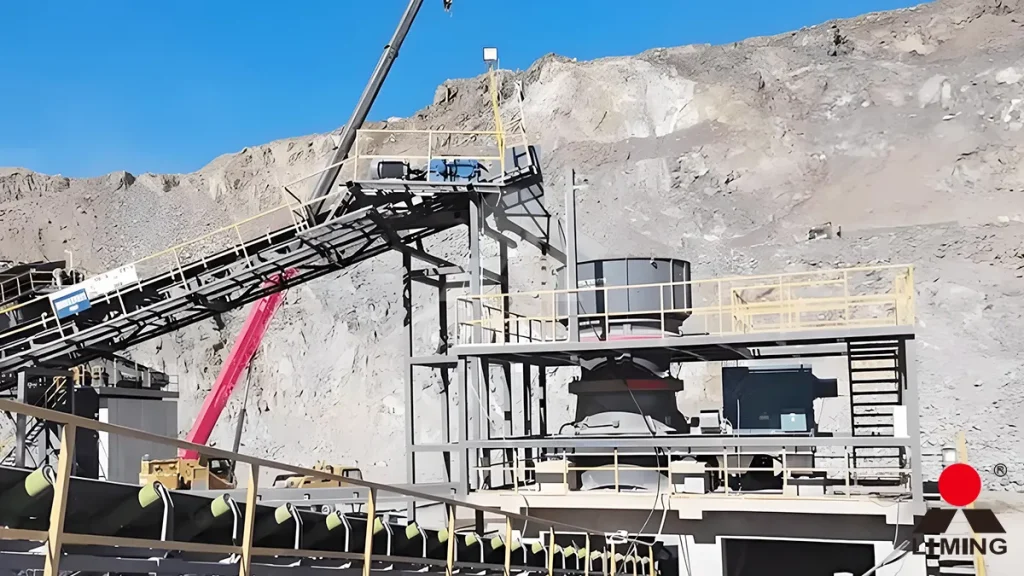
II. Configuration Comparison of Four Operational Production Lines
The table below details four 1000 TPH granite production lines engineered by Liming Heavy Industry. These proven configurations can serve as highly reliable selection references for projects of a similar scale:
| Project Location | Secondary Crushing | Tertiary Crushing | Engineering Characteristics |
|---|---|---|---|
| Fujian Zhangzhou | 1 × HGT Series Gyratory Crusher | 4 × CS Series Spring Cone Crushers | Classic traditional configuration; highly reliable and worry-free operation. |
| Fujian Fuding | 2 × HST Single-Cylinder Cone Crushers | 2 × HPT Multi-Cylinder Cone Crushers | Dual-line parallel operation; highly flexible switching and excellent particle shape. |
| Guangdong Meizhou | 1 × HST Single-Cylinder Cone Crusher | 2 × HST Single-Cylinder Cone Crushers | Three single-cylinder units; immense structural strength and load-bearing capacity. |
| Guangxi Fangchenggang | 1 × HGT Series Gyratory Crusher | 3 × HPT Multi-Cylinder Cone Crushers | Massive throughput securely exceeding 1000 TPH with premium aggregate shaping. |
As the table demonstrates, the primary differences across the four production lines are concentrated entirely in the secondary and tertiary crushing stages.
Although the four lines utilize different machine models, the fundamental engineering logic remains identical: the secondary crusher is responsible for further reducing the coarse material discharged from the primary jaw crusher, while the tertiary crusher is strictly responsible for finalizing the target particle size and perfecting the particle shape.
Let us examine the secondary stage. Utilizing a Gyratory Crusher for secondary reduction provides exceptionally stable feeding and massive volumetric capacity. Conversely, employing single-cylinder cone crushers ensures intense structural durability. In the Fuding project, the plant utilizes a dual-line parallel design mixing HST and HPT cone crushers. If one line is shut down for scheduled maintenance, the other line continues running seamlessly. Furthermore, the inclusion of the HPT multi-cylinder crushers ensures the discharged gravel features an exceptionally cubic shape.
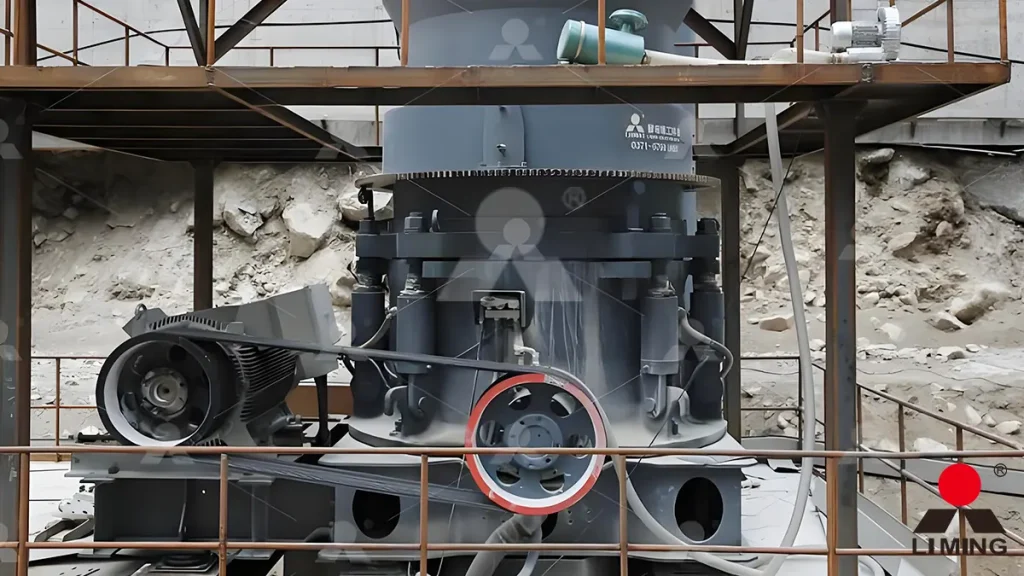
Finally, let us review the tertiary fine crushing stage. The HPT Multi-Cylinder Hydraulic Cone Crusher delivers an outstanding finished particle shape, drastically reducing the content of flat and elongated (needle-like) stones. Meanwhile, the HST Single-Cylinder Hydraulic Cone Crusher possesses immense structural stress resistance, making it ideal for brutal, heavy-load workstations. The Meizhou project utilizes HST single-cylinder crushers for both the secondary and tertiary stages specifically to capitalize on this robust mechanical endurance. As for the Zhangzhou and Fangchenggang projects, both are wet-processing lines. While adding a water-washing circuit requires a larger physical footprint and comprehensive water recycling infrastructure, the resulting finished aggregate is incredibly clean and commands a premium selling price in the market.
It is evident from these examples that there is no absolute “superior” or “inferior” equipment configuration—there is only the configuration that fits perfectly. Using a Gyratory paired with Spring Cones in Zhangzhou, or a Gyratory paired with Multi-Cylinder Cones in Fangchenggang, are both highly successful combinations verified by years of continuous production, provided that the physical site, capital budget, and discharge variables are properly aligned.
III. Pre-Decision Planning for New Lines: Output, Shape, and Budget
If you are planning a new aggregate production line, the sequence of engineering decisions cannot be inverted.
- Step One: Determine the Discharge Specifications. Decide exactly how many commercial sizes you need and what percentage of the total output each size should represent. This entirely dictates the complexity of the screening circuit and the closed-circuit flowsheet.
- Step Two: Define the Particle Shape Requirements. For projects demanding extremely low flakiness indexes (such as high-speed railway concrete), the shaping and fine-crushing stages must be heavily reinforced with equipment like the HPT Multi-Cylinder Cone Crusher or VSI Sand Makers.
- Step Three: Establish Site and Budget Boundaries. Whether you can afford an expansive open layout or must utilize a compact design, and whether you purchase top-tier hydraulic equipment or classic mechanical equipment, all depend entirely on these two rigid constraints.
Only after these three foundational questions are answered can engineers begin to meaningfully discuss the specific equipment manifest for a granite crushing production line.
Frequently Asked Questions (FAQ)
1. Should I use a Gyratory Crusher or a Cone Crusher for secondary granite reduction?
The HGT Gyratory Crusher excels in providing massive, highly stable feeding capacity, making it capable of handling 1000 to 2000 tons per hour effortlessly. Cone crushers are generally assigned to the tertiary stage for fine reduction and shaping. However, if the primary feed size is highly controlled, utilizing large HST Single-Cylinder Cone Crushers for the secondary stage is also a highly effective engineering choice. The decision rests entirely on the site layout and the target discharge specifications.
2. Can standard Spring Cone Crushers withstand the hardness of granite?
Yes. The classic CS Series Spring Cone Crusher features an incredibly mature, robust, and durable mechanical structure. The 1000 TPH plant in Zhangzhou, Fujian, successfully pairs a Gyratory Crusher with multiple Spring Cone Crushers, and it has maintained stable, highly profitable operation for many years.
3. In what specific workstation is the HST Single-Cylinder Hydraulic Cone Crusher utilized?
The HST single-cylinder design offers immense resistance to structural stress, making it perfectly suited for brutal, heavy-load workstations. In the 1000 TPH Meizhou project, Liming Heavy Industry deployed HST Single-Cylinder Cone Crushers exclusively for both the secondary and tertiary crushing stages to maximize mechanical reliability against extreme granite hardness.
