200-300 TPH Granite Crushing Plant Design And Equipment Selection In Guinea
September 8, 2026
Summary:As infrastructure development accelerates across West Africa, the demand for high-quality commercial aggregate is surging. This engineering guide details a newly designed 200 to 300 TPH granite crushing plant located in Guinea. Written by a senior engineer at Liming Heavy Industry, the article explains the metallurgical challenges of processing highly abrasive granite with a 200mm feed size. It outlines a highly efficient "two-stage closed-circuit" configuration utilizing PEW Jaw Crushers and HPT Multi-Cylinder Cone Crushers to produce precise 0-25mm aggregates while minimizing daily operating expenses.
With the continuous advancement of infrastructure construction across the African continent—spanning highway networks, heavy load bridges, and local mining developments—the market demand for premium quality sand and gravel aggregates is growing exponentially. Recently, Liming Heavy Industry successfully engineered and delivered a highly efficient granite aggregate production line with an hourly capacity of 200 to 300 tons for a client located in Guinea, West Africa.
Granite, recognized for its extreme hardness and superior compressive strength, is the premier raw material for construction aggregates in the region. As a senior process engineer at Liming Heavy Industry, I will provide a deep, technical analysis of the process design logic and core equipment selection for this project, highlighting how we utilized professional rock crushing and screening machinery to overcome the immense challenges of high-hardness material comminution.
I. Analyzing the Granite Material Characteristics and Crushing Challenges
Before any equipment layout is drafted, conducting a precise metallurgical analysis of the raw material is a mandatory prerequisite for any plant engineer. Granite sourced from the Guinean region is characterized by an incredibly dense structure, massive compressive strength, and an exceptionally high silica content. During the crushing process, this type of material violently consumes wear parts and frequently results in the generation of flat, needle-like (flaky) aggregates if improper equipment is utilized.
According to the precise data provided by the client, the maximum feed size for this project was 200 millimeters (0-200mm feed), the target discharge particle size was 0-25 millimeters, and the required design capacity was 200 to 300 tons per hour (TPH).
While an initial feed size of 200 millimeters is not considered massively oversized in the heavy crushing industry, the high abrasiveness of the granite must dictate the equipment selection. If a traditional horizontal impact crusher were deployed for this material, the chrome blow bars would suffer catastrophic wear, causing daily operating expenses to skyrocket unacceptably. Therefore, implementing the “lamination crushing” principle through a hydraulic cone crusher, working in tandem with a primary jaw crusher, is the absolute optimal engineering solution to guarantee stable continuous operation and severely lower the production cost per ton.
II. Process Design for the 200-300 TPH Granite Production Line
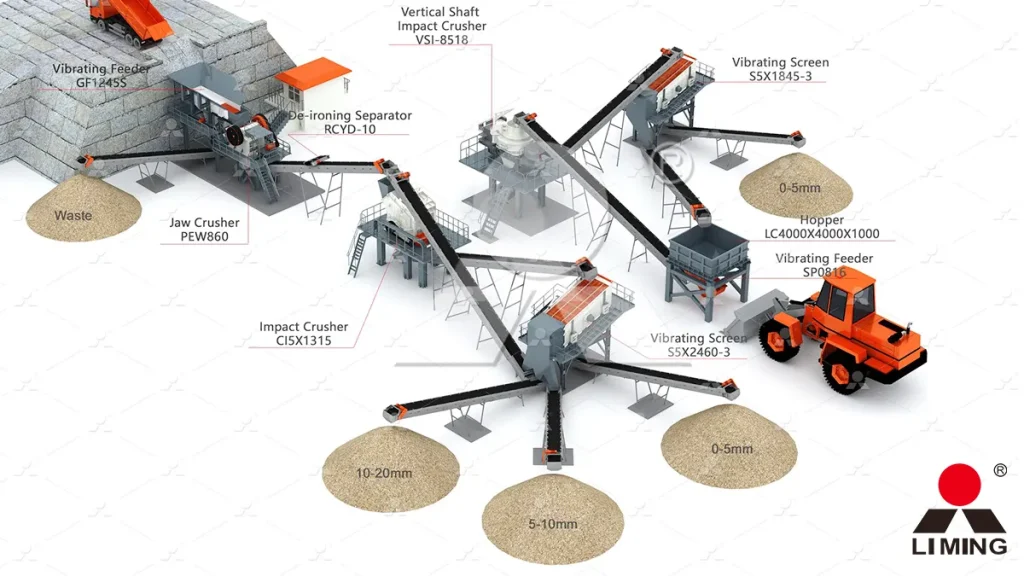
To directly address the practical demands of our Guinean client, the technical engineering team at Liming Heavy Industry tailored a classic “Two-Stage Crushing and One Closed-Circuit Screening” aggregate production flowsheet.
1. The Feeding and Primary Crushing Stage
Although the maximum feed size is relatively manageable at 200 millimeters, to guarantee a uniform and continuous feed to the downstream secondary crushers—and to mitigate any potential blockages from unexpectedly oversized boulders—we installed a heavy-duty vibrating feeder beneath the raw material hopper.
Equipment Selection: We deployed the PEW Series European Jaw Crusher from Liming Heavy Industry as the primary reduction machine. The jaw crusher offers immense advantages, including a massive crushing ratio, a wide feed opening, and exceptional operational stability. It easily processes the 200mm raw granite down to an intermediate size perfectly suited for the secondary cone crusher, while the feeder’s grizzly bars simultaneously extract natural mud and dirt from the feed stream.
2. The Secondary Fine Crushing and Classification Stage (The Core Hub)
The coarsely crushed material is transported via belt conveyors to the medium and fine crushing stage. This is the critical juncture that dictates the final particle shape and total plant capacity.
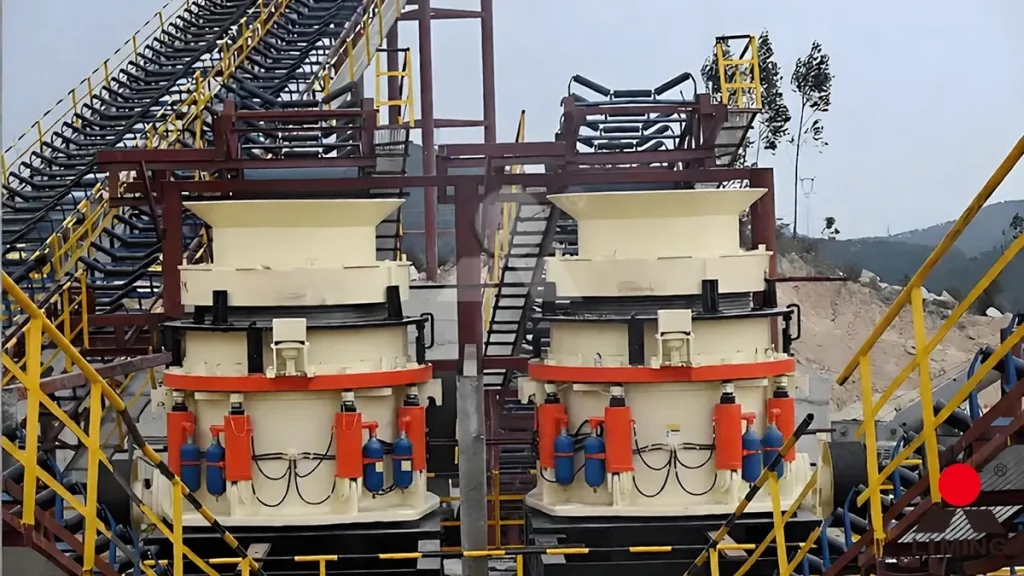
Equipment Selection: We selected the HPT Series Multi-Cylinder Hydraulic Cone Crusher. This advanced machine is engineered specifically to conquer high-hardness, highly abrasive materials such as granite and basalt. Its unique lamination crushing cavity not only effortlessly sustains the massive 200-300 TPH throughput, but it also effectively minimizes the generation of flaky, elongated particles, ensuring the final discharge exhibits an excellent, cubic shape.
Screening Configuration: The material discharged from the cone crusher enters the S5X Series Heavy-Duty Vibrating Screen. To satisfy the strict 0-25mm output specification, we configured the screen with three or four layers of high-tensile mesh. This precisely classifies the finished product into commercial construction aggregate fractions, typically 0-5mm (premium manufactured sand), 5-15mm, and 15-25mm gravel. Any oversized material that fails to pass the 25mm threshold is automatically routed via a return conveyor back into the HPT cone crusher, forming a highly efficient closed crushing loop.
III. The Core Advantages of Liming Heavy Industry Equipment
Why did the client in Guinea ultimately entrust this massive project to Liming Heavy Industry’s aggregate machinery? As an engineer, I can summarize our supremacy into three core technological advantages:
- Exceptional Wear Resistance: To combat the high silica content inherent in granite, our crushing machinery (specifically the manganese steel mantles and bowl liners of the cone crushers) is cast utilizing premium high-manganese steel and advanced composite alloys. This dramatically extends the operational lifespan of the consumable parts, lowering the client’s long-term maintenance expenses.
- Intelligent Automated Control Systems: The entire production line is integrated with an intelligent electrical control system independently developed by Liming Heavy Industry. Operating from the central control room, personnel can continuously monitor the equipment’s running status in real time—including oil temperature, hydraulic pressure, and production throughput—facilitating a highly efficient, reduced-labor operation.
- High-Efficiency Classification: Our screening equipment utilizes an advanced eccentric shaft vibration design, providing highly stable amplitude and massive screening efficiency. This effectively prevents the material from pegging or blinding the screen mesh, guaranteeing the absolute purity of the 0-25mm finished aggregate products.
IV. Globalized Service and Comprehensive Support in Africa
The delivery of heavy equipment marks only the beginning of our partnership; rigorous after-sales service is the true safeguard for maintaining continuous plant profitability. Having deeply cultivated the African mining market for many years, Liming Heavy Industry provided a full-lifecycle service guarantee specifically for this Guinean project:
- Professional Installation Guidance: We dispatched a dedicated team of senior engineers directly to the site in Guinea. They provided hands-on supervision for the civil foundation construction, equipment installation, and final debugging, ensuring the production line was commissioned flawlessly.
- Abundant Spare Parts Supply: We maintain strategic spare parts warehouses across the African continent. This guarantees that critical wear parts and consumables can be dispatched rapidly, minimizing potential mechanical downtime to the absolute minimum.
- Routine Technical Training: We provide systematic equipment operation and daily maintenance training for the local workforce, significantly elevating the autonomous operational capabilities of the client’s management team.
Engineer’s Concluding Remark:
The successful commissioning of the 200-300 TPH granite aggregate production line in Guinea once again validates Liming Heavy Industry’s profound technical foundation in the field of hard rock crushing. From the initial 200mm feed down to the premium 0-25mm discharge, every ton of aggregate embodies our relentless pursuit of engineering excellence. If you are seeking highly efficient rock crushers, screening equipment, or a complete aggregate production line solution, we invite you to contact Liming Heavy Industry at any time. Our senior engineers will customize an exclusive, turnkey solution to help your engineering project generate massive financial returns!
