Molybdenum Ore Beneficiation Complete Equipment Selection Guide
September 16, 2026
Summary:Molybdenum is a strategic alloy metal with complex metallurgical properties. This engineering guide details the complete equipment selection and process flows for different molybdenum ore types. Written by a senior process engineer, the article explains how to configure robust crushing circuits using Liming Heavy Industry's PEW Jaw Crushers and HPT Cone Crushers. It further explores specialized froth flotation flowsheets—including preferential flotation for single molybdenite, sequential separation for copper-molybdenum ores, and combined magnetic-flotation circuits for talc-bearing and oxide molybdenum deposits to maximize concentrate grade.
Molybdenum is an irreplaceable transition metal used extensively to harden high-strength steel alloys, construct nuclear reactors, and manufacture specialized aerospace components. However, extracting molybdenum from the earth is an incredibly delicate metallurgical challenge. The physical and chemical properties of different molybdenum ore bodies vary drastically. A single molybdenite deposit behaves completely differently inside a flotation tank compared to a complex copper-molybdenum deposit or a heavily oxidized molybdenum ore.
Because of these geological variations, “cookie-cutter” plant designs inevitably fail. Metallurgical engineers must deploy highly customized beneficiation flowsheets and strictly matched heavy equipment to guarantee concentrate purity. For single molybdenite, the classic route is closed-circuit crushing, coarse grinding, and intense regrinding combined with multiple stages of froth flotation. For complex copper-molybdenum ores, a bulk flotation followed by sequential separation is mandatory. For challenging talc-bearing ores—where the gangue floats just as easily as the molybdenum—engineers must integrate magnetic separation, desliming, and staged flotation.
In this technical guide, I will break down the specific process flowsheets and the heavy machinery required to process the four major categories of molybdenum ore successfully.
1. Single Molybdenite Ore Beneficiation Equipment
Molybdenite (MoS2) is the primary global resource for molybdenum extraction. Due to its unique crystalline structure and natural hydrophobicity, froth flotation is the absolute standard separation method. Most single molybdenite processing plants rely on a flowsheet encompassing multi-stage crushing, coarse grinding for rougher flotation, and intensive regrinding for multiple cleaner flotation stages. Because molybdenite crystals are often tightly interlocked with quartz gangue, the rough concentrate must be reground to achieve complete monomeric liberation before the final high-grade concentrate can be produced.
Core Equipment Selection:
- Crushing Circuit: We deploy a three-stage closed-circuit process aiming for a final crushed product size of 12 to 15 millimeters. For the heavy-duty primary reduction, the PEW Series European Jaw Crusher from Liming Heavy Industry is mandatory. Secondary and tertiary fine crushing is handled by the HPT Multi-Cylinder Hydraulic Cone Crusher, working in a closed loop with the S5X Series Vibrating Screen to ensure strict particle size control.
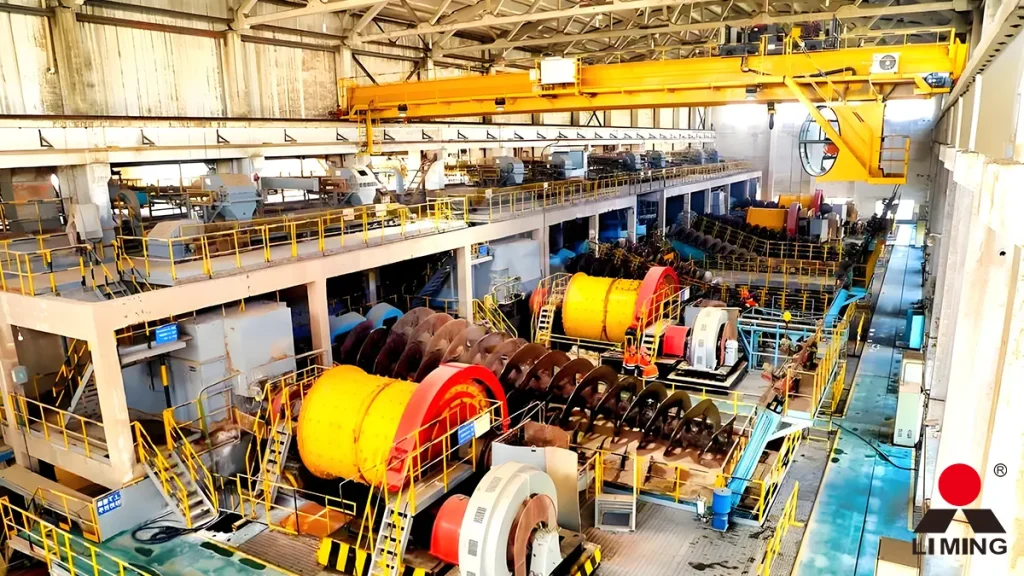
- Coarse Grinding and Regrinding: The initial coarse grinding is typically executed using a Rod Mill paired with a Hydrocyclone cluster to prevent over-grinding. The regrinding of the rough concentrate is handled by a Wet Overflow Ball Mill operating with a Spiral Classifier.
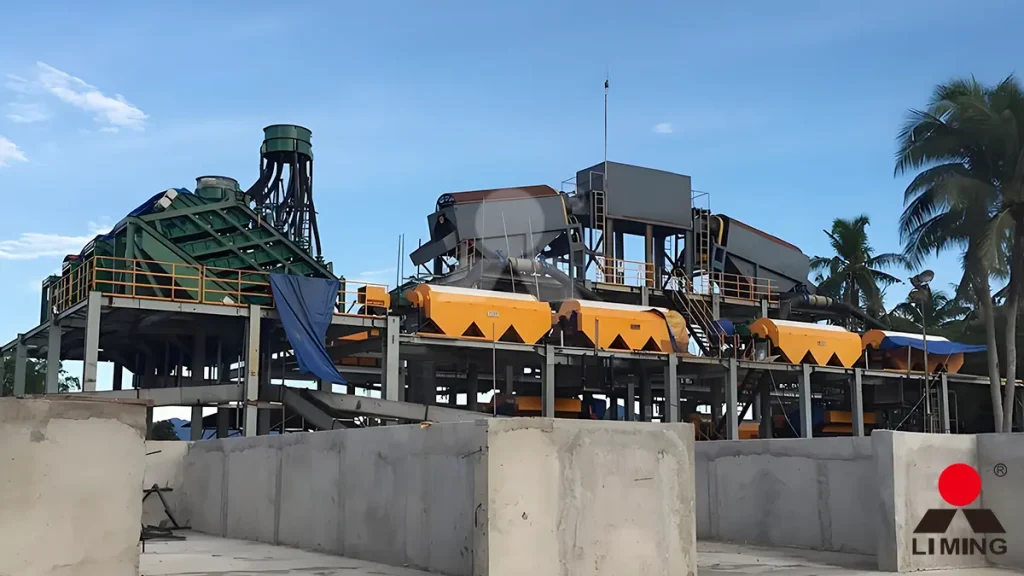
- Flotation Circuit: Engineers employ preferential flotation. The roughing stage captures a rough molybdenum concentrate, while scavenging recovers any remaining associated minerals from the tailings. The rough concentrate is then refined through multiple cleaning stages. The XCF and KYF series mechanical agitation flotation cells are heavily utilized here for their superior aeration and suspension capabilities.
2. Copper-Molybdenum Ore Beneficiation Equipment
Many global deposits contain both recoverable copper and molybdenum. For these ores, engineers deploy a “Bulk Flotation” strategy. The entire ground slurry is floated to produce a mixed copper-molybdenum rough concentrate. This bulk concentrate is then subjected to a highly sensitive chemical separation circuit to produce individual copper and molybdenum concentrates. There are two primary chemical routes to achieve this separation: floating the copper while depressing the molybdenum, or floating the molybdenum while depressing the copper.
Chemical Separation Routes:
Floating Copper and Depressing Molybdenum: In this flow, molybdenum is treated as a secondary byproduct. The ground ore (often chalcocite) is mixed with lime. Ethyl xanthate and aerofloat are used as collectors. The rough froth is thickened, and dextrin is heavily applied to chemically depress the molybdenite. The copper floats to the surface, and the tailings (which contain the depressed molybdenum) are subjected to further chemical treatment to recover the final molybdenum concentrate.
Floating Molybdenum and Depressing Copper: This is the more common approach. The bulk copper-molybdenum concentrate is passed through a hydrocyclone for desliming. The underflow (rough concentrate) undergoes multiple cleaning stages. The final bulk concentrate is filtered, dried, and lightly roasted. It is then repulped, and a frothing agent is added to run a reverse flotation to remove talc (which carries away some copper). The final tailings from this specific reverse flotation stage constitute the premium, final molybdenum concentrate.
The primary equipment for these complex chemical circuits includes JJF and SF series flotation cells, heavy-duty reagent conditioning tanks, and automated chemical dosing systems.
3. Talc-Bearing Molybdenum Ore Beneficiation Equipment
Talc-bearing molybdenum ore is a metallurgical nightmare. Talc possesses natural floatability that is nearly identical to molybdenite. If a standard flotation circuit is used, massive amounts of talc will float directly into the molybdenum froth, destroying the final concentrate grade. To solve this, engineers deploy a highly complex “Coarse Grinding → Magnetic Separation → Desliming → Rough Flotation → Fine Grinding → Cleaner Flotation” flowsheet.
The Process Strategy:
- Coarse Grinding: A robust three-stage crushing circuit followed by closed-circuit ball milling and classification.
- Magnetic Separation: High-Gradient Magnetic Separators (HGMS) are utilized immediately after grinding to pull out iron-bearing impurities.
- Desliming (Talc Removal): The cyclone overflow is pumped into a high-intensity conditioning tank. Methyl Isobutyl Carbinol (MIBC) is added strictly as a collector for the talc. The froth generated here is pure talc waste, which is skimmed off and discarded.
- Molybdenum Roughing: With the talc removed, the remaining slurry is agitated again for the primary molybdenum roughing stage. The froth becomes the rough molybdenum concentrate, while the underflow proceeds to scavenging.
- Regrinding and Cleaning: The rough molybdenum concentrate is pumped to a regrind mill until 75% to 95% of the particles pass 0.038 millimeters. It then enters an intensive “Rougher-Scavenger-Cleaner” flotation loop to produce the final, ultra-pure molybdenum concentrate.
4. Oxide Molybdenum Ore Beneficiation Equipment
Oxide molybdenum is formed by the geological weathering and alteration of original molybdenite deposits. Minerals such as ferrimolybdite, goethite, and wulfenite have exceptionally low natural floatability, making them incredibly difficult to process using standard methods.
Processing Routes:
For Iron-Bearing Oxide Ores: A combined “Flotation → Magnetic → Gravity” circuit is deployed. Fatty acids and kerosene are used for flotation, followed by high-intensity wet magnetic separation, and finally, gravity separation using jigging machines to capture the dense particles.
For Standard Oxide Ores: Engineers utilize a circuit comprising one roughing stage and two scavenging stages. Kerosene is used as the collector and pine oil as the frother. Crucially, sodium silicate is added to the ball mill as a dispersant, and sodium sulfide is introduced to execute “sulfidizing flotation” (artificially creating a sulfide coating on the oxide mineral to force it to float).
5. Specialized Chemical Extraction for Carbonaceous Nickel-Molybdenum Ores
Beyond the common ores, there exists a highly complex class of carbonaceous nickel-molybdenum ores. In these deposits, the molybdenum exists as colloidal jordisite, deeply intergrown with nickel sulfides, vanadium, uranium, and other rare precious metals. Standard physical flotation is entirely useless here. To extract the high-quality nickel and molybdenum, metallurgical engineers must abandon physical separation and deploy hydrometallurgy.
The chemical processing flowsheet involves: Mechanical Crushing → Fine Grinding → Chemical Decomposition (using sodium hypochlorite) → Ion Exchange → Solution Purification → Crystallization → Final Drying.
Conclusion
Successfully upgrading raw molybdenum ore into a premium commercial concentrate demands an uncompromising integration of robust mechanical comminution and highly sensitive chemical separation. By deploying heavy-duty crushing and grinding machinery from Liming Heavy Industry, plant operators guarantee that the initial mineral liberation is exact, preventing the generation of unrecoverable slimes. Whether your deposit requires a standard preferential flotation circuit for molybdenite or a highly complex magnetic-flotation combined flowsheet for talc-bearing ores, matching the mechanical equipment perfectly to your unique mineralogy is the only way to maximize recovery, lower daily operating expenses, and ensure long-term profitability.
