200-300 TPH Sandstone Crushing Plant for Concrete Aggregate Production
April 27, 2026
Summary:Sandstone shears unpredictably, destroying aggregate quality if mishandled. This audit details the exact Jaw-to-Impact synchronization required to suppress fines generation. By integrating VSI shaping and XSD hydrodynamic washing, site operators can secure the strict cubicality and low mud content demanded by high-strength concrete batching plants.
Back in the June 2025 circuit audit of a commercial sandstone quarry in Rizal, Philippines, the operator was hemorrhaging capital due to excessive fines generation at the primary stage. Sandstone is sedimentary; it shears easily under sustained pressure. The legacy primary crusher was literally grinding the rock into useless dust before it even reached the secondary stage. We ripped out the old configuration and deployed the PEW760 Jaw Crusher. By calibrating the deep V-shaped crushing cavity and setting the Closed Side Setting to precisely 100mm, we bypassed the ‘over-crushing’ zone. This simple mechanical synchronization maintained a steady 280 TPH feed of intact rock to the secondary stage while dropping airborne dust generation by 40%.
Secondary Impact: Forcing Cubicality in Sedimentary Rock
Compression crushers create slabs in sandstone; kinetic impact shatters it into perfect cubes.
Concrete batching plants enforce brutal quality control. If your aggregates exceed 8% flakiness and elongation, the cement paste cannot bind properly, and the load is rejected. To achieve strict cubicality, we utilized the CI5X1315 Impact Crusher for the secondary stage. You cannot run a cone crusher on sandstone if your end goal is high-strength concrete; the compressive forces will shear the sedimentary layers into flat, un-bindable shards.
The heavy-duty rotor and high-chrome blow bars of the CI5X utilize extreme kinetic velocity. As the sandstone enters the chamber, the rotor strikes it mid-air, hurling it against the impact racks. This violent kinetic transfer forces the rock to fracture instantly along its natural cleavage planes. The result is a premium cubical grain shape that maximizes the interlocking strength of the final concrete mix.
VSI Shaping and Hydrodynamic Clay Removal
Sandstone naturally crumbles during transit and screening, creating a surplus of friable mid-sized chips. We routed the 5-15mm rejected fractions directly into a VSI6X1040 Sand Maker. Operating at a heavy 200 kW load, the ‘rock-on-rock’ kinematics inside the rotor stripped away the weak, friable edges of the sandstone chips. This high-velocity particle collision outputted a high-grade 0-5mm artificial sand, with the Fineness Modulus (FM) perfectly stabilized at 2.7.
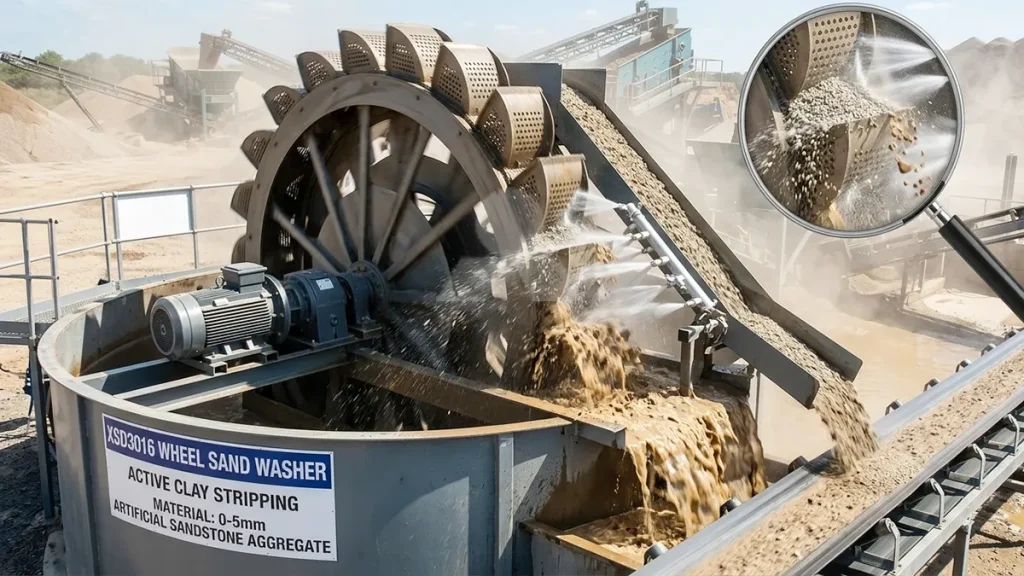
The final, critical friction point was the clay. Sandstone deposits frequently contain high clay and silt inclusions, which coat the aggregates and destroy cement bonding strength. We integrated the XSD3016 wheel sand washer at the discharge end of the circuit. By churning the 0-5mm fraction through the hydrodynamic washing bath, the physical agitation stripped the clay coating from the silica grains. We dropped the final mud content to exactly 1.2%, making the output instantly viable for high-strength C40 concrete mixes.
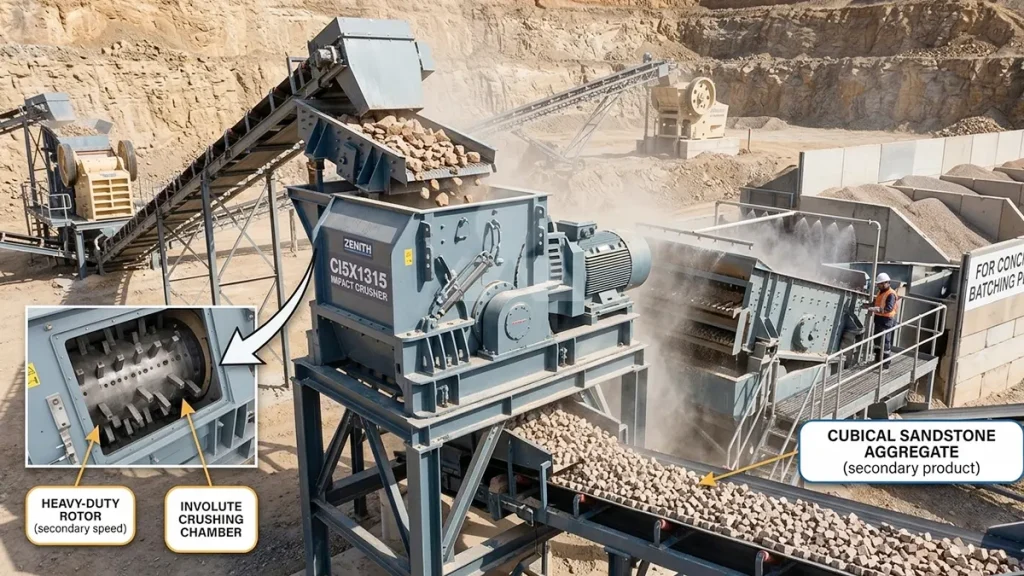
To sustain a 280 TPH output that passes commercial batching audits, the physical capacities of the compression, impact, and washing stages must be perfectly aligned. The matrix below dictates the baseline synchronization.
If your primary jaw outpaces your secondary impactor, the surge will choke the rotor and destroy your blow bars.
| Process Stage | Recommended Model | Capacity (tons per hour) | Power (kilowatts) | Max Feed (millimeters) |
|---|---|---|---|---|
| Primary Compression | PEW760 Jaw | 150-350 | 110 | 620 |
| Secondary Cubical Shaping | CI5X1315 Impactor | 250-350 | 250-315 | 600 |
| Tertiary Fines Kinematics | VSI6X1040 Sand Maker | 264-515 | 200 x 2 | 40 |
| Hydrodynamic Washing | XSD3016 Washer | 50-100 | 15 | 10 |
The PEW760 provides the volumetric intake, but the 250 kW CI5X1315 handles the actual quality control. The XSD washing stage acts as the final gatekeeper, ensuring that the heavy tonnage produced by the impactors is actually sellable to commercial concrete mixers.
Architect’s Memo: Sandstone Shearing and Bond Failures
- Why does pushing sandstone through a cone crusher destroy concrete batching quality?
- Look at the compressive physics of a cone. It squeezes the rock. Because sandstone is formed in sedimentary layers, squeezing it causes it to shear into flat, elongated splinters. These splinters create weak points in the concrete matrix, guaranteeing that the final pour will fail its load-bearing tests.
- How did we deal with excessive primary fines ten years ago?
- Ten years ago, operators just let the dust blow away or choked the secondary crushers with it. By integrating a vibrating grizzly feeder ahead of the PEW jaw, we now bypass the natural -50mm fines directly to the secondary stage, preventing the jaw from grinding already-sized material into useless powder.
- What happens if the XSD washing bath speed is calibrated too high?
- Do not ignore the hydrodynamic settling velocity. If the wheel turns too fast, the turbulence suspends the profitable 0.15mm silica grains alongside the mud, washing your revenue directly into the settling ponds. The RPM must be strictly matched to the specific gravity of the sandstone.
- Why is the VSI6X necessary if the CI5X already produces cubical aggregates?
- When you process sedimentary rock, the edges of the aggregates are inherently friable (brittle). The VSI6X acts as an ‘abrasion scrubber’. The rock-on-rock kinematics knock off these weak edges before they reach the concrete mixer, ensuring the cement paste binds to solid silica, not crumbling dust.
Arresting Concrete Bond Failures Before the Mixer
The mechanical reality of producing concrete aggregates from sandstone is a zero-tolerance battle against clay and flakiness. If you attempt to process this sedimentary rock with compression-only secondary crushers, the resulting elongated shards will inherently destroy the interlocking strength of the concrete pour. Bypassing the XSD hydrodynamic washing stage ensures that your aggregates remain coated in microscopic clay, creating a barrier that prevents cement paste from actually touching the stone. This guarantees catastrophic structural failures on the job site. Synchronizing your CI5X kinetic impactors with rigorous VSI shaping and washing is the only non-negotiable operational boundary. If you do not lock your flakiness below 8% and your mud content below 1.5%, your entire 280 TPH production line is generating rejected waste, not sellable aggregate.
Stop Guessing on Grain Shape and Clay Contamination
“If the cement paste cannot bind to the rock, your aggregate is worthless. Synchronize your washing kinematics now.” — From the Desk of your Solution Architect
Audit Sandstone Circuit Production-to-Cost Ratio