I inspected a failing track section last quarter; the ballast had degraded into a dense, powdery mud. This phenomenon, known as ‘ballast fouling,’ occurs when impact-crushed stones with internal micro-cracks shatter under the dynamic load of freight trains. Deploying cone crushers is a non-negotiable requirement for track stability.
Ballast crushing machine kenya for rail construction
July 3, 2026
Summary:Executing a commercial Ballast crushing machine kenya for rail construction layout requires strict adherence to structural metallurgy. Railway ballast demands perfect 25-60mm geometric interlocking without internal micro-cracks. Utilizing impact crushers induces hidden fractures that pulverize under heavy train loads. A compliant architectural blueprint anchors the primary flow with a PEW860 jaw and strictly enforces secondary laminated crushing via the HPT300 cone. Synchronized with a closed-circuit S5X vibrating screen, this configuration guarantees zero-contamination track ballast, securing government engineering approval and accelerating hardware amortization.
Infrastructure projects scaling across the East African rift tolerate zero margins for metallurgical error. During an engineering audit for a new rail corridor extending from Mombasa this August 2025, a critical structural flaw was identified in the aggregate supply chain. The contractor was attempting to produce track ballast using secondary impact crushers. While the stones appeared cubical to the naked eye, the blunt-force kinetic trauma had induced millions of microscopic internal fractures. Under the dynamic load of a 4,000-ton freight train, these stones would instantly pulverize into mud, destabilizing the tracks and risking catastrophic derailment. Designing a compliant Ballast crushing machine kenya for rail construction demands abandoning impact mechanics entirely. Architects must deploy strict, closed-circuit laminated compression systems to forge 25-60mm aggregate that guarantees absolute track bed integrity.
Primary Fracture: Securing the Volumetric Flow
A railway project consumes thousands of tons of ballast daily. The primary jaw must establish an unbreakable volumetric baseline.
The foundation of the ballast flow chart begins at the basalt or granite quarry face. Railway-grade rock is inherently hard, possessing compressive strengths that frequently exceed 200 MPa. The primary gatekeeper must absorb this initial kinetic shock. Deploying a PEW860 jaw crusher, equipped with a 132 kW motor, provides the mechanical leverage to reduce 720mm raw boulders down to a <200mm profile.
This stage must be synchronized with a heavy-duty vibrating feeder. The feeder absorbs the violent shock of dump trucks unloading and provides a continuous, unbroken ribbon of rock. A steady feed ensures the downstream secondary crushers maintain a “choke-fed” status, maximizing their crushing efficiency and preventing the destructive accordion effect of surge-feeding, which disrupts the mass balance required for precise ballast sizing.
Secondary Lamination: Eliminating Micro-Cracks
The secondary crushing stage dictates the structural survival of the railway line. The fundamental requirement of railway ballast is that it must possess immense compressive strength without internal faults. As noted, pushing abrasive basalt into an impactor destroys both the blow bars and the rock’s internal integrity. The architecture strictly mandates the HPT300 multi-cylinder hydraulic cone crusher.
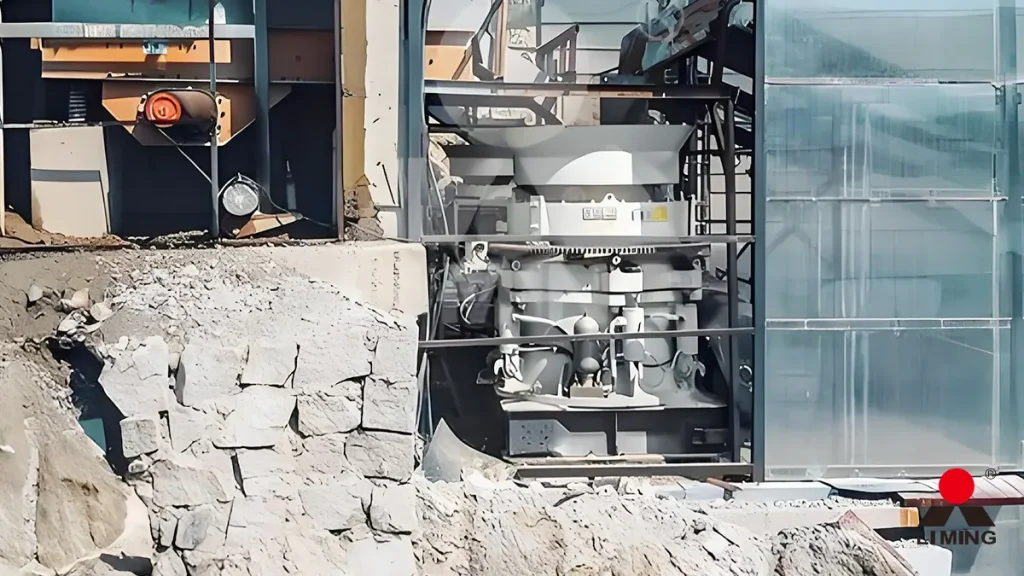
The Kenyan SGR (Standard Gauge Railway) demands a flakiness index strictly below 15%. By utilizing hydraulic clamping force to lock the Closed Side Setting (CSS), the HPT cone ensures that the rocks shear off their flat edges against one another. This geometric correction produces the heavily interlocked, angular 25-60mm stones required to distribute the dynamic load of a passing locomotive.
Synchronized Configuration Matrix for Railway Ballast
A process flow chart is merely a theory until backed by rigid hardware capacity tolerances.
| Process Stage | Recommended Equipment | Capacity (tph) | Power (kW) | Architectural Mission |
|---|---|---|---|---|
| Primary Fracture | PEW860 Jaw Crusher | 200-500 | 132 | High-density raw boulder reduction |
| Secondary Sizing | HPT300 Cone Crusher | 110-440 | 250 | Laminated fracture to prevent micro-cracks |
| Closed-Circuit Control | S5X2460-3 Screen | 100-800 | 30 | Strict +60mm oversize recirculation |
| Fines Elimination | Bottom Deck Mesh | — | — | Total removal of -25mm material |
The synergy between the HPT300 secondary crusher and the S5X2460-3 vibrating screen is absolute. Railway ballast must fall precisely within the 25mm to 60mm window. Any deviation compromises track drainage and stability.
300 TPH Ballast Circuit: Mass Balance & Kinetic Thresholds
- Primary Baseline: 132 kW Jaw ensuring steady >250 tph flow
- Secondary CSS Calibration: Locked to ~35mm to optimize 25-60mm yield
- Recirculating Load Limit: 20-25% oversize (+60mm) returned to Cone
- Fines Rejection: 100% of -25mm flushed to commercial aggregate stockpiles
- Flakiness Index Target: Sub-15% for heavy-haul rail compliance
Closed-Circuit Screening: The Architectural Gatekeeper
To guarantee the 25-60mm output, the system must operate in a strict closed loop. The S5X vibrating screen acts as the absolute gatekeeper for the entire operation. The top deck is fitted with a 60mm mesh; any rock failing to pass is actively recirculated back to the HPT300 via a dedicated return conveyor. This ensures no oversized boulders reach the railbed.
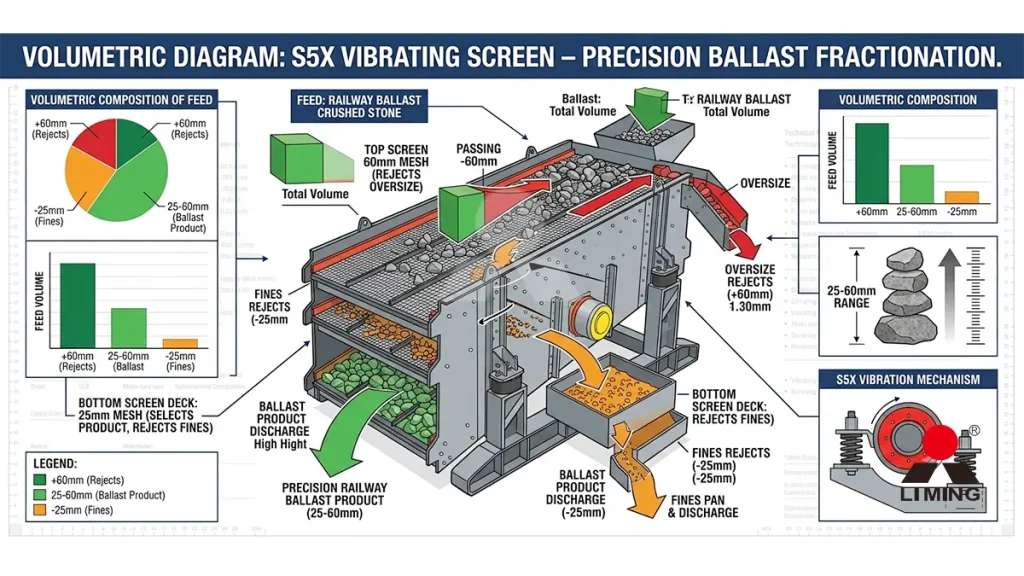
The discarded -25mm material is not waste; it is highly valuable commercial aggregate that can be sold to local concrete batching plants, significantly offsetting the operation’s expenditure per shift and accelerating the hardware amortization cycle.
Ballast Geometry Diagnostics & Micro-Crack Post-Mortem
Decades ago, operators relied on open-circuit layouts to save on conveyor costs. Without a return loop, the top-size was uncontrollable, leading to massive inconsistencies. A modern closed-circuit layout mathematically guarantees that 100% of the product conforms to strict government engineering codes.
Do not starve the machine. An HPT300 spinning at 800 rpm relies on the mass of the rock bed to stabilize the eccentric rotation. Running it empty causes the mantle to physically strike the bowl liner, destroying the manganese profile and generating flat, elongated rocks that fail the flakiness index tests.
Calculating the mass flow proves that if wet clay binds to the screen mesh, the -25mm fines cannot fall through. They ride over the deck and contaminate the clean ballast. Architects must configure screen deck angles and vibration amplitude specifically to combat blinding during the East African wet seasons.
Enforce Geometric Discipline to Secure Track Stability
A national railway infrastructure project demands flawless material science. Answering the architectural challenges of a Ballast crushing machine kenya for rail construction requires deploying laminated cone crushers to eliminate micro-cracks and enforce absolute structural integrity. If you attempt to process hard rock with an impactor or fail to close the screening circuit, your aggregate will be rejected by railway inspectors, obliterating your production-to-cost ratio. Architect your mass balance with exact precision, enforce the 25-60mm parameters, and secure your capital payback velocity immediately.
Related Articles
