Wheeled Mobile Rock Crushing Machinery Benefits
August 7, 2026
Summary:Wheeled mobile rock crushing machinery offers significant capital efficiency, highway transport flexibility, and rapid deployment for quarry operators and road contractors. Written by an aggregate solutions architect, this guide evaluates the benefits of semi-trailer mounted plants over stationary lines. It highlights machinery configurations featuring Liming Heavy Industry's NK and MK series mobile crushers to eliminate civil concrete foundation costs and accelerate project payback timelines.
For decades, establishing a commercial aggregate plant required a long-term commitment to a single quarry location. Mining companies and infrastructure contractors had to spend months pouring heavy reinforced concrete foundations, erecting fixed steel superstructures, and establishing complex power grids before a single ton of rock could be processed. For medium-scale operations, road building contractors, or short-term quarry concessions, this traditional approach ties up immense capital expenditure and severely restricts operational agility.
In modern aggregate systems engineering, trailer-mounted or semi-trailer crushing units have transformed how producers evaluate site viability. By mounting heavy-duty crushing machinery, vibrating screens, and feeders onto engineered wheeled chassis, plant designers can deliver high-capacity comminution circuits that move with the project.
In this technical guide, I will evaluate wheeled mobile rock crushing machinery benefits from a solutions architecture perspective, detailing how modular trailer-mounted plants lower initial capital expenditure, streamline highway logistics, and accelerate project payback timelines.
Engineering Advantages of Semi-Trailer Chassis Design
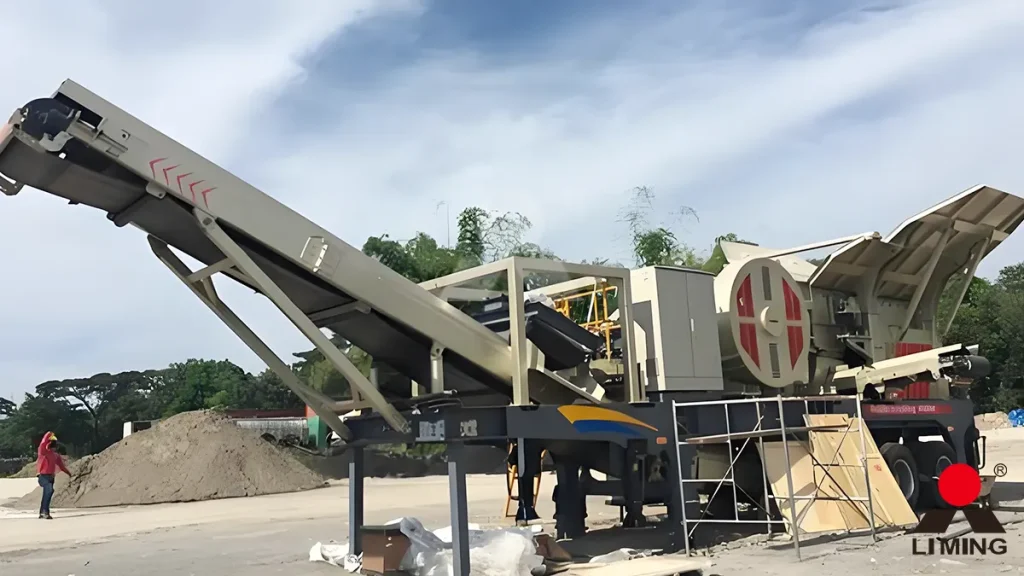
When analyzing crushing machinery chassis, engineers categorize mobile equipment into crawler-tracked units and wheeled semi-trailer units. While tracked units excel in rugged, off-road mud conditions within a quarry pit, wheeled mobile crushing plants are specifically engineered for rapid site-to-site relocation and lower long-term mechanical maintenance.
1. Zero Civil Concrete Foundations
The single largest hidden cost in permanent crushing plant construction is civil engineering. Pouring heavy concrete piers to anchor high-vibration jaw and cone crushers requires extensive excavation, steel rebar, and curing time. Wheeled mobile plants utilize heavy-duty hydraulic or mechanical support legs integrated directly into the steel chassis. Once towed into position, the support legs extend and lock onto compacted ground, distributing operational vibrations evenly and eliminating the need for permanent concrete foundations.
2. Highway Compliance and Towing Flexibility
Wheeled mobile crushing plants feature standardized fifth-wheel kingpin towing arrangements and heavy-duty tandem or triple-axle assemblies. This engineering allows the entire plant—including the feeder, primary crusher, motor, and discharge conveyors—to be towed by a standard commercial truck tractor. Because transport dimensions conform to international highway load regulations, operators can move the plant across regional highways without requiring specialized lowboy trailers or expensive overweight transport permits.
3. Rapid Site Setup and Deployment
Time to first production directly dictates your return on investment. A fixed plant can take six to nine months from civil breaking ground to final commissioning. A modular wheeled mobile plant arrives on site as pre-engineered, factory-tested modules. Folding discharge conveyors and hydraulic hopper walls extend into position within hours. Most two-stage wheeled mobile lines can begin commercial crushing within 24 to 48 hours of arriving on site.
Technical Comparison: Wheeled Mobile vs. Tracked Mobile Plants
To assist quarry managers and project developers in selecting the correct chassis architecture, the table below compares key engineering parameters between wheeled mobile plants and crawler-tracked units.
| Engineering Parameter | Wheeled Mobile Crushing Plant | Crawler-Tracked Crushing Plant |
|---|---|---|
| Chassis Architecture | Heavy-duty steel chassis with kingpin & axles | Hydraulic crawler track assembly |
| Long-Distance Logistics | Towed directly by standard truck tractor on highways | Requires heavy-duty lowboy trailer for transport |
| Civil Foundation Need | Zero foundations; relies on hydraulic steel legs | Zero foundations; rests directly on tracks |
| Chassis Maintenance Cost | Low; simple tire, brake, and mechanical pin servicing | Higher; complex hydraulic track drives and steel shoes |
| Optimal Site Conditions | Semi-paved yards, regional road projects, quarries | Uneven pit floors, soft mud, extreme steep slopes |
| Initial Capital Expenditure | More economical per ton of output capacity | Higher capital cost due to hydraulic track drives |
Modular Plant Flowsheets for 100 to 300 TPH Production
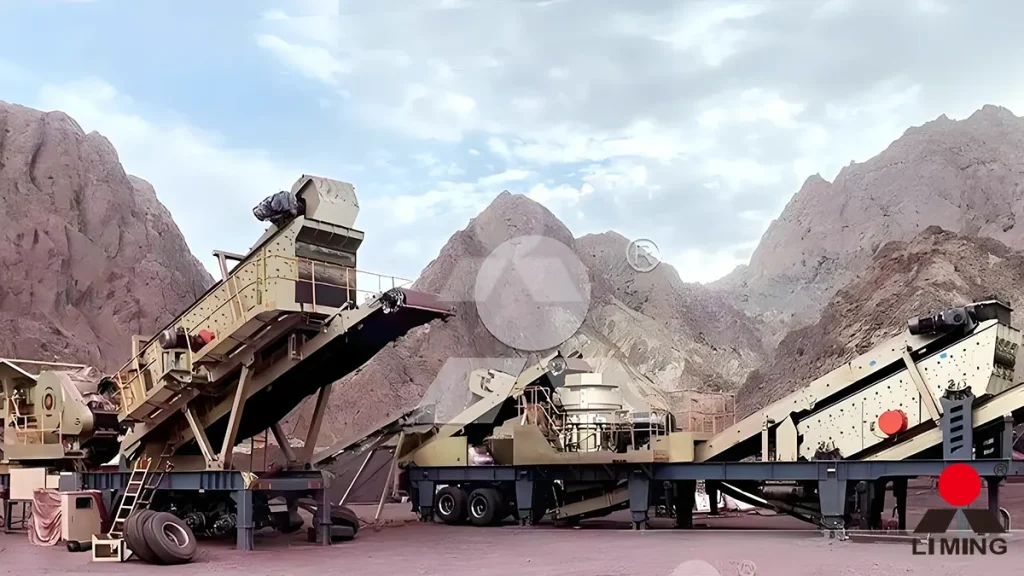
A major benefit of wheeled mobile machinery is its modular interchangeability. Solutions architects can link primary, secondary, and screening mobile chassis together to form a seamless crushing circuit tailored to specific rock mineralogies.
Hard Rock Circuit: Granite and Basalt (200-300 TPH)
For hard, abrasive rock, primary reduction is assigned to a wheeled mobile jaw crusher plant, such as the NK75J Primary Mobile Crusher (featuring a PE3040 jaw crusher and matched vibrating feeder). The crushed primary rock travels via belt conveyor to a secondary wheeled cone plant, such as the NK300H Secondary Mobile Crusher, which houses a high-efficiency HPT300 multi-cylinder hydraulic cone crusher. Sizing is handled by a matched wheeled screening plant, such as the SKX1860 Mobile Screen, creating a high-capacity closed-loop compression circuit.
Soft to Medium Rock Circuit: Limestone (150-250 TPH)
For non-abrasive limestone, primary and secondary reduction can be consolidated using an impactor-based wheeled chassis, such as the NK1213C Primary Mobile Crusher (housing a CI5X1213 impact crusher). This setup yields an exceptionally cubic particle shape in fewer crushing stages, reducing fuel consumption and capital costs.
Why Integrated Systems Engineering Matters for Mobile Operations
Operating a mobile crushing line requires perfect mechanical synchronization between chassis units. If the primary mobile jaw discharges material faster than the secondary mobile cone hopper can absorb it, or if conveyor transfer heights do not align, the entire mobile circuit suffers from bottlenecks and excessive wear.
At Liming Heavy Industry, we design our wheeled mobile series—including the advanced NK, MK, and K3 series mobile plants—as fully integrated comminution ecosystems. Every chassis frame, axle assembly, kingpin location, and folding conveyor is engineered in-house to guarantee seamless physical alignment on site. From factory pre-assembly to complete turnkey EPC delivery, our engineering team ensures your mobile crushing line achieves maximum throughput with low daily operating expenses.
Frequently Asked Questions (FAQ)
Below are technical answers to common engineering queries regarding wheeled mobile rock crushing machinery benefits.
1. What are the primary wheeled mobile rock crushing machinery benefits?
The primary benefits include zero civil concrete foundation costs, standard highway towing compliance without lowboy trailers, rapid site deployment within 24-48 hours, lower capital expenditure per ton of output, and low chassis maintenance costs.
2. How is a wheeled mobile crushing plant transported between highway sites?
Wheeled mobile plants feature a standard fifth-wheel kingpin connection and heavy-duty highway axles. They are towed directly by commercial road tractor trucks, conforming to standard highway clearance and weight limits.
3. Do wheeled mobile crushers require concrete foundations during operation?
No. Wheeled mobile crushers feature heavy-duty hydraulic or mechanical support legs that extend from the steel frame to anchor the chassis on compacted soil, completely eliminating concrete foundation costs.
4. What is the difference between Liming NK and MK series mobile plants?
The NK series features optimized modular chassis designs paired with FK series feeders and SKX screens for high-capacity multi-stage operations. The MK series offers specialized heavy-duty frame combinations featuring C6X jaw crushers and HST cone crushers for extreme hard rock mining conditions.
5. Can a wheeled mobile crushing plant operate on grid electricity?
Yes. Many modern wheeled mobile plants feature dual-power systems (diesel-electric drive). They can run on an integrated diesel generator in remote locations or switch directly to local grid electric power to drastically reduce fuel costs.
6. What is the typical capacity range of wheeled mobile crushing plants?
Commercial wheeled mobile plants typically range from 70 tons per hour for compact setups up to 450-600 tons per hour for large multi-chassis modular primary and secondary combinations.
7. Why are chassis maintenance costs lower on wheeled crushers compared to tracked crushers?
Wheeled chassis rely on simple pneumatic tires, mechanical kingpins, and standard brake systems. They avoid the complex hydraulic drive motors, steel track shoes, and planetary gearboxes required by crawler-tracked undercarriages.
8. How fast can a multi-stage wheeled mobile plant be installed on site?
Most two- or three-stage wheeled mobile plants (e.g., NK75J Primary + NK300H Secondary) can be fully parked, hydraulic legs extended, conveyors unfolded, and commissioned for commercial production within 24 to 48 hours of site arrival.
9. How does a wheeled mobile plant lower long-term operating expenses?
It eliminates concrete demolition costs when moving sites, reduces material haulage distances by crushing directly at the roadbed or pit face, and utilizes high-efficiency electric motors when connected to local grid power.
10. What turnkey services does Liming Heavy Industry provide for mobile plants?
Liming Heavy Industry provides complete EPC services including geological ore testing, mobile flowsheet configuration, factory manufacturing, on-site commissioning supervision, operator training, and global spare parts support.
Conclusion
Understanding wheeled mobile rock crushing machinery benefits is essential for aggregate producers seeking to maximize capital efficiency and operational agility. As detailed in this technical guide, semi-trailer mounted plants eliminate civil concrete foundation costs, simplify regional highway transport, and deliver rapid commissioning timelines for 100 to 300+ tons per hour aggregate production.
By pairing heavy-duty primary jaw crushers, hydraulic cone crushers, and multi-deck screening units onto engineered wheeled chassis, quarry operators can achieve the throughput of a fixed plant with the flexibility of a mobile line. Contact the solutions architecture team at Liming Heavy Industry today to evaluate your site requirements and customize a high-yield wheeled mobile crushing plant.
