When slurry velocity across the wet drum exceeds 1.5 m/s or slurry density drops below 25% solids, the kinetic momentum of the water stream overpowers the magnetic attraction force. Fine, fully liberated magnetite particles are swept away with the waste stream, causing an immediate metallurgical yield loss.
Magnetic separator machine for iron ore mineral processing
July 28, 2026
Summary:Integrating a magnetic separator machine for iron ore mineral processing is a strict exercise in hydrodynamic and magnetic field alignment. Skipping dry magnetic pre-concentration forces the ball mill to waste energy grinding 30% barren gangue. In wet drum separation, pulp velocity exceeding 1.5 m/s causes hydrodynamic drag to overpower magnetic attraction, flushing fine magnetite directly into tailings. Precision slurry density and NdFeB magnet protection are non-negotiable for 65% Fe grade compliance.
Architecting a magnetite processing flowchart requires complete alignment between comminution mechanics and magnetic susceptibility physics. Deploying an uncalibrated magnetic separator machine for iron ore mineral processing creates a severe mass balance deficit. If you skip pre-concentration, your ball mill will waste hundreds of kilowatts grinding waste rock. If your wet drum slurry velocity is uncalibrated, fine iron particles will wash directly into the tailings pond. Achieving a market-compliant 65% Fe concentrate grade demands a multi-stage architecture: dry magnetic cobbing after secondary crushing, closed-circuit hydrocyclone classification, and high-gradient wet drum separation.
Pre-Concentration Mechanics: Dry Magnetic Cobbing
Grinding barren gangue rock is an indefensible energy drain.
In traditional iron ore circuits, raw ore exiting the secondary crusher goes directly into the grinding circuit. This is a fatal architectural oversight. Up to 30% of the crushed rock exiting a secondary HPT cone crusher consists of completely non-magnetic silica and host rock. Feeding this waste material directly into a ball mill inflates your electrical expenditure per shift and severely limits your total plant throughput.
The architecture must incorporate a dry cobbing node.
Installing a heavy-duty dry magnetic separator pulley directly at the discharge head of the secondary cone conveyor executes instant coarse separation. Operating at high field gradients, the magnetic pulley holds the iron-bearing magnetite against the belt while gravity hurls the barren silica waste into a reject chute. Eliminating this 30% deadweight before grinding stabilizes the circuit amortization cycle and drastically increases the grinding mill’s effective capacity.
Wet Drum Physics and Slurry Velocity Control
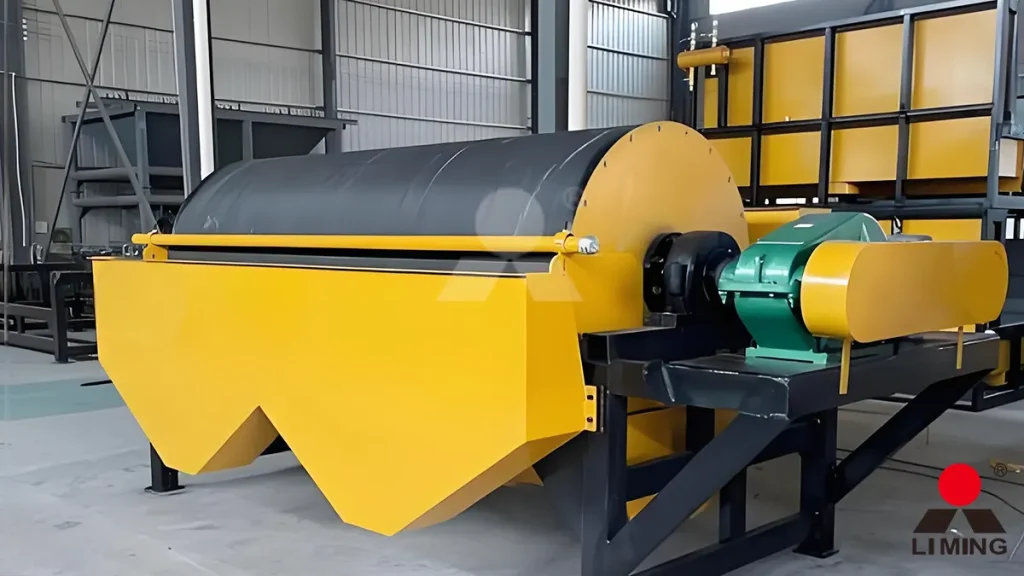
Once the pre-concentrated ore is ground inside the ball mill, the circuit transitions to wet separation. For strongly magnetic magnetite ore (Fe3O4), a wet drum magnetic separator (CTB series) operating at 1200-1500 Gauss is the required processing engine. However, the internal physics of the separator box dictate strict operational boundaries.
Hydrodynamic drag is the constant enemy of magnetic recovery.
To capture fine magnetite particles, the slurry density must be maintained strictly between 30% and 35% solids. If the pulp flow rate surges and fluid velocity across the stainless steel drum exceeds 1.5 m/s, the hydrodynamic force of the water overpowers the magnetic pull of the internal magnet array. Fine, fully liberated iron particles are swept past the magnetic field, flushing tons of high-grade magnetite directly into the tailings flume every shift.
Systemic performance requires aligning crushing reduction with multi-stage magnetic separation nodes.
| Beneficiation Node | Equipment Configuration | Capacity / Specs | Metallurgical Objective |
|---|---|---|---|
| Primary Extraction | C6X Jaw Crusher | 160 – 550 t/h | Gross reduction of raw blast ore |
| Dry Pre-Concentration | HPT Cone + Dry Mag Pulley | 2000 – 3000 Gauss | Discard 30% barren gangue before milling |
| Wet Primary Separation | CTB1030 Wet Drum Separator | 100 – 220 t/h | 11 kW | Extract rougher concentrate (Fe > 58%) |
Examine the CTB1030 specifications. Operating with an 11 kW motor, this drum processes up to 220 tons of slurry per hour. Its performance relies on a stable magnetic circuit and controlled pulp suspension within the tank trough.
Mineral Liberation and NdFeB Array Protection
Magnetic separation efficiency is geometrically bound to particle liberation. If your grinding circuit fails to fully break the physical bonds between magnetite crystals and surrounding silica, you create “middling” particles—grains containing both iron and quartz.
Middlings ruin final concentrate purity.
If closed-circuit hydrocyclones fail to deliver a slurry pulverized to a strict -200 mesh (>80% passing) profile, these locked silica-magnetite middlings will be pulled onto the drum by the magnetic field. This contaminates the concentrate, depressing the iron grade below the mandatory 65% Fe market compliance threshold. The grinding and classification stage must be locked in a precise closed loop with the wet separators.
Field Note: I audited an iron ore beneficiation line where the concentrate grade unexpectedly plummeted to 58% Fe. The operator blamed the magnetic separator. Forensic testing revealed the hydrocyclone apex was worn, allowing coarse +100 mesh unliberated quartz to bypass the mill and drag down the magnetic recovery grade.
Furthermore, processing highly abrasive slurry causes severe mechanical wear on the drum shell. Tier-1 plant design dictates 304 stainless steel drum shells vulcanized with a 3mm seamless wear-resistant rubber layer. This rubber coating prevents slurry scouring from wearing through the steel casing, physically isolating the internal Neodymium-Iron-Boron (NdFeB) permanent magnet array from water infiltration and severe thermal demagnetization.
Magnetite Beneficiation Node: Kinetic & Magnetic Thresholds
- Dry Cobbing Efficiency: 25-30% waste rock discarded post-cone crusher
- Grinding Liberation Target: -200 mesh (>80% passing via hydrocyclone)
- Wet Drum Slurry Density: Maintained at 30-35% solids
- Maximum Slurry Velocity: Restricted to <1.5 m/s across the drum face
- Magnet Array Integrity: NdFeB permanent magnets rated for >10 years stability
Slurry Velocity & Tailings Hemorrhage Verdict
Skipping dry magnetic cobbing after secondary crushing forces your ball mill to grind 100% of the extracted rock. Up to 30% of this rock is non-magnetic gangue that could have been discarded by a simple magnetic pulley. You waste power, accelerate liner wear, and create a permanent mass balance bottleneck.
Low concentrate grade is rarely a failure of the magnetic separator itself. It indicates incomplete mineral liberation. If hydrocyclones allow coarse middling particles (+100 mesh) into the wet drum, the attached silica is pulled along with the iron, diluting the final concentrate grade.
Abrasive slurry eventually wears through bare stainless steel drums. Once water penetrates the drum casing, it oxidizes the internal Neodymium-Iron-Boron (NdFeB) magnet blocks, causing rapid demagnetization. Seamless 3mm rubber vulcanization isolates the shell from abrasive wear and moisture ingress.
Enforce Closed-Circuit Magnetic Separation Immediately
An efficient iron ore beneficiation plant is governed by strict physical parameters. You cannot treat a wet drum separator as a standalone filter box; it must function as part of an integrated, closed-circuit architecture. Skipping dry magnetic cobbing wastes precious mill grinding capacity, while ignoring slurry density control guarantees heavy iron losses to your tailings pond. By combining primary jaw reduction, secondary cone crushing with dry cobbing, precise hydrocyclone classification, and rubber-armored wet drum separators, you secure a continuous 65% Fe concentrate grade and protect your plant from catastrophic mass balance deficits.
Calibrate your pulp velocity, protect your magnet arrays, and lock in your recovery rates today.
Related Articles
