Why a Mobile Impact Crusher is Your Best Bet for Demolition Waste Recycling
July 9, 2026
Summary:Written from the perspective of Dave, a seasoned heavy equipment specialist, this article tackles the core dilemma contractors face on demolition sites: effectively processing reinforced concrete. By weaving in real machinery specs—specifically highlighting heavy-duty tracked impactors like the 45-ton Vertex VTI1415 and the compact VTI1313—the guide explains why impact crushers outperform jaws in handling rebar and producing cubic aggregate. It covers the logistical benefits of tracked mobility on urban sites and provides actionable advice on wear parts maintenance.
If you’ve ever stared down a mountain of tangled rebar and chunky concrete from a freshly dropped parking garage, you know exactly the headache I’m talking about. Processing construction and demolition (C&D) waste isn’t just about smashing rocks; it’s about untangling a nasty mess of steel and stone without tearing your machinery apart in the process.
Over my 15 years setting up plants across North America—from tight urban teardowns in downtown Boston to sprawling plant demolitions out in Texas—I’ve seen contractors make the same expensive mistake. They bring a standard rock crusher to a demo site.
When clients ask me how to turn that pile of liability into profitable, reusable material, my answer is dead simple. You need a dedicated mobile impact crusher for demolition waste recycling. Let’s talk numbers, specs, and why this is the only way to go from a mechanical standpoint.
Jaw vs. Impactor: Stop Making Concrete Pancakes
A lot of old-school guys default to a jaw crusher. I get it. Jaws are simple, and they chew through granite like nobody’s business. But demolition waste isn’t quarry rock. It’s a hybrid beast.
Feed a slab of reinforced concrete into a jaw, and it just compresses the concrete around the rebar. Worse, those flat slabs slip right through the bottom gap intact, giving you useless “pancakes” instead of aggregate. If a long piece of rebar gets hooked on the toggle plate? You’re looking at an hour of downtime and a guy with a cutting torch risking his fingers.
An impact crusher (specifically built around a heavy-duty chamber like the CI5X series) uses heavy blow bars spinning on a massive rotor. This explosive impact literally shatters the concrete, stripping it clean off the steel. More importantly, it creates a perfectly cubic-shaped aggregate. If you want to meet state DOT specs to sell that recycled stuff as premium road base, you need that cubic shape for compaction. A jaw won’t do that.
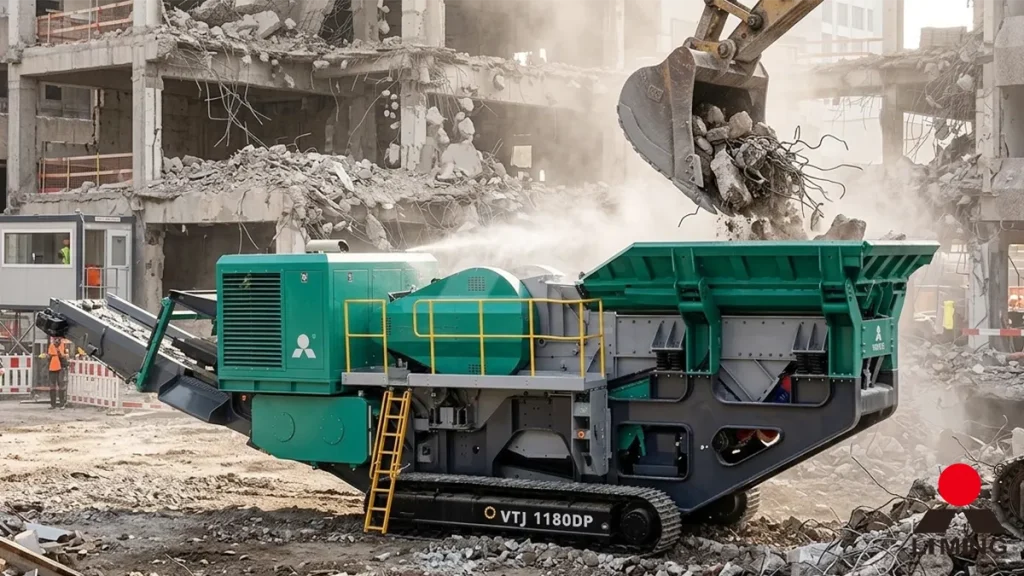
Let’s Talk Real Specs: Tracked Mobility & Iron Management
Geography and logistics dictate your profit margins. Hauling raw demo waste across a city is burning diesel and cash, especially with tipping fees skyrocketing in places like California. You need tracked mobility.
When guys ask me for specific machine recommendations, I usually point them toward serious tracked rigs like the Vertex series. If you are dealing with massive highway tear-outs or heavy industrial demo, look at something like the Vertex VTI1415. You’re looking at a 45-ton beast pushing 250 kW of power. Because it has a massive 900mm maximum feed opening, your excavator operator doesn’t have to spend hours breaking down slabs with a hammer first. You just feed it, and it spits out 260 to 330 tons of clean aggregate per hour.
Now, if you’re working on a tighter footprint—say, an old brick-and-concrete apartment block in a crowded city lot—you might want to step down to the Vertex VTI1313. It’s got a smaller 38-ton footprint and an 800mm feed, but it still comfortably pushes 180 to 240 tons an hour running on a 180 kW diesel setup.
Dealing with the Iron: The Overband Magnet
You can’t run a mobile impact crusher for demolition waste recycling without talking about tramp iron. Because the impactor shatters the concrete, the steel comes out loose.
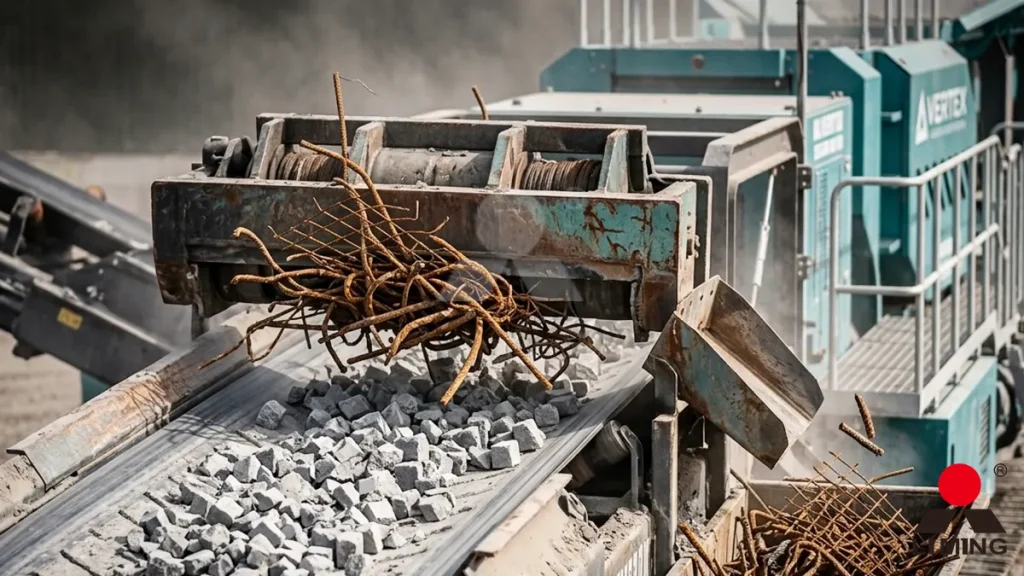
Every proper recycling unit comes with an overband magnetic separator suspended right above the main discharge conveyor. The magnet snatches that twisted rebar right out of the flow and spits it off into a side pile. Instead of paying landfill fees for concrete loaded with hidden steel, you now have a pile of clean scrap metal to sell to the local yard. Nine times out of ten, that scrap check pays for the machine’s diesel for the week.
A Quick Word on Wear Parts
I wouldn’t be a good mechanic if I didn’t give you a reality check. Impact crushers do have higher wear rates than jaws. Those blow bars inside the rotor take a serious beating, especially if you’re crushing highly abrasive materials.
My advice? Keep a spare set of blow bars in your service truck. Inspect them daily, and learn how to flip them before they wear down to the rotor base. If you damage the rotor on a big CI5X chamber, you’re going to have a very bad, very expensive week. Control your feed rate, don’t let your excavator dump blindly, and keep your belts tensioned.
The Bottom Line
Equipment selection comes down to the material in front of you and the product you need to sell. If your site is loaded with reinforced concrete and you want to walk away with salable, cubic road base while eliminating haulage fees, a tracked mobile impactor is the smartest financial decision you can make.
Match the machine’s feed opening to your primary rubble size, keep an eye on your wear parts, and stay safe out there.
