Mobile rock crusher in vietnamese
June 29, 2026
Summary:Forcing sprawling stationary plants into the narrow valleys of Vietnam is an architectural absurdity. You must adapt your extraction geometry to the topography. Deploying an NK series mobile rock crusher eliminates civil engineering excavation, utilizing hydraulic support legs to compress the spatial footprint by 60%. Whether extracting 200MPa basalt in the Central Highlands or processing limestone for the North-South Expressway, survival dictates a strict closed-circuit mobile matrix to guarantee mass balance and absolute geometric compliance.
Deconstructing Spatial Constraints in Mobile rock crusher in vietnamese Deployments
I am constantly forced to audit and dismantle failed quarry designs in Vietnam because amateur contractors attempt to force flat-land logic into extreme vertical topography. The narrow, steep valleys of Northern Vietnam and the Central Highlands do not possess the flat acreage required for a sprawling stationary plant. Attempting to blast a massive footprint out of the mountainside just to pour a concrete foundation destroys your circuit amortization cycle before you crush a single rock. Extraction in Vietnam is an exercise in extreme spatial compression. The absolute architectural mandate is a highly integrated mobile rock crusher matrix, capable of executing a strict closed-circuit mass balance within a deeply confined operational radius.
Topographical Strangulation and the Mobile Mandate
You cannot pour a 400-cubic-meter foundation on a 30-degree mountain incline.
Deploying a traditional stationary crushing plant in the narrow valleys of Lang Son or the Central Highlands requires massive explosive excavation just to clear a foundation pad. You are literally moving mountains to accommodate the machine, rather than forcing the machine to adapt to the mountain. This induces a massive, unrecoverable capital bleed.
The architecture dictates a pneumatic tire-mounted mobile chassis.
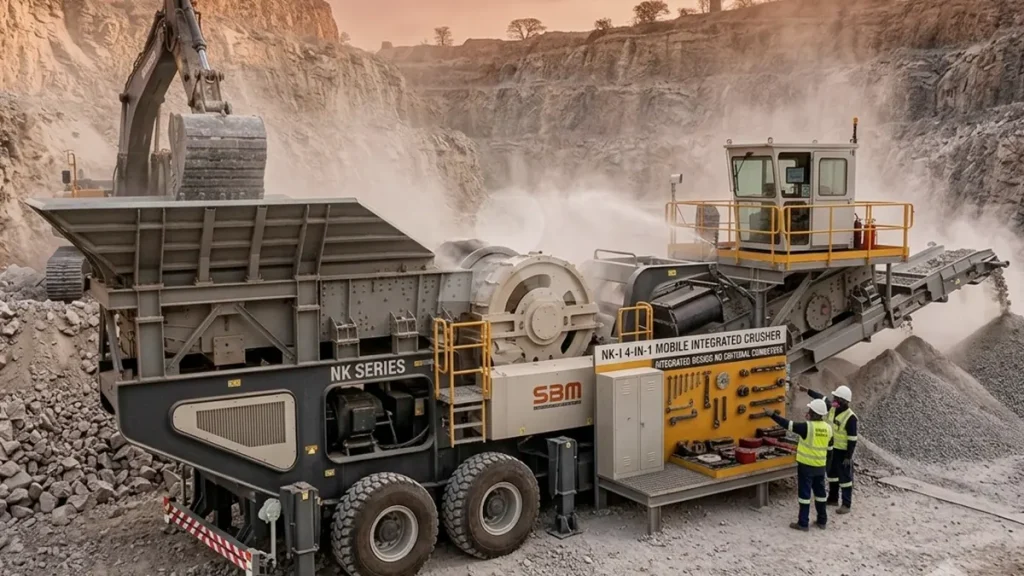
An NK series mobile crusher does not require civil engineering. It is towed into the valley. Once positioned, heavy-duty hydraulic support legs are deployed directly onto the uneven, unpaved terrain. This lifts the tires off the ground, anchoring the 250kW kinetic vibration directly into the bedrock. This engineering severely compresses the spatial footprint by 60%, allowing high-tonnage extraction to occur in ravines where a stationary plant physically cannot fit.
Geological Division: Basalt vs. Limestone Architectures
Once you have conquered the topography, you must conform to the geology. Vietnam presents a stark geological divide: the extremely hard, 200MPa basalt of the Central Highlands (Tây Nguyên) versus the softer, high-volume limestone required for the North-South Expressway projects. Deploying the same mobile chassis for both is an architectural fatal flaw.
Field Note: I audited a site in Dak Lak where the operator deployed a single-chassis impactor to process Central Highlands basalt. The 85% silica content vaporized the blow bars in exactly 48 hours. The abrasive friction destroyed their expenditure per shift and paralyzed the operation.
For 200MPa basalt, the architecture strictly mandates a two-stage mobile matrix: a primary C6X jaw chassis feeding directly into a secondary HPT cone chassis. This enforces abrasive survival through lamination crushing. Conversely, for medium-soft limestone extraction supporting highway infrastructure, space is the ultimate premium. Deploying a fragmented setup introduces excessive conveyor belting. Here, the mandate is a 4-in-1 portable impact plant (like the NK1213C). It centralizes the feeder, impactor, screen, and return conveyor onto one chassis, executing a strict mass balance within a 15-meter radius.
Mobile architecture must rigidly align with the compressive strength of the target geology.
| Target Geology | Mandatory Mobile Architecture | Kinetic Mechanism | Spatial Footprint |
|---|---|---|---|
| Central Highlands Basalt (>200MPa) | Dual-Chassis: NK Jaw + NK Cone | Lamination (High Pressure) | Linear, Two-Node Matrix |
| Northern Limestone (<150MPa) | Single-Chassis: NK1213C Impactor | Kinetic Cleavage (High Speed) | Ultra-Compact (4-in-1) |
| River Pebbles (High Silica) | Tri-Chassis: Jaw + Cone + VSI | Rock-on-Rock Autogenous | Extended Shaping Circuit |
Analyze the Single-Chassis NK1213C. By integrating the entire extraction, reduction, and screening process onto one frame, the architect eliminates the need for independent transfer conveyors, which are highly susceptible to tracking misalignment on uneven valley floors.
Closed-Circuit Screening and Zero-Waste Mass Flow
Open-circuit mobile crushing guarantees geometric failure at the discharge belt. You cannot simply push rock through a crusher and hope it meets the strict gradation curves required for Vietnamese civil engineering. If oversized rock reaches the final stockpile, the batch is rejected.
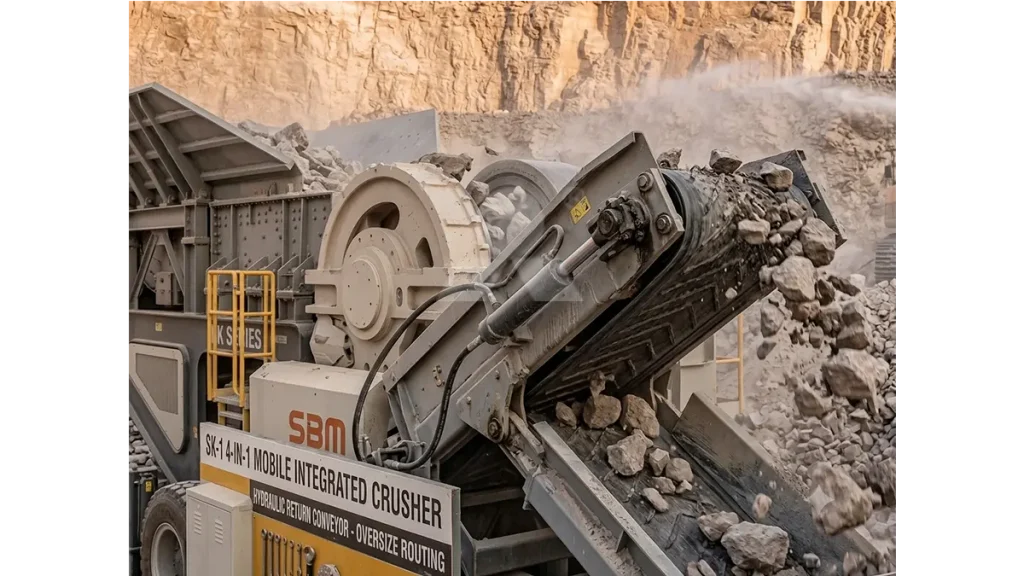
To secure your production-to-yield ratio, the mobile architecture must integrate an onboard S5X vibrating screen.
This creates a strict closed-circuit loop. Any oversized aggregate (+40mm) that fails to pass the screen mesh is physically trapped. It is then routed via a hydraulic folding return conveyor directly back into the crusher’s feed opening. The rock is forced to undergo continuous reduction until it submits to the required dimensions. This closed loop ensures absolute zero-waste extraction, maximizing the kinetic yield velocity of the mobile asset.
NK1213C Confined Operation: Spatial & Kinetic Metrics
- Sustained Tonnage: 150-240 tph continuous closed-circuit flow
- Kinetic Engine: 228.5 kW integrated impactor drive
- Spatial Footprint: 60% reduction vs. fragmented stationary setups
- Foundation Amortization: 0 days; deployed via hydraulic legs
- Gradation Control: 100% onboard oversize return loop
Valley Topography & Closed-Circuit Choke Verdict
Narrow valleys lack the acreage for sprawling conveyor networks. Excavating a flat pad out of a mountain is a massive, unrecoverable fiscal bleed. A mobile crusher adapts to the terrain, utilizing hydraulic legs to stabilize the chassis on uneven ground, allowing high-tonnage extraction in highly confined ravines.
The Central Highlands are dominated by 200MPa high-silica basalt. Deploying a single-chassis impactor here vaporizes the steel blow bars in 48 hours due to extreme abrasive friction. This geology strictly mandates a dual-chassis Jaw-to-Cone mobile matrix to survive through lamination crushing.
An open-circuit setup allows uncrushed, oversized rock to contaminate the final stockpile, triggering immediate rejection by highway inspectors. A true mobile architecture must feature an onboard vibrating screen and a return conveyor to physically force oversized rock back into the crusher.
Using separate mobile units connected by long transfer conveyors on uneven ground guarantees tracking issues. The belts will wander and tear. A 4-in-1 integrated chassis locks the geometry of the entire mass flow, eliminating external transfer points and stabilizing the circuit.
Enforce Spatial and Geological Discipline
You cannot fight the topography of a Vietnamese valley, nor can you negotiate with the hardness of Central Highlands basalt. If you attempt to force a sprawling stationary plant into a ravine, or deploy an impactor against high-silica rock next month, the resulting spatial strangulation and wear-part destruction will permanently terminate your operation. The architecture demands strict compliance: deploy pneumatic mobile chassis to eliminate civil engineering, match your crushing kinetic mechanism to the geology, and enforce an absolute onboard closed-circuit return loop.
