Basalt Crushing Processing Flow Chart
April 28, 2026
Summary:Processing 220 MPa basalt dictates a ruthless mechanical flow chart. Amateurs vaporize capital by feeding volcanic rock into impact crushers. This diagnostic exposes the mandatory transition from C6X primary compression to HST cone loops and VSI rock-on-rock shaping to survive extreme silica abrasion without shattering frames or melting blow bars.
During a November 2025 flowsheet audit of a commercial quarry in West Java, Indonesia, the operator was hemorrhaging capital. They attempted to feed 220 MPa basalt into a legacy primary jaw. The kinetic recoil literally sheared the 40mm mounting bolts and micro-fractured the cast iron frame within a single month of operation. Basalt does not yield; it transfers kinetic shock directly into your foundation. We re-engineered the primary stage, immediately deploying the C6X125 Jaw Crusher. Operating at a heavy 160 kW load, its heavy cast-steel frame absorbed the extreme kinetic shock of 800mm basalt boulders. This enforced mass balance stabilized the primary feed without foundation degradation or catastrophic eccentric shaft failure.
Silica Friction and the Impactor Catastrophe
Feeding volcanic rock into a high-speed impactor is an intentional act of financial sabotage.
The West Java basalt deposit possessed a notoriously high silica content of 58%. The original flow chart included a European secondary impact crusher because the operator wanted to “save on the upfront equipment price.” The mechanical physics were unforgiving. The kinetic friction melted their high-chrome blow bars into useless, glowing scrap in exactly 18 hours. The abrasive nature of silica acts like a grinding wheel against steel rotating at 600 RPM. Your expenditure per shift will instantly eclipse any initial capital savings.
We ripped the impactor out of the circuit entirely. For basalt, you fight hardness with compression, not impact. We deployed an HST315 single-cylinder cone crusher. By utilizing inter-particle compression and hydrostatic tramp-iron protection, the abrasive basalt fractures against itself inside the crushing chamber. This strict adherence to compressive physics extended the manganese mantle life by 400%, restoring the operation’s capital payback velocity.
Choking the Loop: Recirculating Load Bottlenecks
Pushing 350 tph of crushed basalt creates a massive bottleneck at the grading stage. Compression crushers naturally produce elongated splinters. These splinters immediately pegged the single-deck screens, blinding the mesh. The recirculating load pushed past 35%, forcing the uncrushed material back into the secondary cone. The internal hydraulic pressure spiked, thermally overloading the HST315.
To arrest this, we installed dual S5X2460-3 vibrating screens in parallel. By splitting the feed, we thinned the material bed. We adjusted the inclination angle to exactly 18 degrees and utilized high-amplitude stroke dynamics to aggressively stratify the heavy basalt. This mechanical calibration locked the recirculating load strictly under 15%, preventing the cone from choking on its own bypass material.
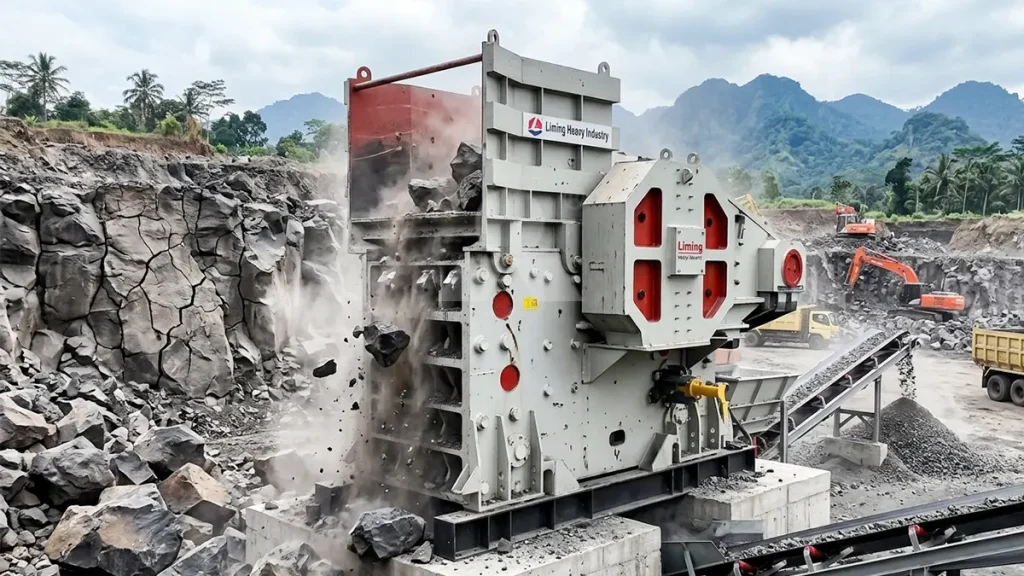
To sustain commercial-grade basalt production, the mechanical capacities of the compression and shaping stages must be flawlessly synchronized. The matrix below dictates the baseline engineering.
If your primary jaw outpaces your secondary cone, the surge will trigger hydraulic bypass alarms and stall the 315 kW motor.
| Process Stage | Recommended Model | Capacity (tons per hour) | Power (kilowatts) | Kinematic Function |
|---|---|---|---|---|
| Primary Shock Absorption | C6X125 Jaw | 230-760 | 160 | Heavy Compression |
| Secondary Reduction | HST315 Cone | 170-1050 | 315 | Inter-Particle Compression |
| Parallel Grading | S5X2460-3 (Dual) | 100-800 | 30 x 2 | High-Amplitude Stratification |
| Tertiary Flakiness Removal | VSI6X1150 Sand Maker | 344-663 | 250 | Rock-on-Rock Attrition |
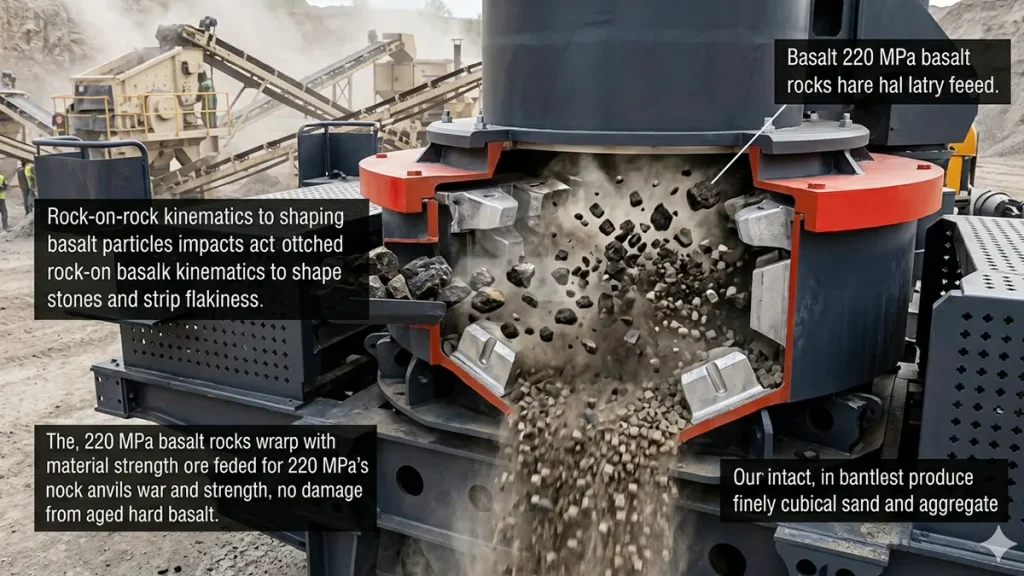
Because basalt shears under cone compression, the HST output had a flakiness index of 14%—instantly failing highway asphalt specifications. We routed the 5-20mm fractions into a VSI6X1150 Sand Maker. Operating at 250 kW, we strictly bypassed the metallic anvils and used ‘rock-on-rock’ kinematics. The abrasive basalt abraded its own jagged edges mid-air in the crushing chamber, dropping the flakiness below 6% without touching a single piece of steel.
Silica Hemorrhage & Mantle Seizure Analysis
- Why does 220 MPa basalt melt secondary impactor blow bars?
- Look at the silica friction coefficient. When a high-chrome blow bar strikes 58% silica rock at 600 RPM, it generates microscopic plasma arcs. The heat destroys the metallurgical temper of the steel, turning hardened metal into soft clay that simply grinds away in hours.
- How did operators survive basalt kinetic shock ten years ago?
- Ten years ago, operators poured 300 cubic meters of extra concrete to anchor standard jaws, and the frames still cracked. The C6X design shifted the absorption from the foundation to the heavy cast-steel frame itself, isolating the kinetic recoil.
- What happens if the recirculating load into the HST315 exceeds 35%?
- Do not ignore screen blinding. If bypass material floods back into the cone, it eliminates the internal void space required for rock-on-rock compression. The internal hydraulic pressure spikes, the bronze bushings overheat, and the main shaft seizes completely, stalling the 315 kW motor.
- Why is VSI rock-on-rock shaping mandatory for highway asphalt?
- When you crush basalt in a cone, it inherently shears into flat splinters. Asphalt plants will reject 14% flakiness because the splinters break under tire load. The VSI uses kinetic air collision to abrade the weak edges off the stone, mechanically forcing cubicality without touching steel anvils.
Arresting Catastrophic Wear in Volcanic Circuits
The mechanical reality of processing basalt is a zero-tolerance war against silica abrasion and kinetic shock. If you attempt to process 220 MPa volcanic rock using secondary impact crushers, the silica friction will literally vaporize your blow bars, driving your expenditure per shift into immediate bankruptcy. Bypassing tertiary VSI rock-on-rock shaping ensures your aggregates retain a 14% flakiness index, guaranteeing rejection by every commercial asphalt plant. Synchronizing your heavy C6X primary compression with rigorous HST hydrostatic cone loops and dual S5X grading is the only non-negotiable operational boundary. If you do not lock your recirculating load below 15% and enforce strict compressive physics, your entire flow chart will face total mechanical seizure before the end of the month.
Stop Guessing on Silica Abrasion Rates
“If you feed basalt into an impactor, you are intentionally destroying your capital. Synchronize your cone compression now.” — From the Desk of your Solution Architect
Audit Basalt Circuit Payback Velocity