Cone Crusher Vs VSI Sand Maker Yield And Shape Comparison
November 10, 2026
Summary:When designing a manufactured sand plant, selecting between a Cone Crusher and a Vertical Shaft Impactor (VSI) dictates the final sand yield and operating expenses. This engineering guide details a cone crusher vs VSI sand maker yield and shape comparison. Written by a senior process engineer, the article explains the difference between the compressive lamination crushing of Liming Heavy Industry's HPT Cone Crusher and the high-velocity kinetic impact of the VSI6X Sand Maker, guiding aggregate producers in matching equipment to rock hardness.
Aggregate plant owners frequently ask me a critical question: “When building a manufactured sand production line, should I choose a cone crusher or a vertical shaft impactor (VSI)?” Some operators swear by the stable yield of a cone crusher, while others insist on the massive throughput of a VSI. From an engineering standpoint, both arguments hold merit under specific geological conditions. Today, bypassing the marketing jargon, we will break down the mechanical realities of both machines to clarify exactly which crusher delivers a higher sand yield and a better return on your capital investment.
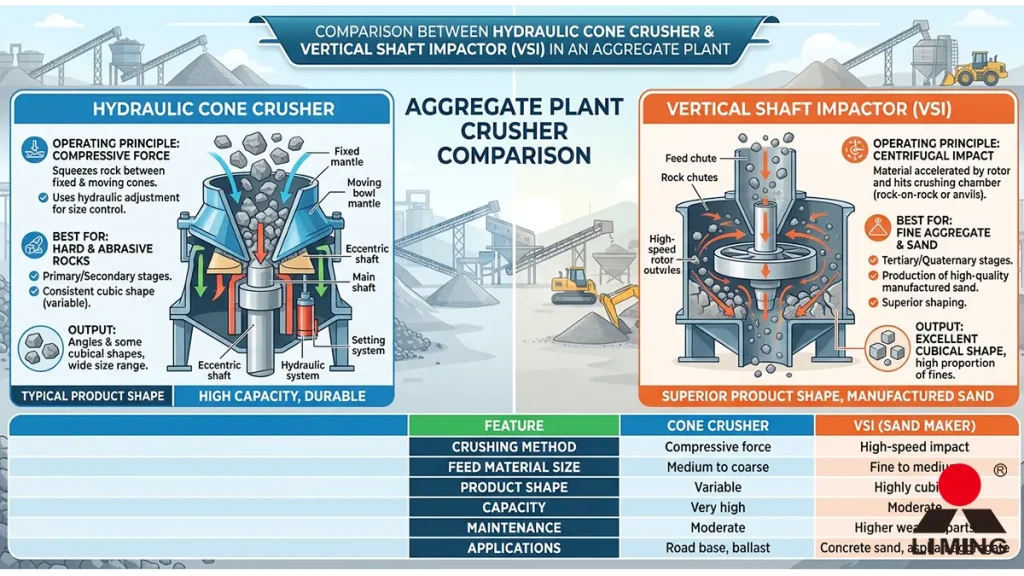
I. Different Crushing Principles Mean Different Yield Metrics
1. The Lamination Principle of the Cone Crusher
The cone crusher, particularly advanced models like the HPT Series Multi-Cylinder Hydraulic Cone Crusher and the HST Series Single-Cylinder Cone Crusher from Liming Heavy Industry, operates on the “lamination crushing” principle. The rock particles are subjected to multi-directional compressive stress, forcing the stones to squeeze and grind against one another. Internal micro-fissures propagate strictly along natural crystalline boundaries.
Under this compressive action, the proportion of fine material (below 5 millimeters) is remarkably high, and the resulting particle shape closely resembles a natural cube with very few flat or elongated (needle-like) shards. This makes the finished product highly suitable for medium-to-high grade commercial concrete. In the industry, the sand yield for a cone crusher is typically measured by its “sub-5mm pass rate,” which, under a mature, choke-fed process flow, can stabilize above 60%.
2. The Kinetic Impact Principle of the VSI Sand Maker
The Vertical Shaft Impactor (VSI), such as the flagship VSI6X Series Sand Maker, relies entirely on high-velocity kinetic impact. Material is accelerated inside an impeller to extreme velocities (60 to 70 meters per second) and launched outward, crushing via “rock-on-rock” or “rock-on-anvil” collisions.
The finished sand from a VSI exhibits a wider continuous gradation curve and a relatively higher content of fine stone powder. The total volume of sand produced is massive, making the VSI the mandatory choice for operations demanding ultra-high capacity. For a VSI, the sand yield is generally measured under a “full center feeding” condition. The overall throughput capacity is incredibly broad, heavily dependent on the exact rotor speed, cavity mode, and initial feed size.
II. Hard Rock Sand Making: Stability Beats Peak Output
The harder the raw material, the faster the VSI impeller throw heads and perimeter guard plates wear down. As the internal components of an impactor wear out, the kinetic crushing efficiency drops, causing the sand yield to steadily decline over the course of a maintenance shift.
Conversely, because the cone crusher relies on lamination compression, the manganese steel mantles and bowl liners can sustain an operational lifespan of 1500 to 2000 hours. The extreme hardness of the rock exerts vastly less disruption on the cone crusher’s continuous sand yield.
Engineer’s Verdict: When processing highly abrasive hard rocks—such as granite, basalt, or diabase—the cone crusher guarantees a far more stable, predictable sand yield with lower daily operating expenses. However, for processing medium-to-low hardness materials—such as limestone or soft river pebbles—the VSI sand maker flawlessly balances a massive production yield with highly acceptable wear part costs.
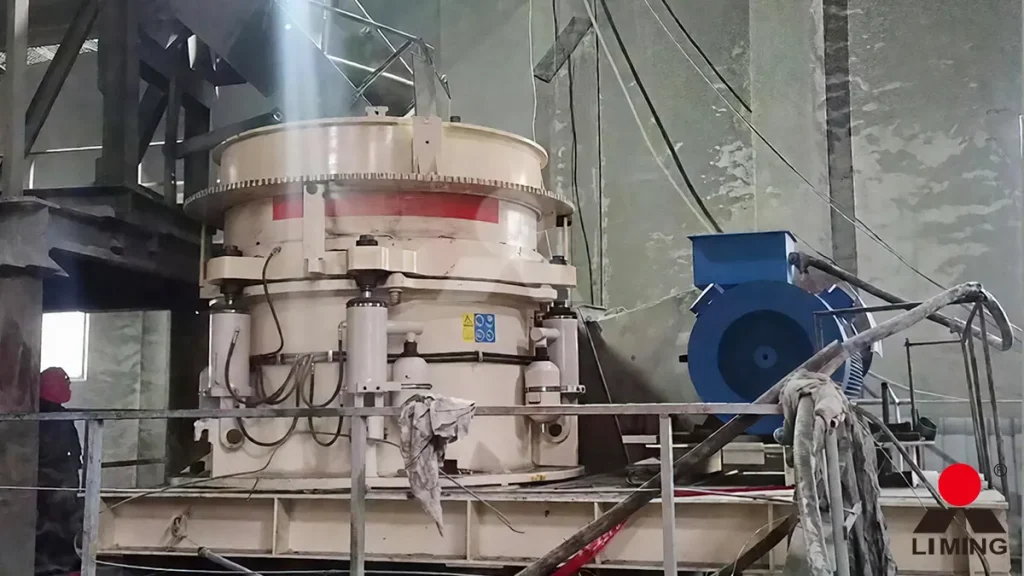
III. Differences in Particle Shape and Gradation
Because the sand exiting a cone crusher is essentially “squeezed” into existence, its particle shape mimics natural river sand perfectly. It boasts a high cubic percentage and a continuous gradation, allowing it to be used directly in commercial concrete mixing plants without issue.
The sand exiting a VSI sand maker is violently shattered, resulting in sharply angular, distinct edges. While this angular sand is perfect for dry-mix mortar applications, it often requires blending with other aggregates when utilized for pouring high-strength structural concrete.
Regarding the specific sand yield fraction: the finished product from a fine-cavity cone crusher is highly concentrated in the sub-5mm fine zone. The finished product from a VSI sand maker tends to skew slightly coarser, with a higher proportion of 5mm to 10mm coarse sand. If the end buyer strictly demands a high volume of pure fine sand, the cone crusher provides a more favorable metallurgical output.
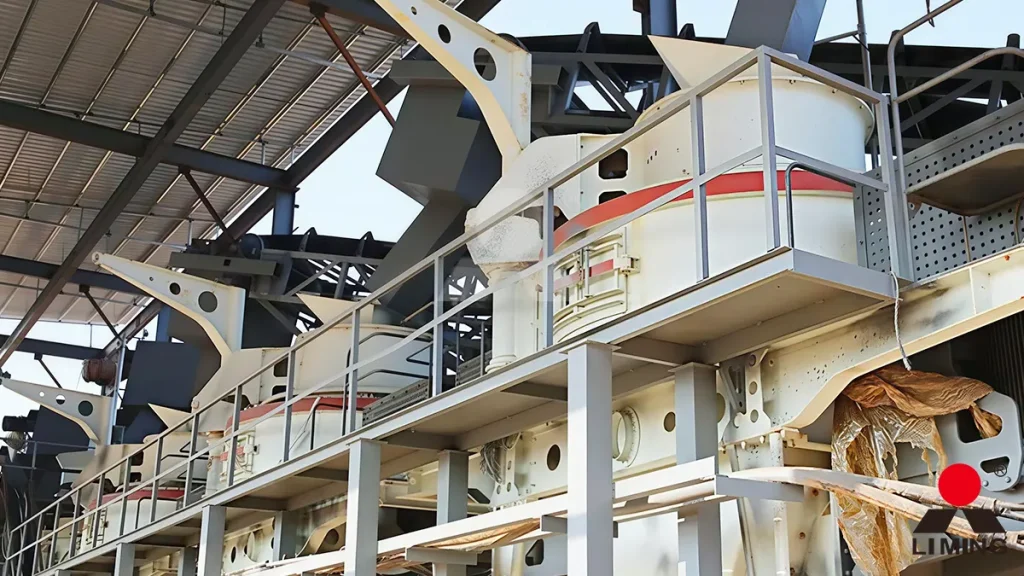
IV. Sand Yield Targets Dictate Operating Expenses
If an operator attempts to force a VSI sand maker to achieve a maximum sand yield by running it in the aggressive “rock-on-anvil” mode at peak rotor velocities, the electrical power draw will skyrocket (requiring dual heavy-duty motors). Simultaneously, the intense impact energy will rapidly destroy the throw heads and impact anvils, causing both electrical consumption and consumable wear costs to surge in tandem.
The cone crusher, relying primarily on lamination compression, operates at a much more moderate rotational speed. A heavy-duty cone crusher requires a significantly lower single-motor power draw. Because the manganese liners survive for 1500 to 2000 hours, the unit cost per ton of produced sand remains highly controllable, provided the operator prioritizes a stable yield over an absolute peak surge in capacity.
Conclusion
Ultimately, there is no absolute “standard answer” when choosing between a cone crusher and a VSI sand maker. The critical decision relies entirely on three engineering variables: the physical hardness of your raw material, the exact particle shape demanded by your buyers, and your budget for long-term daily operating expenses.
If you remain unsure about which configuration suits your quarry, we invite you to send your raw material samples and finished product specifications to the technical engineering team at Liming Heavy Industry. We will mathematically calculate the projected sand yield and comprehensive operating costs for both configurations, providing you with a precise, custom-engineered equipment layout.
