Should I Use An Impact Crusher Or Jaw Crusher For Limestone?
October 20, 2026
Summary:Processing limestone efficiently requires understanding that jaw crushers and impact crushers are not mutually exclusive alternatives; they perform completely different roles in a production line. This engineering guide details the optimal limestone crushing configuration. Written by a senior process engineer, the article explains how Liming Heavy Industry's PEW Jaw Crusher is mandatory for primary coarse reduction, while the CI5X Impact Crusher handles secondary reduction and particle shaping. This classic "Jaw + Impact" combination guarantees perfectly cubic commercial aggregate while minimizing initial capital investment.
When engineering a limestone crushing plant, selecting between an impact crusher and a jaw crusher is not an “either-or” decision. The selection is dictated entirely by the crushing stage. The primary stage requires a jaw crusher to engulf massive run-of-mine boulders, while the secondary stage utilizes an impact crusher to guarantee a perfectly cubic aggregate particle shape. How these two machines divide the workload in a production line will become absolutely clear through the following technical comparison.
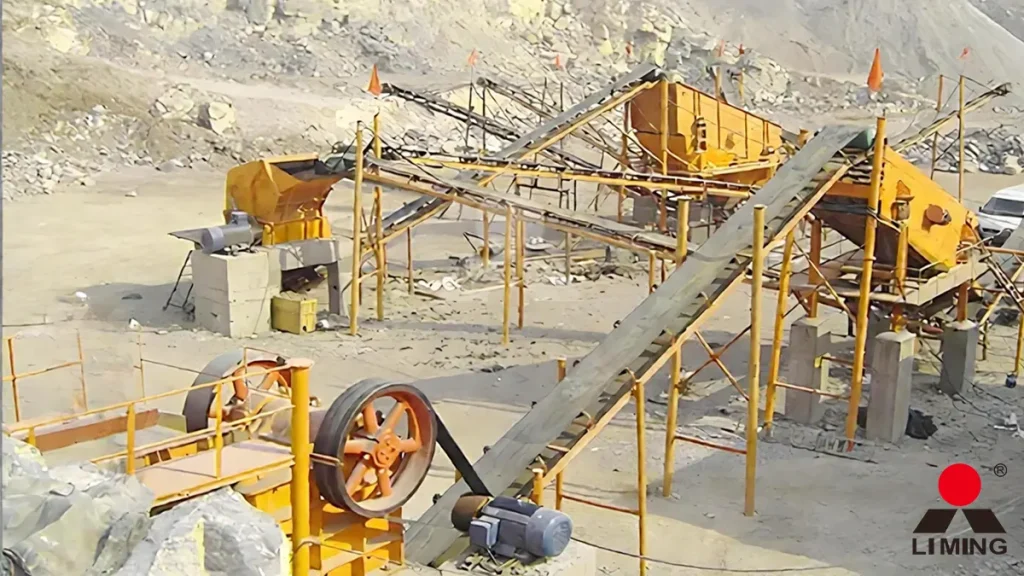
I. The Jaw Crusher Manages Primary Reduction: Massive Feed and Throughput
Run-of-mine limestone extracted directly from the quarry features exceptionally large block sizes. Therefore, the primary crushing equipment must possess an immense feed opening and the physical capability to swallow these boulders without stalling. The jaw crusher utilizes a compressive crushing mechanism. Featuring a deep crushing cavity with absolutely no dead zones, it provides massive volumetric processing capacity.
Advanced equipment, such as the PEW Series European Jaw Crusher from Liming Heavy Industry, can accept a maximum feed size of up to 1100 millimeters, delivering a continuous processing capacity of 50 to 1200 tons per hour. It easily handles any material with a compressive strength up to 320 megapascals. The optimized deep-cavity design ensures that a single machine can achieve up to a 30% reduction in electrical power consumption. The discharge opening is rapidly adjusted via a hydraulic wedge system (ranging from 60 to 300 millimeters), allowing operators to set the exact output size required to feed the secondary crushing equipment.
II. The Impact Crusher Manages Secondary Reduction: High Ratio and Final Shaping
Limestone typically exhibits medium to low hardness, placing it perfectly within the ideal operational zone of an impact crusher. Modern impactors, such as the CI5X Series Impact Crusher, handle feed sizes up to 800 millimeters and deliver processing capacities ranging from 60 to 2000 tons per hour.
The impact crusher boasts an incredibly large reduction ratio and produces an exceptionally uniform product size. It is capable of taking the intermediate gravel discharged from the jaw crusher and reducing it to the final commercial specifications in a single pass. This effectively eliminates unnecessary tertiary crushing stages, thereby saving massive amounts of initial capital expenditure. The combination of a primary jaw crusher and a secondary impact crusher remains the undisputed standard flowsheet for the vast majority of commercial limestone production lines.
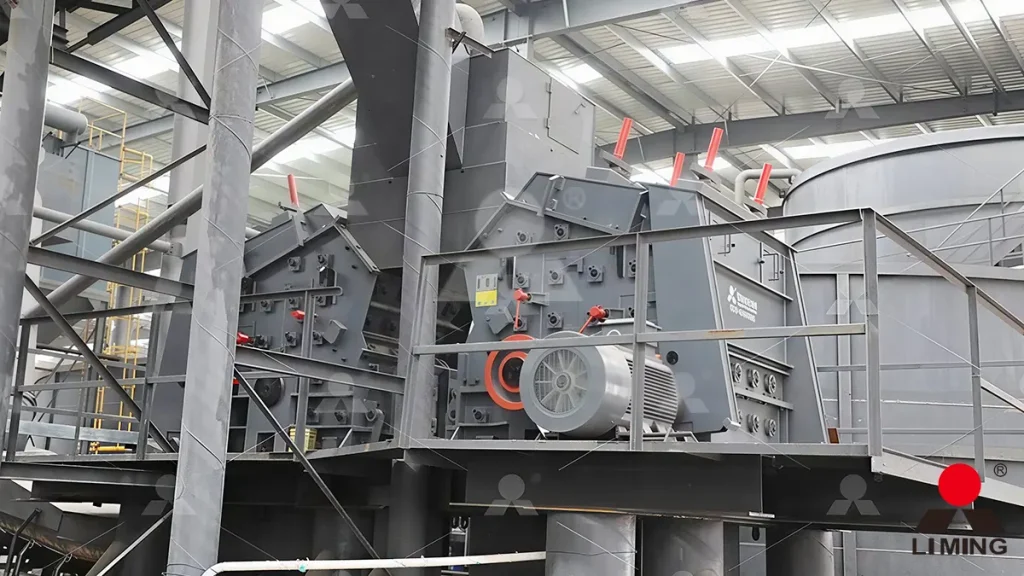
III. Particle Shape and Rock Powder: Balancing Based on Downstream Application
Once the primary jaw crusher is installed, the critical engineering decision centers on the secondary (and potentially tertiary) crushing stations. In a standard limestone line, the impact crusher is overwhelmingly favored for the secondary stage. Because it shapes the rock using kinetic impact, the resulting aggregate is perfectly cubic with minimal flat or elongated (needle-like) particles. This flawlessly satisfies the strict geometrical standards required for commercial concrete and high-speed highway surface layers.
However, because the impact shaping action is so aggressive, it inherently generates a higher volume of fine rock powder. While this is a welcome bonus if the plant is simultaneously producing manufactured sand, it requires engineers to add extra screening decks or advanced dust collection systems if the aggregate is destined strictly for asphalt mixing plants.
If the limestone deposit contains unusually hard, high-silica intrusions, or if the plant management strictly prioritizes long-term operating expenses, engineers can pivot to a multi-cylinder hydraulic cone crusher, such as the HPT Series Cone Crusher. The cone crusher also produces highly cubic aggregate via lamination crushing, but it generates significantly less rock powder. Furthermore, the HPT series features backing-compound-free liners, ensuring a highly stable and predictable wear part replacement cycle. Both the impact and cone routes produce aggregate shapes that pass rigorous roadbed filling standards; the core selection criteria ultimately depend on the acceptable powder volume and the layout of the downstream screening circuit.
IV. Common Limestone Production Line Configurations
For a limestone production line demanding 200 to 300 tons per hour, the standard configuration consists of a PEW Jaw Crusher for primary reduction, followed by a CI5X Impact Crusher for secondary reduction, feeding into a closed-circuit vibrating screen loop where oversized material is returned for re-crushing. For massive production lines exceeding these capacities, the primary jaw crusher can be upgraded to a Gyratory Crusher to maximize throughput, while the secondary stage utilizes massive impact or cone crushers.
There is a critical engineering detail frequently overlooked on site: in a closed-circuit loop, the oversized material retained on the top screen deck is routed back to the secondary crusher. This recirculating load directly consumes the secondary crusher’s processing capacity. When configuring the plant, engineers must calculate a 10% to 20% capacity safety margin for the secondary machine based on the primary commercial output sizes. If this margin is ignored, the recirculating load will overwhelm the secondary crusher, completely bottlenecking the entire production line.
Table 1: Primary vs. Secondary Limestone Crushing Equipment Comparison
| Comparison Parameter | PEW Series Jaw Crusher | CI5X Series Impact Crusher |
|---|---|---|
| Standard Position | Primary Coarse Reduction | Secondary Medium/Fine Crushing & Shaping |
| Maximum Feed Size | ≤ 1100 mm | ≤ 800 mm |
| Production Capacity | 50 – 1200 Tons Per Hour | 60 – 2000 Tons Per Hour |
| Discharge Adjustment | Hydraulic Wedge (60 – 300 mm) | Hydraulic Clearance (Impact plate to rotor) |
| Finished Particle Shape | Average, higher percentage of flat/elongated particles | Highly cubic, minimal flakiness |
| Rock Powder Yield | Relatively low | Relatively high (acceptable in manufactured sand lines) |
| Primary Wear Parts | Manganese Jaw Plates | High-Chrome Blow Bars, Impact Plates |
Frequently Asked Questions (FAQ)
1. Can a limestone production line operate using only a single impact crusher?
This depends entirely on the size of the raw blasted boulders. Run-of-mine limestone extracted from a quarry frequently exceeds 500 millimeters in diameter. Feeding boulders of this size directly into a standard impact crusher exceeds its maximum feed limit and will cause catastrophic mechanical failure. Therefore, the primary jaw crusher is mandatory. A single impact crusher can only be used if the raw material has already been pre-crushed or is naturally small enough to meet the feed size limits.
2. How should a 300 TPH limestone production line be configured?
A highly mature and proven engineering configuration utilizes a PEW Jaw Crusher for the primary stage, a CI5X Impact Crusher for the secondary stage, followed by an S5X Vibrating Screen in a closed-circuit loop. The specific machine models must be selected based on your raw boulder size and required finished product specifications. We recommend sending your operational data to the technical engineering team at Liming Heavy Industry for a precise capacity calculation and customized plant layout.
