Stone crusher machine price in ethiopia
June 16, 2026
Summary:Hyper-focusing on the initial sticker price of crushing equipment in Ethiopia is a fatal procurement liability. A cheap impactor deployed on 200MPa basalt vaporizes wear parts instantly. Due to severe foreign exchange shortages, waiting for LC approvals to import replacement steel will paralyze your quarry for months. To accelerate capital payback velocity, operators must invest in HPT cone crushers that utilize rock-on-rock lamination, drastically extending wear life and stopping the daily forex bleed.
Mitigating Forex Bleed in Stone crusher machine price in ethiopia Assessments
I routinely audit the financial collapse of quarry operations in Oromia and Addis Ababa because local buyers fell for the illusion of a low FOB price. Procuring heavy machinery for the Ethiopian market is not a standard transaction; it is an exercise in extreme financial defense. When evaluating extraction equipment, the sticker price is irrelevant compared to the brutal reality of inland logistics, unstable power grids, and the country’s severe foreign exchange shortages. If you buy a cheap, high-wear machine to process 200MPa basalt, the resulting parts consumption will force you into an agonizing 6-month wait for LC (Letter of Credit) approvals, permanently terminating your capital payback velocity.
The Djibouti Logistics Trap
A cheap machine destroys your budget before it even touches rock.
Focusing solely on the initial factory price is a fatal fiscal error. The true procurement liability begins the moment the cargo hits the Port of Djibouti. Inland transport from Djibouti to the Ethiopian highlands is notoriously complex and expensive. If you purchase a cheap, un-modularized crusher with an oversized, welded static frame, you are forcing your logistics team to hire specialized heavy-haul transport.
This massive logistical amortization erases any savings you made at the factory.
A strategic investment requires a modular architecture. Machines designed to break down and fit perfectly into standard 40HQ shipping containers drastically reduce trans-oceanic freight costs and completely eliminate the need for specialized inland trucking. The asset reaches the blast face faster, cheaper, and ready for immediate deployment.
Forex Hemorrhage and the Basalt Reality
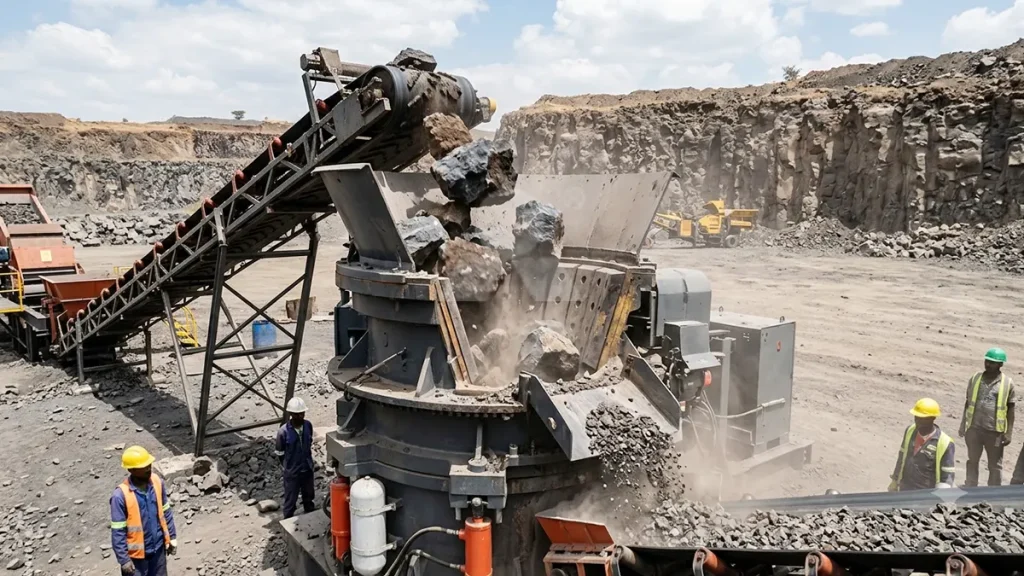
Ethiopian geology is unforgiving. The predominant rock is volcanic basalt, which regularly exceeds 200MPa in compressive strength and contains extreme silica levels. I constantly see amateur buyers attempt to process this rock with cheap, single-stage impact crushers to save money. This is an architectural and financial disaster.
The abrasive basalt will vaporize high-chrome blow bars in 48 hours.
When the machine breaks, the real crisis begins. Due to the severe forex (foreign exchange) shortage in Ethiopia, you cannot simply buy new parts online. You must apply for an LC approval just to import replacement steel. This bureaucratic paralysis can leave your quarry shut down for up to 6 months. To arrest this forex hemorrhage, the extraction architecture must mandate a multi-cylinder hydraulic cone crusher. The HPT’s rock-on-rock lamination crushing forces the basalt to grind against itself, extending the lifespan of the manganese mantle by up to 30% and drastically reducing your dependency on imported consumables.
Financial survival in Ethiopia demands matching kinetic longevity to the geological reality.
| Crusher Typology | Kinetic Mechanism | 200MPa Basalt Survival | Forex Liability Risk |
|---|---|---|---|
| Cheap Impact Crusher | Direct Steel Impact | < 48 Hours | Catastrophic (Constant imports) |
| Legacy Spring Cone | Mechanical Compression | Medium (Spring fatigue) | High (Frequent downtime) |
| HPT Hydraulic Cone | Lamination (Rock-on-Rock) | Maximum Longevity | Low (Extended wear life) |
Analyze the operational difference. The HPT300 operates at 250kW, utilizing deep-cavity lamination to protect its steel. You are paying a higher initial price to permanently lock down your expenditure per shift.
Electrical Grid Volatility and Contactor Burnout
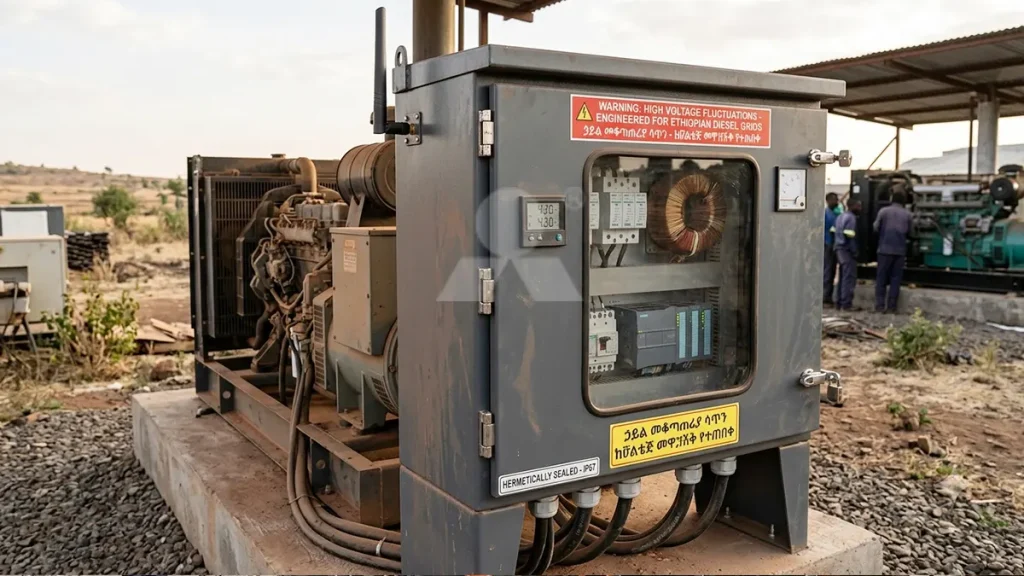
Ethiopian power grids suffer from violent voltage fluctuations. Many remote quarries operate entirely on unsynchronized diesel generators. When a 160kW primary jaw motor engages, the voltage drops radically. A cheap crusher with sub-standard electrical cabinets will suffer immediate contactor burnout.
Field Note: I audited a site near Dire Dawa where a sudden grid surge melted the unsealed switchgear of a bargain crusher. The machine was reduced to scrap iron because they could not source replacement PLC components locally.
True capital defense requires hermetically sealed PLC control cabinets specifically calibrated to absorb voltage drops from diesel generator surges during cold restarts. The electrical architecture must be engineered to survive in isolation. If you compromise on the electrical integrity of your plant, the mechanical capability of the crusher is entirely irrelevant.
Ethiopian Hard Rock Circuit: Capital Protection Metrics
- Primary Extraction: C6X100 Jaw engineered for 200MPa basalt survival
- Secondary Defense: HPT200 Cone utilizing lamination to slash imports
- Logistical Framework: 100% containerized modular dismantling
- Electrical Resilience: High-tolerance switchgear for generator surges
- Forex Optimization: +30% wear life extension via hydraulic automation
Secure Your Capital Payback Velocity
Evaluating machinery in Ethiopia based purely on the lowest factory quotation is an indefensible fiscal error. The extreme hardness of volcanic basalt combined with the country’s severe foreign exchange constraints will instantly expose cheap engineering. If you install a low-grade impactor next month, your expenditure per shift will skyrocket as you burn through wear parts, ultimately plunging your operation into a 6-month downtime paralysis waiting for LC approvals. You must invest in the modular logistics of the C6X jaw and the rock-on-rock lamination physics of the HPT cone to secure your operational independence.
