How does a stone crusher work?
June 9, 2026
Summary:A stone crusher is not a generic mechanical sledgehammer; it is a highly calibrated kinetic energy transfer engine. To fracture 200MPa stone, machinery must exploit crystal cleavage physics. Jaws utilize single-particle compressive leverage. Cones execute high-pressure lamination, inducing micro-cracks via rock-on-rock friction. VSI units deploy centrifugal kinetic energy to shatter rock along natural fault lines. Misapplying these physics guarantees catastrophic motor stalls and wear-part hemorrhage.
Deconstructing Kinetic Energy Transfer: How does a stone crusher work?
Single-Particle Compressive Cleavage (The Jaw)
A jaw crusher does not chew; it leverages kinetic inertia to split solid mass.
The primary extraction of raw blast rock relies on single-particle compressive cleavage. When an 800mm boulder drops into a C6X jaw crusher, it is trapped in a V-shaped cavity between a stationary manganese plate and a moving pitman. The 160kW motor does not provide all the force directly; it drives massive steel flywheels. These flywheels store immense rotational inertia.
This inertia drives an eccentric shaft, which forces the pitman into a reciprocating motion.
As the pitman closes the gap, it applies extreme mechanical leverage to the boulder. The pressure exploits the macroscopic structural weaknesses—existing cracks and fault lines—forcing the rock to fracture into smaller, asymmetrical slabs. During the retreat stroke, gravity pulls the fractured pieces lower into the narrowing V-cavity, where the cycle repeats until the rock is small enough to fall through the bottom discharge opening. It is a violent, intermittent application of overwhelming compressive force.
High-Pressure Lamination Crushing (The Cone)
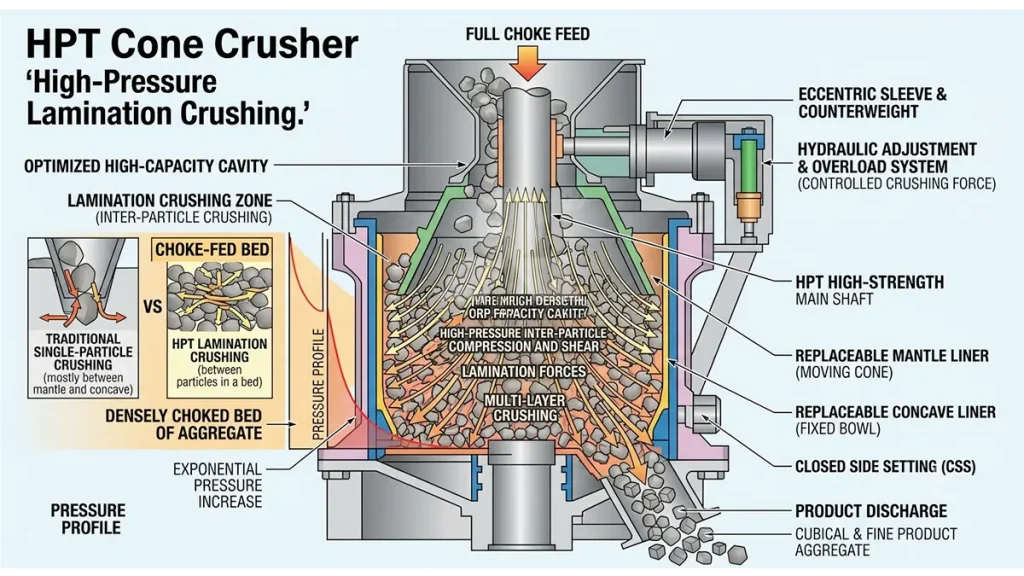
If the jaw is a sledgehammer, the multi-cylinder hydraulic cone is an industrial vice grip. An HPT cone crusher abandons single-particle impact for lamination crushing. The architecture consists of a stationary outer concave and a gyrating central mantle, driven by an eccentric sleeve.
The cone does not crush single rocks; it crushes a dense, choked bed of aggregate.
When the mantle gyrates, it forces the entire bed of rock against the concave under extreme hydraulic pressure. This high-pressure environment causes intense rock-on-rock friction. The particles grind and crush against each other. This lamination effect induces microscopic internal fissures (micro-cracks) throughout the crystal structure. The stone literally crumbles under its own density, producing a much finer and more uniform output than a jaw, while significantly reducing direct abrasive wear on the machine’s steel components.
Each machine is strictly governed by a specific kinetic energy transfer mechanism.
| Crusher Typology | Physics Mechanism | Energy Transfer | Geometric Result |
|---|---|---|---|
| C6X Jaw | Compressive Cleavage | Rotational Inertia to Linear Force | Flaky, asymmetrical slabs |
| HPT Cone | Lamination Friction | Hydraulic Pressure via Gyration | Uniform sizing, high micro-cracks |
| VSI6X Impactor | Centrifugal Impact | Rotational Velocity to Kinetic Shock | Perfectly cubical grain geometry |
Analyze the geometric result. Compressive machines (jaws and cones) inherent produce a high flakiness index because they shear rock along flat planes. Correcting this requires an entirely different physical approach.
Centrifugal Kinetic Impact (The VSI)
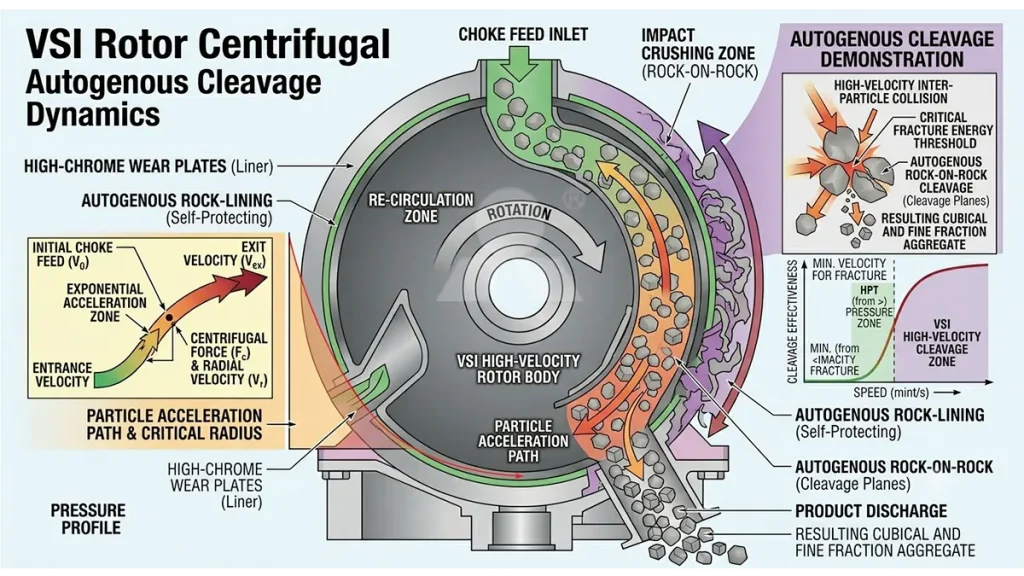
A Vertical Shaft Impactor (VSI) abandons compressive pressure entirely. It operates strictly on centrifugal kinetic energy. Aggregate drops into a central rotor spinning at extreme speeds, driven by dual motors (up to 400kW). The rotor acts as a centrifugal accelerator, hurling the stone outward at lethal velocities.
Field Note: I audited a plant attempting to produce commercial concrete sand using only a cone crusher. The aggregate failed shear testing due to extreme flakiness. We integrated a VSI6X. The autogenous cleavage instantly cured the grain geometry, eliminating the micro-cracks and yielding 100% compliant cubical sand.
When the flying rock strikes a stationary anvil bed (rock-on-rock configuration), the kinetic shock wave travels instantly through the stone. It shatters cleanly along its natural crystal cleavage planes. Because there is no compressive steel plate to flatten the rock, the violent collision physically chips away sharp edges, acting as the ultimate geometric finisher to yield perfectly cubical sand.
Kinetic Velocity Physics: VSI6X1040 Parameters
- Kinetic Accelerator: Dual 200kW motors driving central rotor
- Energy Transfer: Centrifugal velocity yielding >264 tph
- Autogenous Protection: Rock-on-rock stationary anvil bed
- Geometric Constraint: Strict 40mm max feed to prevent rotor bridging
- Micro-crack Obliteration: High-speed impact curing cone-induced flaws
Enforce Kinetic Discipline
A crusher is a highly specific application of thermodynamic and kinetic law. You must align the machine’s internal physics with the geological reality of your ore. If you deploy compressive lamination on wet clay, or if you expect a primary jaw to produce cubical sand next month, you will trigger catastrophic motor stalls and an unrecoverable wear-part hemorrhage. You must respect the crystal cleavage planes of the rock and deploy the correct kinetic energy transfer mechanism to achieve structural failure.
