Two Stage Vs Three Stage Aggregate Crushing Plant Selection Guide
November 24, 2026
Summary:Deciding between a two-stage or three-stage crushing circuit depends entirely on raw rock hardness and finished aggregate specifications. Written by a senior engineer at Liming Heavy Industry, this guide explains why soft limestone thrives in a two-stage Jaw and CI5X Impact Crusher circuit, whereas abrasive granite requires three stages using HST and HPT Cone Crushers. Proper stage selection optimizes particle shape while preventing wasted capital expenditure and operating expenses.
When designing a sand and gravel aggregate production line, deciding whether to deploy a two-stage or a three-stage crushing circuit depends entirely on two core engineering variables: the physical hardness of the raw material and the strictness of the finished product specifications. Soft and medium-soft rocks possess high crushing ratios, meaning two stages (primary coarse crushing plus secondary medium-fine crushing) are completely sufficient to produce commercial gravel. Conversely, hard rocks exhibit lower reduction ratios and require strict particle shaping, demanding three stages (coarse, medium, and fine crushing).
More crushing stages are not automatically better. Every additional stage introduces another full set of heavy machines, additional transfer conveyors, and higher daily operating expenses. Before finalizing your blueprints, you must thoroughly evaluate both your raw rock and your commercial sales targets.
I. What Does a Crushing “Stage” Actually Mean?
In mineral processing, a crushing “stage” defines how many distinct mechanical reduction steps the rock undergoes as it shrinks from a massive quarry boulder down to finished commercial aggregate. A single-stage setup executes only coarse crushing to break down massive rocks. A two-stage setup links primary coarse crushing with secondary medium-fine crushing. A three-stage setup cascades sequentially through coarse, medium, and fine crushing stations.
As the number of stages increases, the mechanical reduction ratio required from each individual machine shrinks. This delivers finer output sizes and dramatically improved particle cubicity. However, the trade-off is clear: equipment counts, civil concrete foundation footprints, and electrical power consumption all rise proportionally.
II. Two-Stage Crushing: Optimal for Soft and Medium-Soft Rock
A standard two-stage crushing plant pairs a primary coarse crusher (typically a C6X or PEW Series Jaw Crusher from Liming Heavy Industry) with a secondary medium-fine crusher (usually an impact crusher, or occasionally a cone crusher). Because soft and medium-soft rocks yield high crushing ratios, an impact crusher like the CI5X Series Impact Crusher can absorb a massive reduction ratio in a single pass, easily reducing jaw-crushed rock straight down to final commercial specifications.
This two-stage layout is the undisputed standard for limestone quarries and many tuff production lines. The process flow is short, machine counts are low, and initial capital expenditure is minimal. Because the CI5X impact crusher excels on soft rock—delivering high reduction and exceptionally cubic gravel—the entire middle section of the plant is streamlined. Fewer transfer points mean fewer mechanical failure risks and vastly simplified maintenance. With fewer machines running, labor requirements, spare parts inventory, and daily inspection workloads drop significantly, making it ideal for small-to-medium projects with lean operational teams.
If a soft-rock line can achieve its targets in two stages, never force a third stage onto the blueprint. However, attempting to force hard, abrasive rock through a two-stage impact circuit will cause catastrophic wear on the blow bars, wiping out any initial capital savings.
III. Three-Stage Crushing: Mandatory for Hard Rock and High-Spec Products
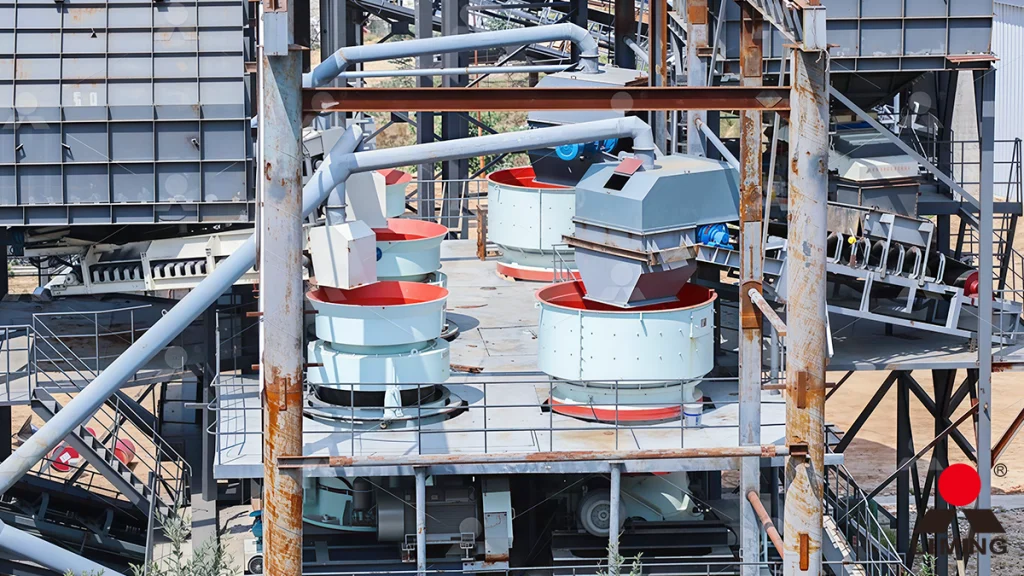
A three-stage crushing circuit connects a primary coarse crusher (a heavy-duty C6X Jaw Crusher or an HGT Gyratory Crusher), a secondary medium crusher (such as an HST Single-Cylinder Hydraulic Cone Crusher), and a tertiary fine crusher (an HPT Multi-Cylinder Hydraulic Cone Crusher). Hard rocks exhibit low reduction ratios and devastating abrasiveness; two stages physically cannot squeeze the rock fine enough without causing severe mechanical overload. Therefore, both the secondary and tertiary stations must rely on hydraulic cone crushers utilizing compressive lamination crushing.
Hard igneous rocks like granite and basalt universally follow this three-stage route—and if the plant adds a VSI6X Series Sand Maker for dedicated manufactured sand shaping, it technically operates as a four-stage system. Investing in that third crushing stage buys absolute stability in aggregate cubicity and continuous gradation, delivering an exceptionally profitable return on investment when supplying premium highway and structural concrete markets.
IV. Table 1: Two-Stage vs. Three-Stage Crushing Comparison
The table below contrasts the operational realities of both configurations to assist engineers in matching their raw material to the optimal process flow:
| Configuration | Typical Equipment Fleet | Applicable Material | Finished Product Traits | Investment & Operations |
|---|---|---|---|---|
| Two-Stage Crushing | Primary Jaw Crusher (PEW/C6X) + Secondary Impact Crusher (CI5X) or Cone | Soft & Medium-Soft Rock (Limestone, Tuff) | Primarily coarse aggregate; short process flow | Fewer machines, lower initial capital expenditure, simple maintenance |
| Three-Stage Crushing | Primary Jaw/Gyratory + Secondary Cone (HST) + Tertiary Cone (HPT) | Hard Rock (Granite, Basalt, River Pebbles) | Excellent cubic shape, highly stable gradation | More machines, higher capital cost; highly profitable on premium aggregate |
Note: Configurations reflect practical engineering experience from Liming Heavy Industry; exact stage counts must be verified against laboratory rock testing and target specs.
V. Decision Workflow: Evaluate Hardness and Product Specs Simultaneously
The required number of crushing stages is never dictated by rock hardness alone; the commercial specifications of the finished product are equally decisive. Consider two limestone lines processing the exact same medium-hard rock: if one plant demands ultra-fine manufactured sand and zero-flakiness structural concrete stone, two stages are inadequate—you must add tertiary fine crushing and VSI shaping, shifting the layout to three or four stages. Conversely, if the plant strictly produces coarse roadbase gravel without tight shape tolerances, two stages are entirely sufficient.
Determining stage counts requires evaluating “Material Properties + Finished Targets” simultaneously. Looking at only one side leads to severe design flaws. First, test the rock samples; second, lock in the finished particle specifications; third, calculate the total required reduction ratio to mathematically determine the exact number of stages.
VI. Frequently Asked Questions (FAQ)
1. What is the exact difference between two-stage and three-stage aggregate crushing?
The difference lies in the number of mechanical reduction steps. A two-stage line combines primary coarse crushing with a single medium-fine crushing stage. A three-stage line inserts an extra secondary or tertiary reduction step. Hard rocks require this extra stage to divide the total reduction ratio across three machines, allowing the plant to achieve fine output sizes while maintaining an excellent cubic particle shape, albeit with higher initial capital and daily operating expenses.
2. Why must hard rock use three stages? Can two stages work?
Hard rock resists fracture, yielding a low reduction ratio per pass. Trying to squeeze hard granite from 800mm down to 15mm in just two stages overloads the secondary crusher, resulting in poor particle shape and excessive flat, needle-like shards. Splitting the workload across three stages lightens the burden on each machine and maximizes inter-particle lamination crushing, guaranteeing stable gradation. Thus, two stages simply cannot meet premium quality standards on hard rock.
3. If I only need coarse aggregate, can I always rely on two stages?
If your raw material is soft to medium-hard and you only require coarse gravel without strict demands for fine sand or particle cubicity, two stages are typically sufficient and require significantly less investment. However, if the rock becomes exceptionally hard or your buyers enforce strict aggregate shape rules, two stages will fail to hold specifications, making a third stage mandatory.
4. Is there a “two-and-a-half stage” compromise between the two?
Yes. A highly common hybrid layout utilizes two crushing stages followed by a single shaping stage (such as a VSI6X Sand Maker). This adds a particle-shaping step onto a standard two-stage framework. It sits squarely between two-stage and three-stage circuits, making it ideal for operations demanding moderately high aggregate cubicity without wanting to invest in a complete three-stage hydraulic cone setup.
VII. Application Boundaries and Engineering Experience
Whether you deploy a streamlined two-stage limestone circuit, a heavy-duty three-stage granite configuration, or a “two-and-a-half stage” hybrid shaping system, the fundamental rule never changes: calculate the total reduction ratio based on verified rock hardness and target product specifications, and work backward to determine the exact stage count. Adhering to the principle of “matching stages to material” prevents costly site rework and ensures low long-term daily operating expenses. Contact the engineering team at Liming Heavy Industry today to test your rock samples and engineer the optimal crushing circuit for your enterprise.
