VSI6X vertical shaft impact crusher for sand making
April 30, 2026
Summary:Modern infrastructure demands strict geometric interlocking in the 0-5mm fine spectrum. The VSI6X vertical shaft impact crusher for sand making utilizes 'stone-on-stone' kinetic physics to eliminate the structural micro-cracks inherent in traditional compressive crushing. By calibrating the dual-motor 500kW drive and adjusting the center-to-cascade feed ratio, architects can stabilize a 400 tph output with a flakiness index below 8%, drastically improving the production-to-cost ratio of the entire aggregate circuit.
400tph Premium Sand Circuit: Volumetric & Kinetic Parameters
- Circuit Anchor: VSI6X1150 (344-663 tph rated capacity)
- Kinetic Power Draw: 500 kW (Dual 250 kW synchronized motors)
- Feed Strictness: < 45mm pre-screened hard rock
- Cascade Bypass Calibration: 25-30% optimal for shaping
- Final Aggregate Quality: Sub-8% flakiness index, 0-5mm dominant
Technical Index: LH-VSI6X VERTICAL SHAFT IMPACT CRUSHER FOR SAND MAKING-AUG/2026-Ref-#48192
Kinematic Shaping: The “Stone-on-Stone” Cavity Dynamics
Relying on metal anvils to shape abrasive rock rapidly destroys your production-to-cost ratio. The material must fracture itself.
The architectural superiority of the deep-cavity rotor lies in its fluid dynamics. When high-velocity rock is ejected from the spinning rotor, it does not strike a bare steel wear plate. Instead, the cavity geometry creates a stationary, highly dense “rock bed” along the perimeter. The ejected material collides with this bed at velocities exceeding 70 meters per second. This “stone-on-stone” interaction exploits the natural cleavage planes of the mineral.
Unlike a cone crusher that applies slow, crushing compression—which often induces invisible micro-cracks deep within the aggregate—this high-speed kinetic impact cleanly shears off sharp edges. The result is a perfectly cubical grain structure that interlocks flawlessly in cement matrices, drastically reducing the required cement paste volume for construction firms.
Synchronizing the Center-to-Cascade Feed Ratio
Raw kinetic energy without volumetric control produces highly erratic grading curves. The VSI6X features a dual-feed distributor that splits the incoming material. A portion enters the center of the deep-cavity rotor to gain acceleration, while the rest cascades directly into the crushing chamber from the outside, forming a dense curtain of falling rock.
Calibrating this ratio is the most critical task for a plant architect. If the central rotor is starved, the kinetic energy drops, and shaping fails. If the cascade bypass is closed, the machine functions purely as an impactor, reducing efficiency and increasing fine dust. Dialing the cascade bypass to approximately 30% creates an optimal collision matrix, yielding high volumes of premium 0-5mm sand while sustaining the protective rock bed.
Closed-Circuit Integration for Premium Grading
A high-performance impactor cannot compensate for poor upstream screening. The entire plant architecture must be synchronized to protect the deep-cavity rotor and ensure strict feed parameters.
| Circuit Stage | Recommended Configuration | Capacity (tons per hour) | Power (kilowatts) | Target Feed/Output |
|---|---|---|---|---|
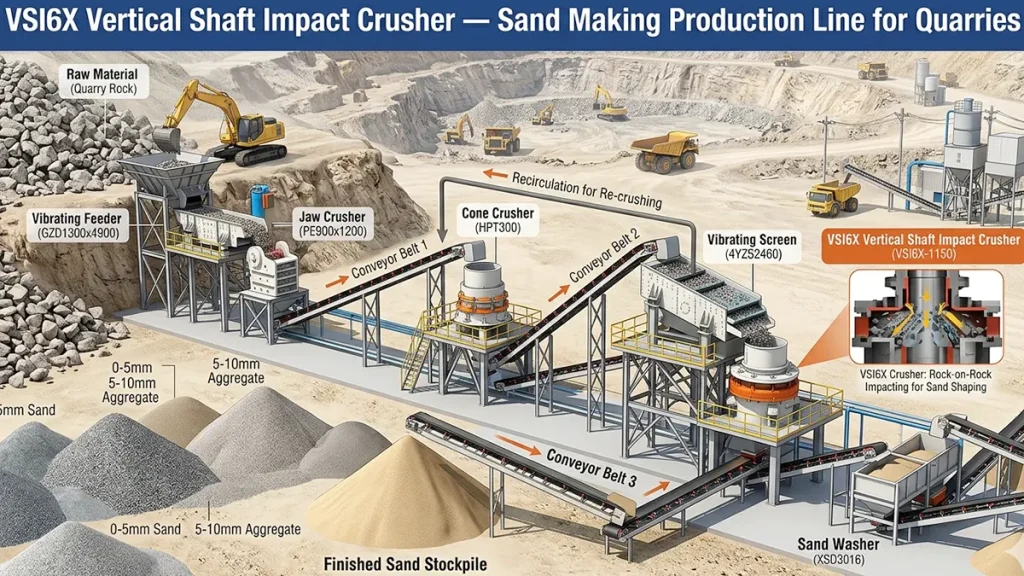
| Primary Stage | PEW860 Jaw Crusher | 200-500 | 132 | Max Feed 720 mm |
| Secondary Stage | HPT300 Multi-Cylinder Cone | 110-440 | 250 | Strict 45mm Output |
| Shaping & Sand Making | VSI6X1150 | 344-663 | 500 (250×2) | Premium 0-5mm Sand |
| Washing & Grading | XSD3220 Wheel Washer | 60-150 | 15 | Silt Removal |
The HPT300 cone crusher acts as the critical gatekeeper. By operating in a closed circuit with a high-frequency vibrating screen, the HPT300 ensures that absolutely no rock larger than 45mm enters the VSI6X1150. Feeding oversized material into a precision rotor instantly throws the dual 250 kW motors out of phase and shatters the tungsten throwing blocks.
Enforcing Volumetric Discipline for Hardware Amortization
Designing a high-yield aggregate plant requires more than bolting machines to a foundation; it demands mastery over the material flow. If the cascade bypass ratio is ignored or the upstream screens allow oversized rock to breach the chamber, the precise kinematics of the rotor will collapse. The resulting drop in 0-5mm yield and the spike in flakiness will immediately compromise your concrete mix specifications.
Calibrate Cascade Bypass for Fiscal Efficiency
“What is the current flakiness index of your secondary cone output? Send us your 0-5mm grading curve requirements, and let’s architect a synchronized shaping circuit.” — From the Desk of your The Solution Architect
Architect a High-Yield Sand Plant