150 TPH Chrome Ore Crushing Plant In South Africa
I. Client Background
Our client is a medium-sized mining enterprise located in Limpopo Province, South Africa. This region is a globally renowned chromite belt, and the client primarily supplies metallurgical-grade chrome ore to international markets. With overseas demand for standard chrome lump products steadily rising in recent years, the client’s legacy crushing equipment could no longer satisfy current production capacity and particle size requirements. They urgently required a modern crushing and screening system that is stable, durable, and strictly controls over-pulverization.
II. Project Overview
Upon receiving the requirements, technical engineers from Liming Heavy Industry conducted multiple rounds of video site surveys and data verifications with the client. The baseline parameters of the project were clearly defined:
- Processed Material: Raw Chrome Ore
- Maximum Feed Size: 400mm – 600mm
- Target Discharge Size: 5 – 20 mm (Standard Lump Product)
- Design Capacity: 100 – 200 TPH (Tons Per Hour)
In the chrome market, the price disparity between lump ore and fine concentrate is substantial. Therefore, the core assessment metric for this production line was not merely the ability to crush, but to crush with precision—specifically, maintaining a stable throughput of approximately 150 TPH while maximizing the advantages of lamination crushing to minimize the generation of fine powder.
III. On-Site Challenges and Technical Difficulties
- High Material Hardness and Extreme Abrasiveness: Chrome ore typically registers between 5.5 and 6.5 on the Mohs hardness scale, with associated minerals exhibiting severe abrasiveness, placing demanding requirements on the wear resistance of crusher liners and mantles.
- Fines Control (Over-Pulverization): Chrome ore is inherently brittle. If secondary reduction equipment is improperly selected (such as the erroneous use of impact crushers), it generates massive amounts of sub-5mm fines, directly undermining the economic return of the production line.
- Local Operational Constraints: Certain mining areas in South Africa experience electrical grid voltage fluctuations, and remote locations require long spare parts replacement cycles. The equipment must possess high continuous operational reliability.
IV. Solution: Liming Heavy Industry Customized Crushing Flowsheet
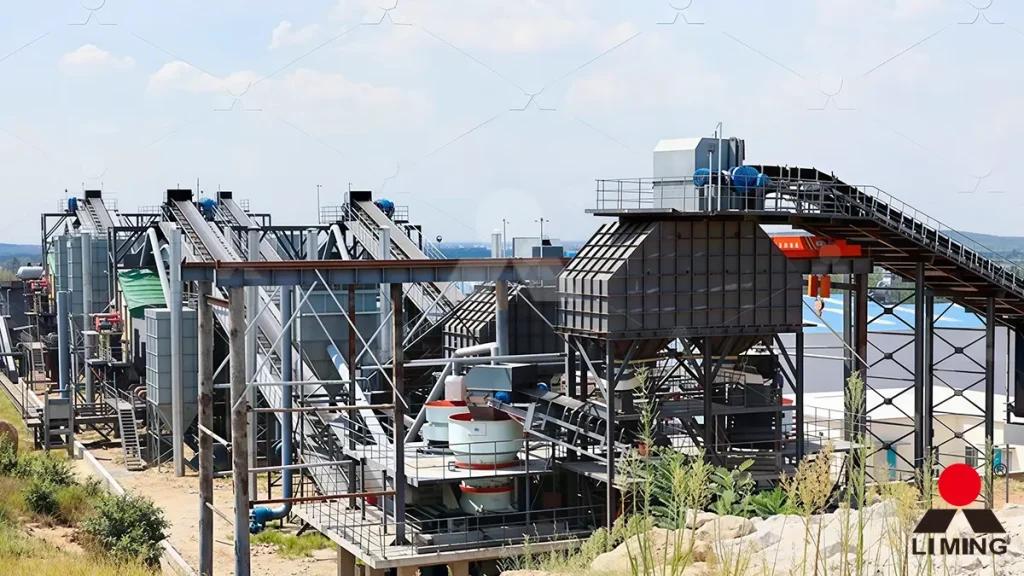
Addressing these operational challenges, our process engineers moved away from the traditional “Jaw Crusher + Impact Crusher” circuit, implementing a closed-circuit flowsheet comprising “Primary Coarse Jaw Crusher + Secondary Fine Multi-Cylinder Hydraulic Cone Crusher + High-Precision Vibrating Screen.” Below is the core equipment configuration and selection logic:
1. Feeding Stage: ZSW490×110 Vibrating Feeder
- Function: Evenly and continuously feeds raw material into the jaw crusher.
- Engineering Perspective: Raw chrome ore frequently contains clay and fine debris. The grizzly bar structure on the ZSW series pre-screens fines during the feeding stage, reducing the load on the primary crusher, while its heavy-duty exciter prevents feed blockages under full load.
2. Primary Crushing: PEW760 European Jaw Crusher
- Processing Capacity: 130 – 280 TPH
- Maximum Feed Size: 630 mm (Completely accommodating the client’s 400-600mm feed)
- Selection Logic: The PEW series features a V-shaped symmetrical crushing cavity with no dead zones, delivering greater intake capacity than traditional jaw crushers. To withstand chrome ore abrasiveness, modified high-manganese steel (Mn18Cr2) jaw plates were supplied to extend wear life. The discharge opening features a hydraulic wedge adjustment system, allowing operators to calibrate particle size in minutes without stopping the machine.
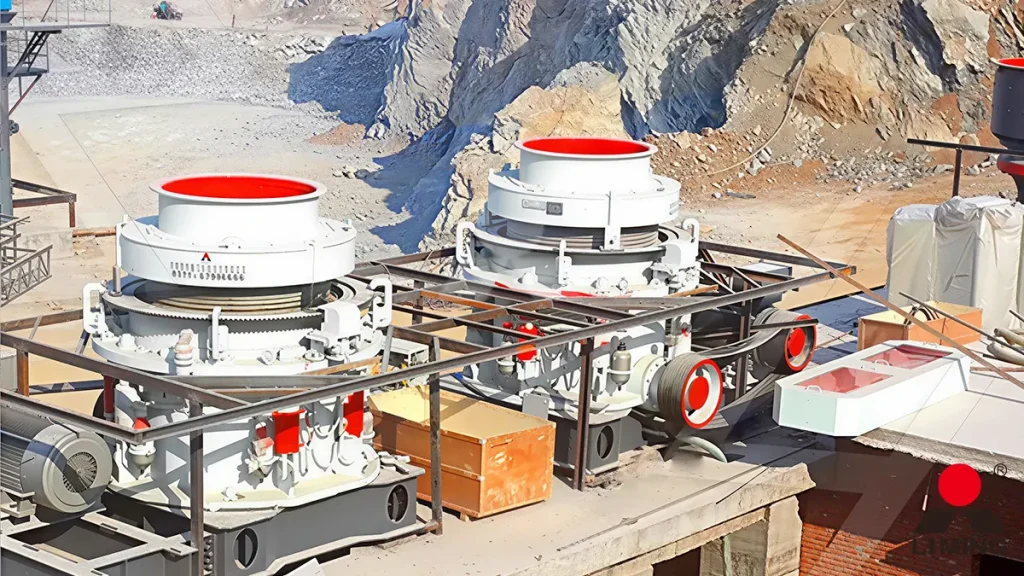
3. Secondary Crushing: HPT200 Multi-Cylinder Hydraulic Cone Crusher
- Processing Capacity: 80 – 250 TPH
- Function: Undertakes the primary reduction task, dictating the final particle shape and fines ratio.
- Selection Logic: This machine represents the core technological hub of the line. The HPT series operates on the lamination crushing principle, subjecting the material to multi-directional compressive stress within the cavity rather than single-point impact. This comminution method produces cubic 5-20mm chrome particles with minimal flat or elongated pieces and few internal micro-cracks, significantly reducing fines generation. Furthermore, its automated programmable logic control system continuously monitors main shaft position and power draw. When uncrushable tramp iron enters the chamber, hydraulic cylinders automatically release pressure to discharge the obstruction and immediately reset, protecting the machine and minimizing unscheduled downtime.
4. Screening Stage: S5X2160 Circular Vibrating Screen
- Function: Accurately classifies the crushed material.
- Selection Logic: Configured with a triple-deck screen design. Screen mesh apertures were calibrated with the client on site to ensure qualified 5-20mm lump ore cleanly passes through as final product, while material larger than 20mm is returned via conveyor to the HPT200 cone crusher for closed-circuit reduction. The S5X series uses rubber shear springs for low operating noise and features modular block-eccentric exciters that maintain screening efficiency above 95%.
5. Conveying System
- Utilizes B800 and B1000 heavy-duty belt conveyors fitted with tear-resistant, wear-resistant rubber belts engineered for dusty outdoor mining environments with high temperature variations.
V. Core Technical Highlights
- Closed-Circuit Control: The closed loop formed by the cone crusher and vibrating screen guarantees that all final output falls strictly within the 5-20mm target envelope, eliminating oversized particles.
- Wear Part Longevity: The mantles and bowl liners of the HPT200 are cast from specialized composite alloys paired with an optimized cavity design, reducing wear part consumption costs per ton by approximately 25% compared to conventional machines.
- Intelligent Operations: Equipped with industrial internet connectivity, operational data including motor current, oil temperature, and hydraulic pressure can be monitored in real time. Remote diagnostic capabilities bridge the geographical distance for technical support.
VI. Operational Data and Delivery Results
Following installation, debugging, and live load commissioning in South Africa, the production line achieved the following operational metrics:
- Actual Capacity: Stabilized at 160 – 180 TPH, meeting and exceeding the target 100-200 TPH envelope.
- Particle Sizing: 5-20mm lump ore accounted for over 85% of total production, while fine powder (<5mm) was strictly contained below 8%, enabling the client to capture a premium market price.
- Energy and Maintenance: Electrical power consumption per ton decreased by approximately 15% compared to the client’s previous machinery. The hydraulic cavity-clearing system shortened routine maintenance periods by 40%.
VII. Customer Feedback
“The solution provided by Liming Heavy Industry is exceptionally pragmatic. They not only delivered machinery but deeply understood our metallurgical priority to maximize lump ore and minimize fines. The performance of the HPT cone crusher exceeded our expectations, delivering outstanding particle shapes. Furthermore, the technical competence demonstrated by their engineers during remote commissioning gives us complete confidence in our ongoing partnership.”— Operations Director, Mining Company, Limpopo Province, South Africa
VIII. Conclusion
In mineral comminution, there are no generic solutions—success relies on deep engineering customization aligned with material characteristics and commercial objectives. If you have crushing requirements for medium-to-hard materials such as chrome ore, iron ore, or basalt, contact Liming Heavy Industry for customized process design, equipment manufacturing, and complete turnkey engineering services.
