How Much Is A 50 To 100 TPH Basalt Crusher Models And Prices?
August 24, 2026
Summary:Basalt is a high-hardness volcanic rock widely used in premium construction materials. Due to its extreme compressive strength (up to 300 MPa), processing basalt requires heavy-duty compressive crushing equipment. This engineering guide answers how much a 50 to 100 TPH basalt crusher costs and details the recommended equipment models. Focusing on the PE Series Jaw Crusher for primary reduction and the HST/HPT Cone Crushers for secondary crushing, it explains how to configure a highly profitable basalt plant.
Basalt is a dense or vesicular rock formed by the rapid cooling and solidification of magma erupted from a volcano. It boasts strong corrosion resistance, exceptional wear resistance, low water absorption, and excellent sound and thermal insulation. These physical properties make it an incredibly versatile, premium building material. Currently, there are many types of crushing equipment available on the market to process this hard volcanic rock. For medium-scale operators, how much does a 50 to 100 tons per hour (TPH) basalt crusher cost? Below is a detailed engineering breakdown.
What Are the Models for a 50-100 TPH Basalt Crusher?
Basalt is a basic extrusive rock, typically black, though sometimes appearing grey-green or dark purple. It has a bulk density ranging from 2.8 to 3.3 grams per cubic centimeter. Dense basalt exhibits immense compressive strength, reaching up to 300 MPa, and ranks between 5 and 7 on the Mohs hardness scale. Because of this extreme, abrasive hardness, compressive crushing equipment such as Jaw Crushers and Cone Crushers are the most highly recommended.
For a target production range of 50 to 100 TPH, there are several highly efficient models to choose from. The specific technical parameters are listed below.
| Model | Max Feed Size (mm) | Capacity (t/h) | Motor Power (kW) |
|---|---|---|---|
| PE500×750 | 425 | 50-100 | 55 |
| PE600×900 | 500 | 60-130 | 75 |
| PEW400×600 | 350 | 15-70 | 37 |
| HST100 (Single-Cylinder) | 240 | 27-170 | 90 |
| HPT100 (Multi-Cylinder) | 140 | 45-140 | 90 |
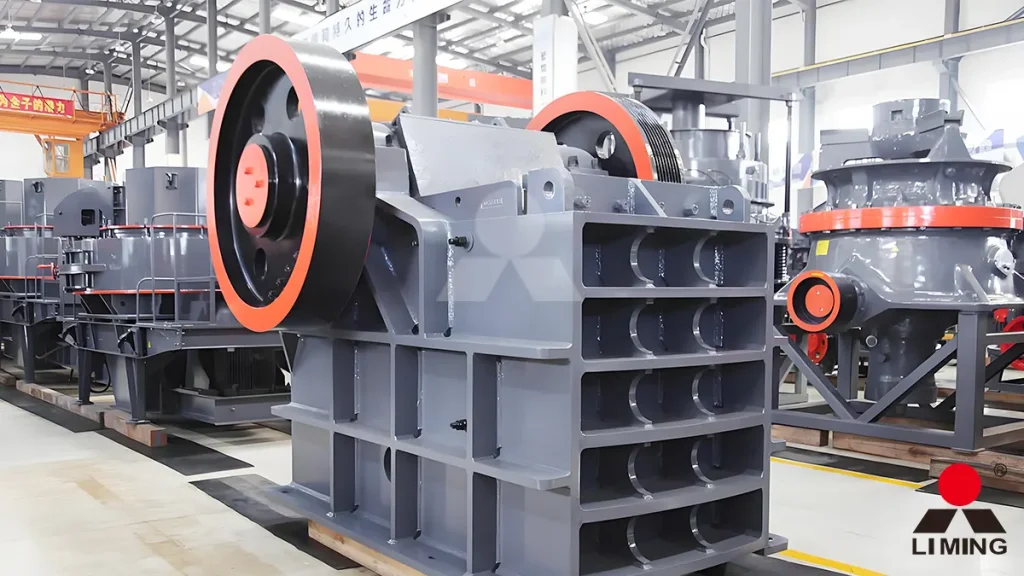
01 Jaw Crusher (Primary Reduction)
Recommended Models: PE600×900, PEW400×600, etc.
The jaw crusher is utilized for the primary coarse crushing stage. Modern models have undergone significant structural optimization and improved kinematic parameters. They feature a deep V-shaped crushing cavity, which allows the rock to begin fracturing at the very top of the chamber, while a larger stroke at the bottom drastically improves the crushing ratio and overall working efficiency. The discharge opening can be adjusted rapidly, ensuring a uniform finished particle size. Furthermore, the integral motor bracket design simplifies the installation process, reduces the required floor footprint, and enhances the equipment’s overall compactness and convenience.
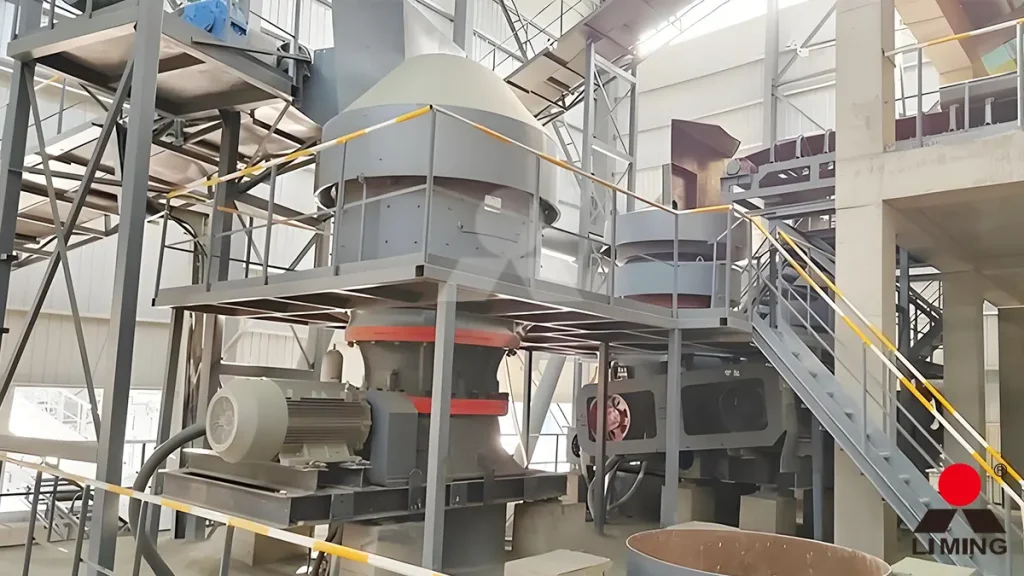
02 Cone Crusher (Secondary Fine Crushing)
Recommended Models: HST100, HPT100, etc.
Cone crushers are utilized for secondary and tertiary fine crushing. Their working principle is based on rock-on-rock lamination crushing between a moving cone and a fixed cone. The overall structure is optimized for convenient maintenance and flexible adjustment. The equipment supports multiple crushing cavity configurations, which can be precisely matched to different material characteristics and particle size requirements.
By adjusting the discharge opening size, operators gain absolute control over the final particle dimensions. Cone crushers possess significant engineering advantages, including immense crushing force, high energy efficiency, superior wear resistance, and reliable overload protection. Modern units like the HST and HPT series fully support automated control systems, which effectively prevent non-crushable metal (tramp iron) from causing mechanical damage to the main shaft.
How Much Is a 50-100 TPH Basalt Crusher?
Regarding the price of a 50 to 100 TPH basalt crusher, the general market range is typically around several tens of thousands of dollars. Because there are numerous manufacturers globally, there are significant differences in production craftsmanship, material selection, and technical engineering levels between brands. Additionally, the exact price fluctuates based on your specific production demands and the precise models selected.
It is important to note the nature of the supplier. Some companies are not direct manufacturers; they procure equipment from other factories and resell it. This middleman process often results in multiple price markups. Conversely, enterprises that manufacture and sell their own equipment directly can offer substantial price advantages.
Liming Heavy Industry is an exceptional choice. We have dedicated decades to the research, development, and manufacturing of premium mining equipment, always serving every client with integrity. As a direct source factory, we insist on direct supply and direct sales, ensuring you receive a highly competitive price.
For an exact quotation on a 50 to 100 TPH basalt crushing line, we welcome you to contact our engineering team online. Our company strictly controls raw material quality and production processes to ensure that every machine is stable and reliable. We are equipped with a professional technical team to provide a one-stop EPC service, including installation guidance, equipment commissioning, and comprehensive operator training.
