Jaw Crusher Philippines
June 2, 2026
Summary:Operating a primary extraction node in the Philippines is a brutal war against monsoons and 200MPa volcanic rock. Cheap crushers die here. Monsoon mud breaches standard seals, seizing oversized bearings in under 500 hours. Abrasive basalt snaps inferior toggle plates, triggering massive downtime bleeds on remote islands. Survival dictates deploying heavy-duty C6X jaws equipped with labyrinth seals, forged eccentric shafts, and work-hardening manganese plates to arrest your maintenance hemorrhage.
Arresting Mechanical Suicide in Jaw Crusher Philippines Deployments
Monsoon Mud and Bearing Infiltration
Water and silica dust create a liquid grinding compound that destroys bearings instantly.
A primary jaw crusher operates under massive kinetic stress. The oversized bearings supporting the eccentric shaft are the heart of the machine. In a dry climate, standard rubber lip seals might survive. In the Philippines, they fail instantly. The monsoon rain mixes with the silica dust generated by crushing rock, creating an abrasive mud paste.
This paste forces its way past cheap rubber seals.
Once the silica mud infiltrates the bearing housing, it mixes with the lubricating grease. It physically scores the bronze bushings and the steel rollers. I have spent 12-hour shifts in the pouring rain prying loose jaws that suffered complete thermal bearing seizures in under 500 hours. The only defense is a heavy-duty labyrinth seal. A true tropicalized machine, like the C6X series, utilizes a complex maze of steel grooves that physically block fluid intrusion, ensuring your expenditure per shift is not burned on replacing scorched bearings.
Volcanic Basalt and Toggle Plate Fatigue
Crushing Philippine volcanic basalt and andesite is an act of extreme violence. This rock regularly exceeds 200MPa. When you feed 700mm boulders of this material into a cheap jaw crusher, the weak cast-iron toggle plates cannot absorb the kinetic recoil. They snap.
The entire production line dies instantly.
A heavy-duty jaw like the C6X does not compromise on metallurgy. It utilizes high-manganese steel jaw plates that undergo a chemical transformation under extreme impact—they physically work-harden the more you crush. This extends their wear life exponentially. Coupled with a massive, reinforced cast-steel toggle plate, the machine absorbs the brutal kinetic shock of basalt without suffering mechanical suicide, actively arresting your daily downtime bleed.
Surviving 200MPa Philippine basalt requires a primary node engineered for absolute kinetic dominance.
| Process Stage | Recommended Model | Capacity (tons per hour) | Power (kilowatts) |
|---|---|---|---|
| Tropical Primary Extraction | C6X110 | 160-550 | 160 |
| High-Volume Primary Extraction | C6X125 | 230-760 | 160 |
| Massive Volcanic Extraction | C6X145 | 320-950 | 200 |
Look at the 160kW power rating on the C6X110. You need massive electrical torque to force a heavy forged eccentric shaft to break 200MPa rock. If you underpower your primary jaw, the machine will stall the moment a hard boulder enters the cavity.
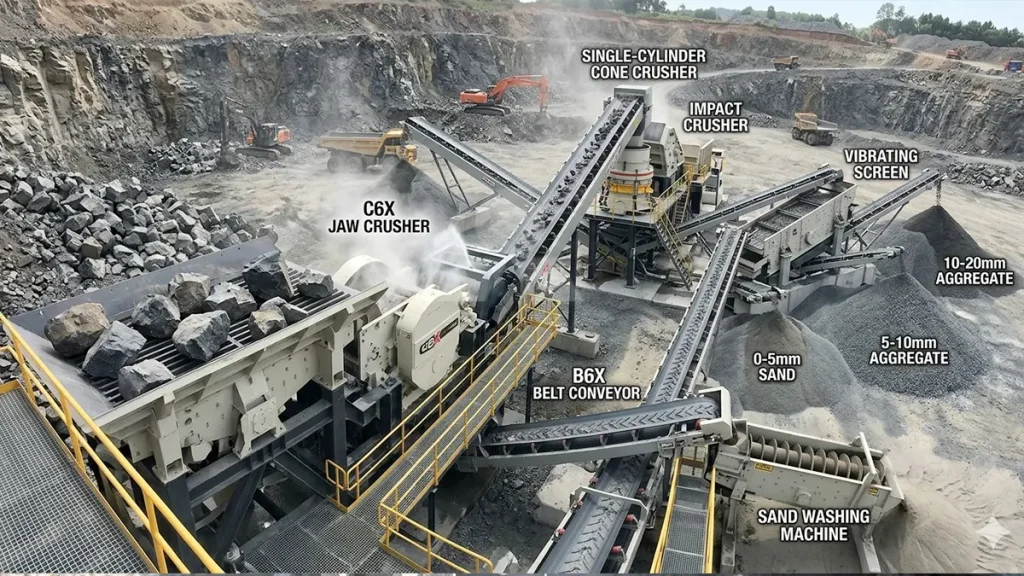
Cavity Blinding and Thermal Motor Stalls
Rain does not just attack the bearings; it attacks the mass flow. Feeding monsoon-soaked, clay-heavy rock directly into a jaw without an active F5X vibrating grizzly feeder is a rookie mistake. The wet clay packs solid inside the V-cavity.
Field Note: I shut down a plant in Luzon because the operator fed wet, muddy boulders straight into the jaw. The mud blinded the cavity. The rock could not compress. The 160kW main motor spiked its amperage and suffered a violent thermal stall, blowing the main contactor out of the electrical cabinet.
You cannot compress mud. An architect must specify an F5X grizzly feeder to screen out the sticky wet fines before they enter the jaw. This bypasses the clay directly to the discharge belt, ensuring the jaw only crushes solid rock, thereby protecting the motor from catastrophic thermal overload.
C6X110 Monsoon Operation: Kinetic Thresholds
- Sustained Tonnage: 280-310 tph under continuous wet feed
- Motor Load: 160 kW with integrated thermal overload defense
- Bearing Protection: Multi-stage steel labyrinth seals engaged
- Max Feed Acceptance: 720 mm boulders (Volcanic Basalt)
- Mud Bypass: F5X feeder ejecting -100mm wet clay prior to cavity
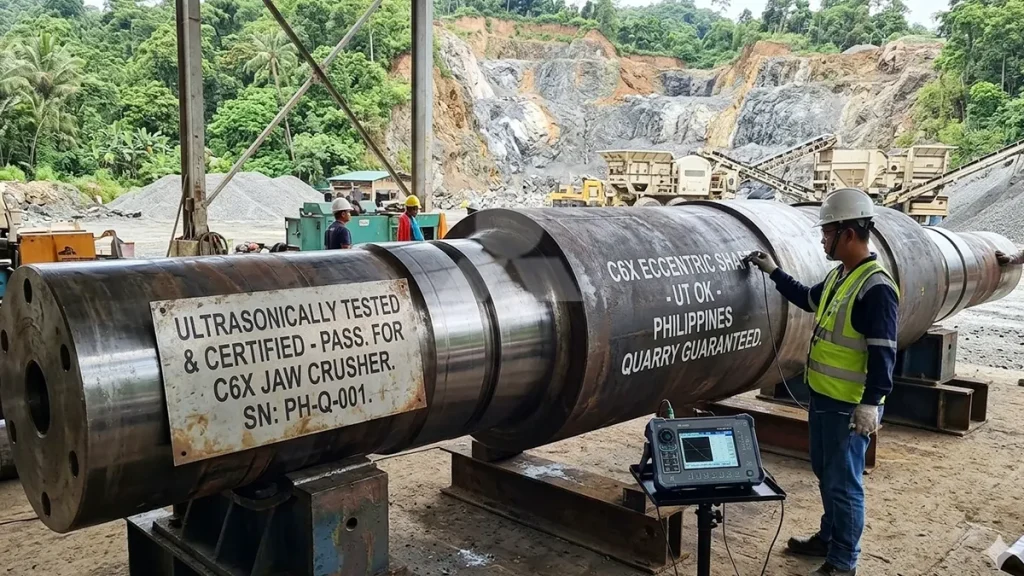
Enforce Tropical Mechanical Discipline
Operating a jaw crusher in the Philippines is not a casual endeavor; it is a war of attrition against mud, rain, and volcanic rock. If you procure a cheap, non-tropicalized machine next month, the resulting bearing seizures and snapped toggle plates will violently terminate your operation. You will bleed cash waiting for parts on a remote island. The architecture demands a heavy-duty C6X jaw equipped with labyrinth seals, a forged eccentric shaft, and an active F5X grizzly feeder to bypass the mud.
