Sand making machine price for 100tph quarry project
May 25, 2026
Summary:Focusing solely on the upfront sticker price of a VSI is a devastating fiscal error. Cheap, shallow-cavity rotors expose tungsten carbide tips to immediate friction, driving up expenditure per shift. The VSI6X8015 uses deep-cavity rock-on-rock physics to shield internal steel, ensuring a 100 tph yield without catastrophic wear-part hemorrhage. True capital payback velocity relies on mechanical survival, not bargain procurement.
The Kinetic Illusion of Cheap Rotors
A low upfront price guarantees a permanent operational hemorrhage.
Let us dissect the physical mechanics of a bargain VSI. To manufacture artificial sand at 100 tph, the machine must accelerate raw aggregate to lethal velocities. Cheap machines utilize a shallow rotor design. When 150MPa limestone enters this cavity, it strikes the bare steel and the tungsten carbide wear plates directly. This is rock-on-metal friction.
The metal loses every time.
Your maintenance crew will be shutting down the line every two days to swap out shattered rotor tips. You are no longer producing sand; you are running a steel consumption facility. To arrest this fiscal bleed, the architecture must mandate a deep-cavity rotor. The VSI6X series utilizes a specific geometric profile that creates a dead zone within the rotor. This allows incoming aggregate to violently grind against a stationary layer of trapped rock, entirely shielding the exterior steel from abrasive impact.
100 TPH Mass Balance and the VSI6X8015 Mandate
Relying solely on the machine’s catalog capacity ignores the reality of a mass balance deficit. If your contract dictates a final yield of 100 tph of 0-5mm manufactured sand, purchasing a machine rated exactly for 100 tph is an architectural error. You must account for the recirculating load.
The sizing screens will reject up to 30% of the material back to the crusher.
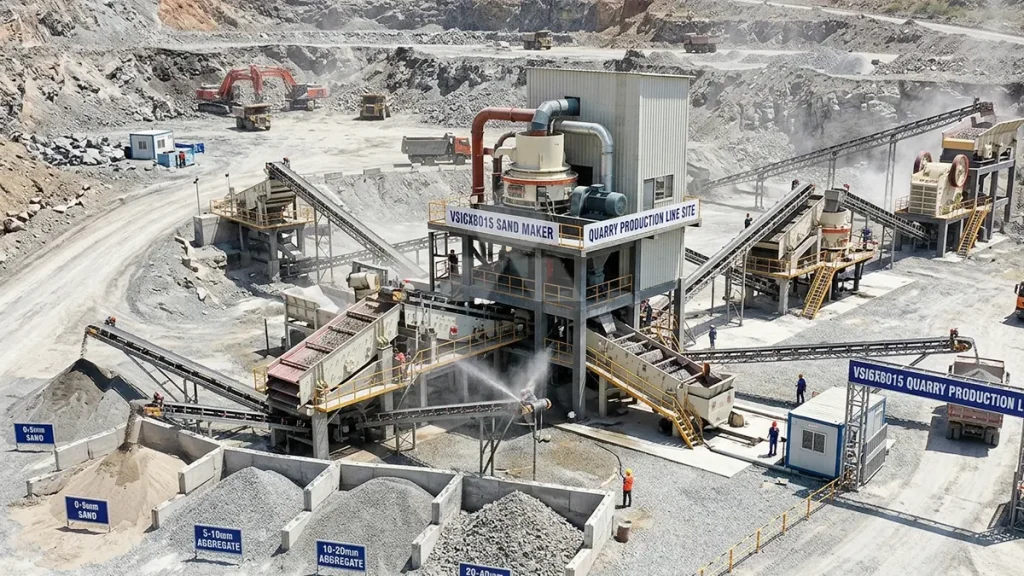
To guarantee a continuous 100 tph yield, the machine must be sized to accept a 130 tph input feed. The VSI6X8015 is mathematically engineered for this exact scenario. With a rated capacity of 109-210 tph, it provides the necessary kinetic buffer to absorb the recirculating load without stalling the dual motors. Sizing the machine correctly on day one is the ultimate defense for your capital payback velocity.
Fiscal viability requires matching the machine’s kinetic capacity to the total closed-circuit mass flow.
| VSI6X Series Model | Capacity (tons per hour) | Motor Power (kilowatts) | Mass Balance Application |
|---|---|---|---|
| VSI6X8015 | 109 – 210 | 75 × 2 | Optimal for strict 100 tph yield |
| VSI6X9026 | 167 – 323 | 132 × 2 | Handles 150 tph with heavy recirc load |
| VSI6X1040 | 264 – 515 | 200 × 2 | High-volume commercial sand plants |
Analyze the 75×2 kW dual-motor setup on the VSI6X8015. This split-drive architecture ensures balanced rotational torque, preventing asymmetric stress on the main shaft during heavy feed surges.
Thermal Seizures and Hydrodynamic Defense
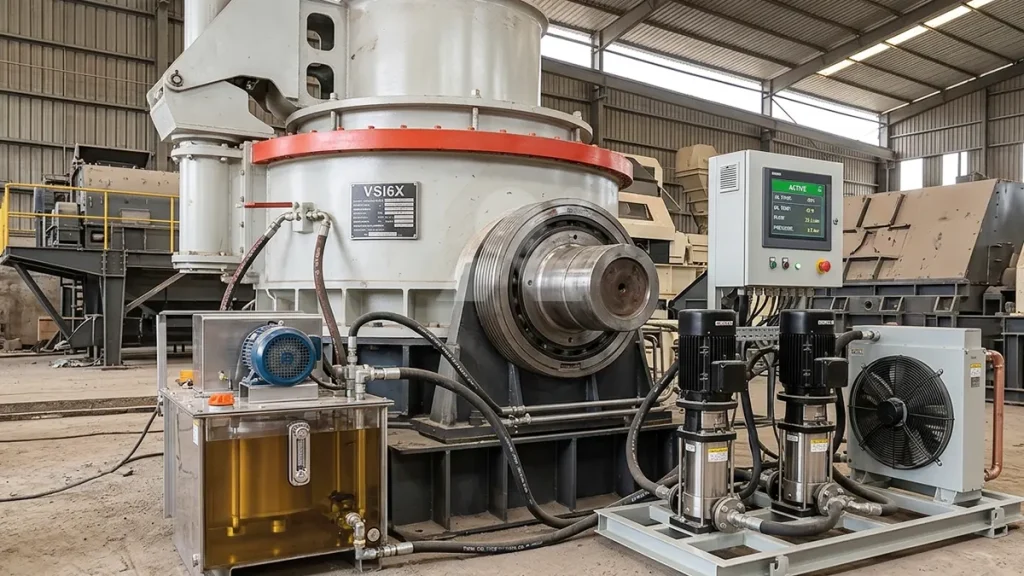
A VSI operates at extreme kinetic velocities. The main bearing assembly is the absolute heart of the machine. Cheap machines rely on basic grease lubrication. When a 150kW kinetic load spins at high RPMs, grease cannot dissipate the massive thermal energy generated by the bearings.
Field Note: I audited a plant in Southeast Asia where a bargain VSI suffered a thermal bearing seizure at 450 hours. The main shaft friction welded itself to the housing, requiring a complete $40,000 internal rebuild. The initial “savings” evaporated instantly.
Premium models utilize a dual-pump thin oil lubrication station. This system actively circulates filtered oil through the bearing housing, creating a hydrodynamic film that physically separates the moving steel. It guarantees thermal dissipation and actively flushes out micro-silica contaminants, permanently eliminating catastrophic downtime hemorrhage and securing your asset amortization cycle.
VSI6X8015: Fiscal & Kinetic Tolerances
- Sustained Yield: 110-140 tph continuous extraction
- Drive Power: 150 kW (Dual 75kW synchronization)
- Rotor Architecture: Deep-cavity rock-on-rock (Extends tip life by 30%)
- Max Feed Intake: Strict 30 mm calibration required
- Lubrication Defense: Automated dual-pump thin oil circulation
Securing Your Capital Payback Velocity
Procuring a sand making machine based purely on the lowest initial quotation is an indefensible fiscal error. The kinetic violence of 100 tph extraction will instantly expose cheap engineering. If you install a shallow-cavity, grease-lubricated VSI next month, your expenditure per shift will skyrocket as you burn through tungsten carbide tips and inevitably suffer a thermal bearing seizure. The VSI6X8015 utilizes rock-on-rock physics and thin-oil hydrodynamics to shield its internal components, guaranteeing your mass flow while completely arresting your wear-part hemorrhage.
