VSI Crusher Vs Impact Crusher Which Is Better For Sand Making
September 1, 2026
Summary:Choosing the correct crushing equipment is the most critical decision in aggregate plant engineering. This guide compares Vertical Shaft Impactors (VSI) and Horizontal Shaft Impact Crushers to determine which is better for sand making. While both utilize impact forces, their mechanics differ drastically. Featuring Liming Heavy Industry's VSI6X Sand Maker and CI5X Impact Crusher, the article explains how rock hardness, maximum feed size, and wear part costs dictate whether a "rock-on-rock" VSI or a heavy blow-bar impactor is the optimal choice for manufactured sand production.
In modern aggregate production plants, both Vertical Shaft Impact (VSI) crushers and Horizontal Shaft Impact crushers can be utilized for producing manufactured sand. However, their working principles, applicable raw materials, and the final quality of the manufactured sand are distinctly different. When clients ask which machine is more suitable for sand making, the answer depends entirely on the hardness of the rock and the exact target particle size.
As a general engineering rule, if your goal is to process materials strictly below 50 millimeters to produce fine concrete sand (0-5 millimeters), the VSI sand maker is the absolute priority choice. To help investors optimize their equipment configurations, we will conduct a deep technical comparison between these two critical pieces of machinery.
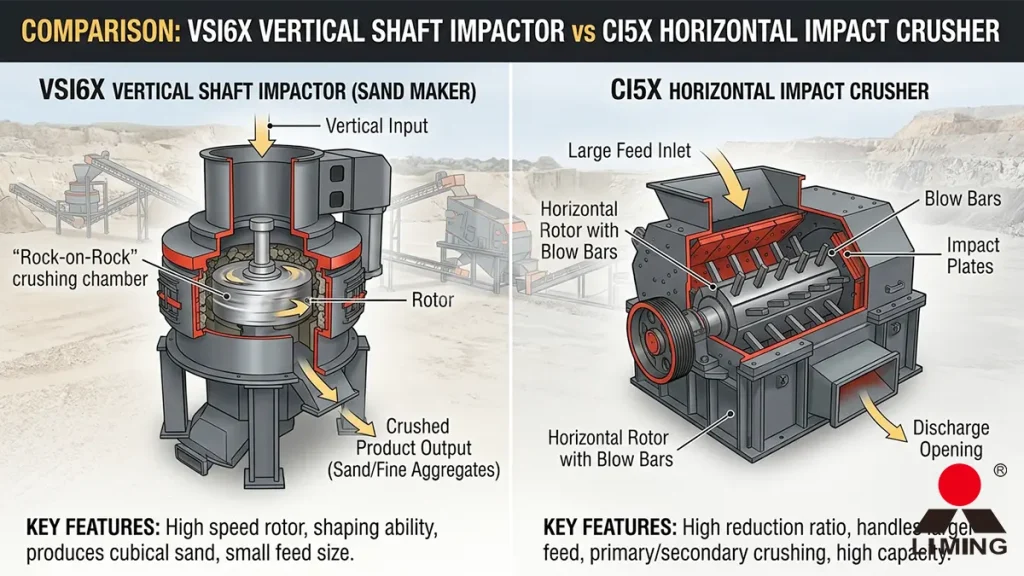
1. Fundamental Differences in Working Principles
Both machines utilize kinetic impact force to shatter rock, but the way they apply that force dictates the shape of the final product.
The Vertical Shaft Impactor, such as the advanced VSI6X Series Sand Maker from Liming Heavy Industry, relies on high-velocity centrifugal force. Material enters the center of a rapidly rotating impeller and is violently ejected outward. It utilizes a combination of “rock-on-rock” and “rock-on-anvil” crushing modes. The stones collide with each other and grind against a continuous material curtain inside the vortex chamber. This intense inter-particle friction generates significantly higher production efficiency and yields an exceptionally round, perfect cubic particle shape.
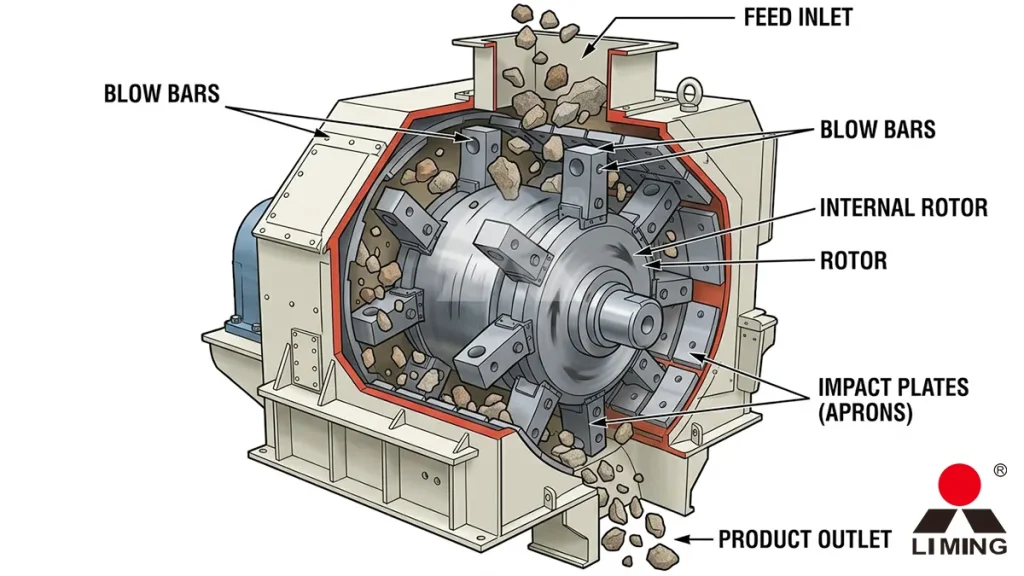
Conversely, a Horizontal Shaft Impact Crusher, such as the CI5X Series Impact Crusher, uses a massive spinning horizontal rotor equipped with heavy alloy blow bars (hammers). As the rock drops into the crushing cavity, the blow bars strike it violently, shattering the rock and launching it against heavy steel impact plates suspended from the roof of the chamber. While this also produces a highly cubic, block-like product, the crushing action relies entirely on direct, forceful contact with metal components.
2. Differences in Feed Size and Circuit Position
The physical size of the raw material determines which machine must be deployed in the crushing circuit. These two machines operate in entirely different stages of the production line.
The Horizontal Impact Crusher is primarily a secondary (medium to fine) crushing machine. It possesses a massive feed opening capable of accepting stones up to 800 millimeters in diameter, depending on the model. Therefore, it does not impose strict limitations on the size of the incoming gravel. Operators can easily adjust the clearance between the impact plates and the rotor to control the final discharge size, making it highly versatile for producing commercial coarse aggregate (like 10-20mm or 20-30mm gravel).
The VSI Sand Maker, on the other hand, is a dedicated tertiary fine crushing and shaping machine. It has extremely strict feed requirements. The maximum feed size for most VSI models is restricted to approximately 40 to 50 millimeters. Its primary objective is to take pre-crushed gravel and reduce it specifically into 0-5 millimeter fine manufactured sand. If your raw material consists of large boulders, you must first employ a primary jaw crusher and a secondary cone crusher before the material can safely enter the VSI sand maker.
3. Raw Material Hardness and Wear Part Costs
All mining equipment utilizes internal wear parts. However, matching the machine to the correct rock hardness is the only way to maximize the life cycle of these consumables and lower your long-term daily operating expenses.
The Horizontal Impact Crusher relies entirely on its blow bars to crush the rock. Because these metal bars absorb massive direct impacts, they wear out very quickly. Therefore, horizontal impactors are strictly recommended for processing medium to soft materials, such as limestone, bluestone, or dolomite. They are absolutely not suitable for crushing high-hardness, abrasive materials like river pebbles, granite, or basalt. Doing so will result in catastrophic wear part consumption and frequent, costly machine downtime.
The VSI Sand Maker is highly wear-resistant, specifically because the “rock-on-rock” principle forces the stones to crush themselves, protecting the steel machine body. The primary wear parts in a VSI are the small alloy throw heads (rotor tips) located at the ejection ports of the impeller. Modern equipment, like the VSI6X, utilizes a modular, diamond-shaped throw head design. When the leading edge wears down, operators do not need to replace the entire part; they simply flip the throw head to utilize the unworn side. This ingenious design dramatically lowers the maintenance costs and makes the VSI the perfect choice for highly abrasive, high-hardness rock.
Conclusion: Which is Better for Your Plant?
Neither machine is inherently “better” than the other; they serve completely different engineering purposes within an aggregate plant. If you need to reduce large, soft limestone boulders into commercial gravel with a low initial equipment investment, the Horizontal Impact Crusher is highly cost-effective. However, if your goal is to produce premium, perfectly round 0-5mm manufactured sand from hard rocks like river pebbles or granite, investing in a dedicated Vertical Shaft Impactor (VSI) is mandatory.
At Liming Heavy Industry, we provide comprehensive, tailor-made aggregate production solutions. From the heavy-duty CI5X Impact Crushers to the advanced VSI6X Sand Makers, our engineering team ensures your equipment perfectly matches your geological conditions and production goals. Contact us today to receive a customized equipment configuration and maximize the profitability of your sand making operation.
