Wheeled Mobile Cone Crusher For Granite & Basalt Crushing
May 6, 2026
Summary:Concrete foundation curing delays paralyze capital payback velocity. The Wheeled Mobile Cone Crusher For Granite & Basalt Crushing bypasses stationary infrastructure entirely. Deploying heavy-duty pneumatic tires and hydraulic support legs, the NK series transitions from highway transport to full-load 220 MPa granite processing in under 24 hours. Integrating a 250 kW multi-cylinder cone directly onto the axle-mounted chassis ensures operators achieve 440 tph throughput without sacrificing the kinetic force required for abrasive hard rock.
Waiting 30 days for concrete foundations to cure on a temporary highway project is a failure of operational strategy. Asset amortization begins the second rock hits the belt.
Contractors building high-speed rail networks through the mountainous terrain of Eastern Europe this August 2025 faced a brutal deadline. They needed 400 tons per hour of high-grade 0-20mm aggregate, but the local 220 MPa basalt was too abrasive for standard impactors, and pouring concrete footings for a stationary plant would destroy the project timeline. The deployment of a pneumatic tire-mounted chassis proved to be the only profitable geometry. A Wheeled Mobile Cone Crusher For Granite & Basalt Crushing does not negotiate with geography; it is towed into the pit, levels itself on hydraulic legs, and begins crushing.
Bypassing Concrete: The Physics of Pneumatic Deployment
A traditional stationary secondary cone circuit requires up to 30 days of site preparation. The NK300H eliminates this dead time entirely.
The primary friction point in hard rock quarrying is mobilizing heavy machinery. Hauling raw basalt to a distant stationary plant consumes massive amounts of diesel fuel, driving up the expenditure per shift. The axle-mounted NK series inverts this logic by taking the plant directly to the blast face. Utilizing a standard semi-truck cab, the unit is towed down public highways and rugged quarry access roads.
Once positioned, the reliance on pneumatic tires is shifted. Heavy-duty hydraulic support legs extend to lift the chassis, leveling the 34-ton plant on uneven pit floors. This mechanical anchoring absorbs the violent kinetic recoil generated by crushing 200+ MPa granite. The transition from transport mode to processing 440 tph occurs in under 24 hours, rapidly accelerating capital payback velocity.
Kinetic Force on Axles: Sustaining 250 kW Power Draws
A persistent industry myth suggests mobile plants lack the crushing force of their stationary counterparts. The NK300H dismantles this assumption. Equipped with the HPT300 multi-cylinder cone crusher, the wheeled chassis sustains a 250 kW power draw. Mobility does not sacrifice raw kinetic crushing force.
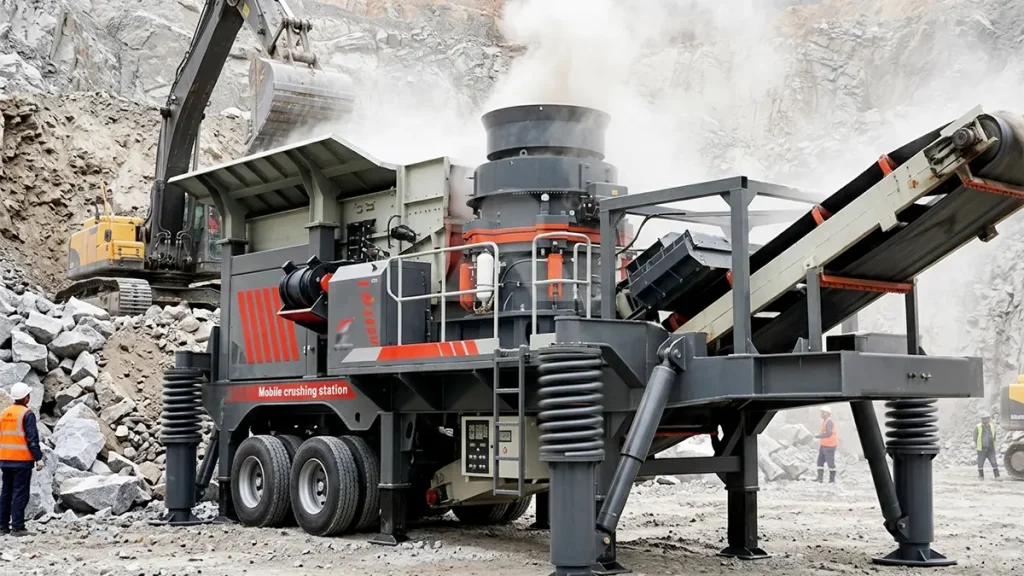
The HPT unit utilizes “stone-on-stone” laminated crushing physics. By driving the eccentric shaft at 800 rpm, the rocks are compressed against each other in a dense bed, shattering abrasive silica without direct metal-on-metal friction. This high-density interaction generates superior cubical aggregate, satisfying strict government concrete standards directly from a mobile platform.
Synchronized Configuration for Axle-Mounted Production
Integrating the screening loop onto the chassis eliminates the need for separate conveying infrastructure.
| Process Stage | Recommended Wheeled Model | Capacity (tph) | Power (kW) | Max Feed (mm) |
|---|---|---|---|---|
| Primary Hard Rock | NK75J (Jaw) | 150-350 | 141.4 | 680 |
| Secondary High-Capacity | NK300H (No Pre-screen) | 110-440 | 283 | 220 |
| Secondary Closed-Circuit | NK300H (With Return Screen) | 110-440 | 323.5 | 220 |
| Large Scale Mobile Setup | MK300H-2M (Two-seat) | A+(30~70) | 280 | 220 |
Selecting the NK300H with return material screening transforms the wheeled unit into a standalone closed-circuit plant. The vibrating screen is mounted directly on the chassis. Oversized rock (+20mm) is caught and automatically recirculated back into the cone’s feed throat via a built-in return conveyor. This architecture guarantees a strictly graded output without pouring a single yard of concrete.
220MPa Granite Circuit: Pneumatic Chassis Performance
- Site Preparation Time: 0 Days (No concrete curing required)
- Deployment to Production: < 24 Hours via hydraulic leveling
- Kinetic Drive Output: 250 kW sustained load (HPT300)
- Tramp Iron Clearance: 60-second automated hydraulic flush
- Mobility Format: Multi-axle pneumatic tire highway towing
Technical Index: LH-WHEELED MOBILE CONE CRUSHER FOR GRANITE & BASALT CRUSHING-AUG/2026-Ref-#88219
Automated Clearance: Defeating Tramp Iron Downtime
When uncrushable tramp iron—such as an excavator tooth—enters the chamber of a classic spring-cone setup, the machine seizes, requiring hours of manual labor to clear. On a fast-moving mobile contract, this level of mechanical downtime destroys the daily production-to-cost ratio.
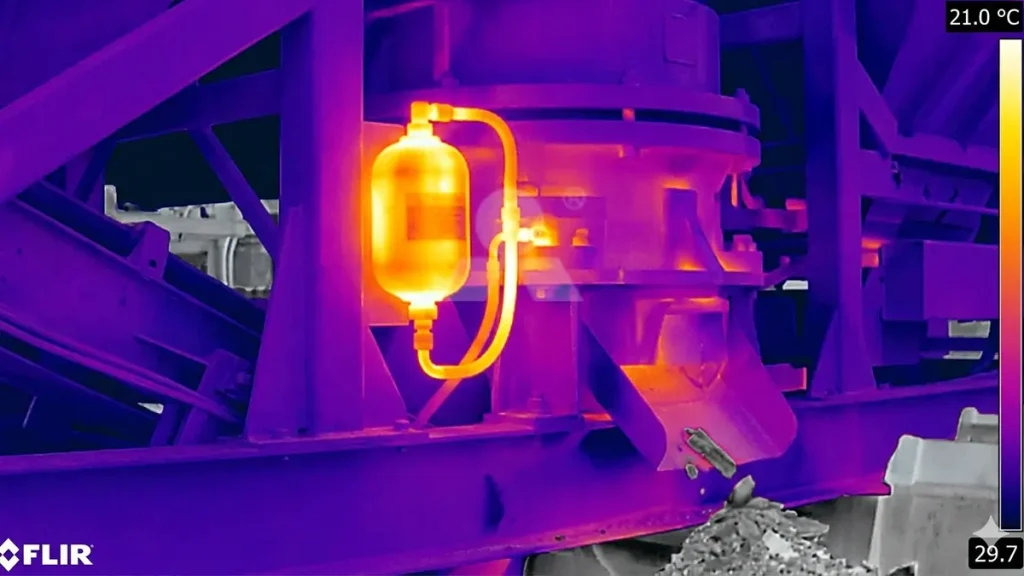
The NK series utilizes a hydraulic automated clearing system. Sensors detect the immediate pressure spike. The hydraulic cylinders instantly release their fluid, dropping the mantle and flushing the chamber in exactly 60 seconds. The system re-pressurizes, calibrates the Closed Side Setting (CSS), and resumes crushing. You do not lose hours to manual digging; you lose one minute.
Deploy Chassis Mobility to Erase Dead Time
Committing to a 30-day concrete foundation process on a transient highway contract is financial negligence. The Wheeled Mobile Cone Crusher For Granite & Basalt Crushing demands respect because it converts dead waiting time into active tonnage. Next month, if you choose to build stationary infrastructure for a 6-month pit, your competitors using pneumatic deployment will secure the aggregate contract while you are still waiting for concrete to cure. Deploy the NK series, anchor the hydraulic legs, and execute the production mandate immediately.
Bypass Foundations and Initiate Axle-Mounted Production
“How many days of production did you lose to site preparation last quarter? Send us your hard rock tonnage requirements, and let’s configure a pneumatic deployment schedule.” — From the Desk of your The Efficiency Evangelist
Deploy NK300H For Capital Payback Velocity